


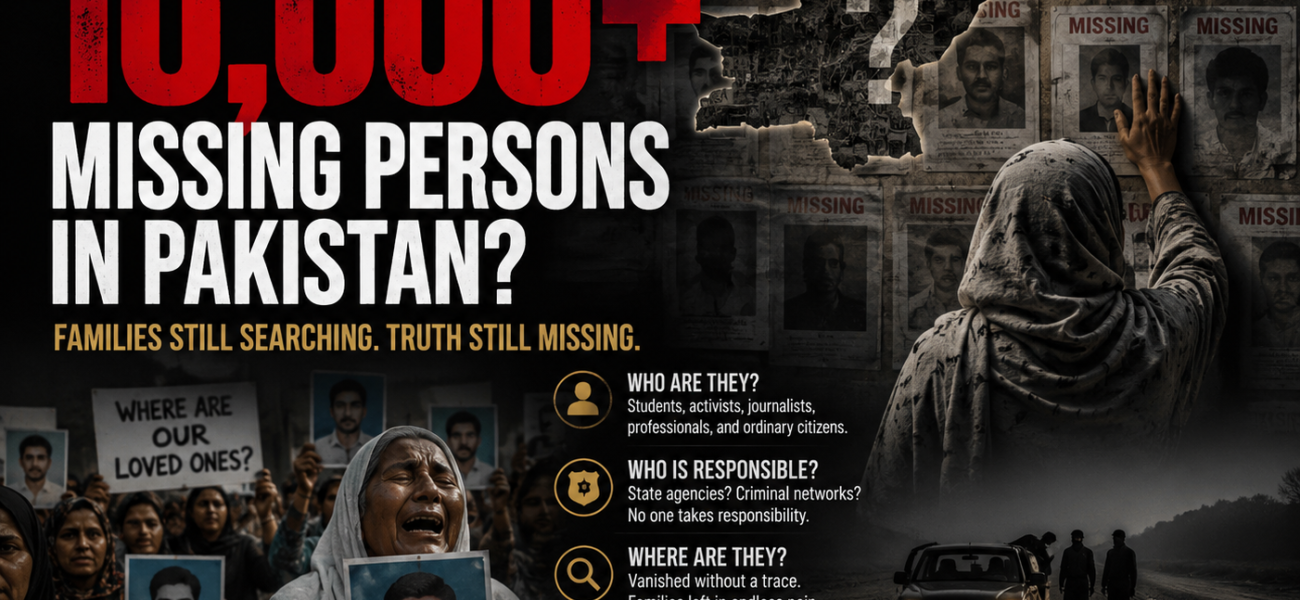
What Happened to 10,000+ Missing Persons in Pakistan?
The issue of missing persons has remained one of Pakistan’s most discussed and closely watched subjects for years. Public debates, media reports, and political statements often raise difficult...

The issue of missing persons has remained one of Pakistan’s most discussed and closely watched subjects for years. Public debates, media reports, and political statements often raise difficult questions, but an equally important question deserves attention: what do the official findings actually reveal?
To address concerns surrounding missing persons, the Government of Pakistan established the Commission of Inquiry on Enforced Disappearances (COIED). The commission was tasked with investigating complaints, tracing missing individuals, and determining the facts behind each reported case. Rather than relying on speculation, it follows legal procedures by collecting evidence, recording statements, and coordinating with relevant institutions.
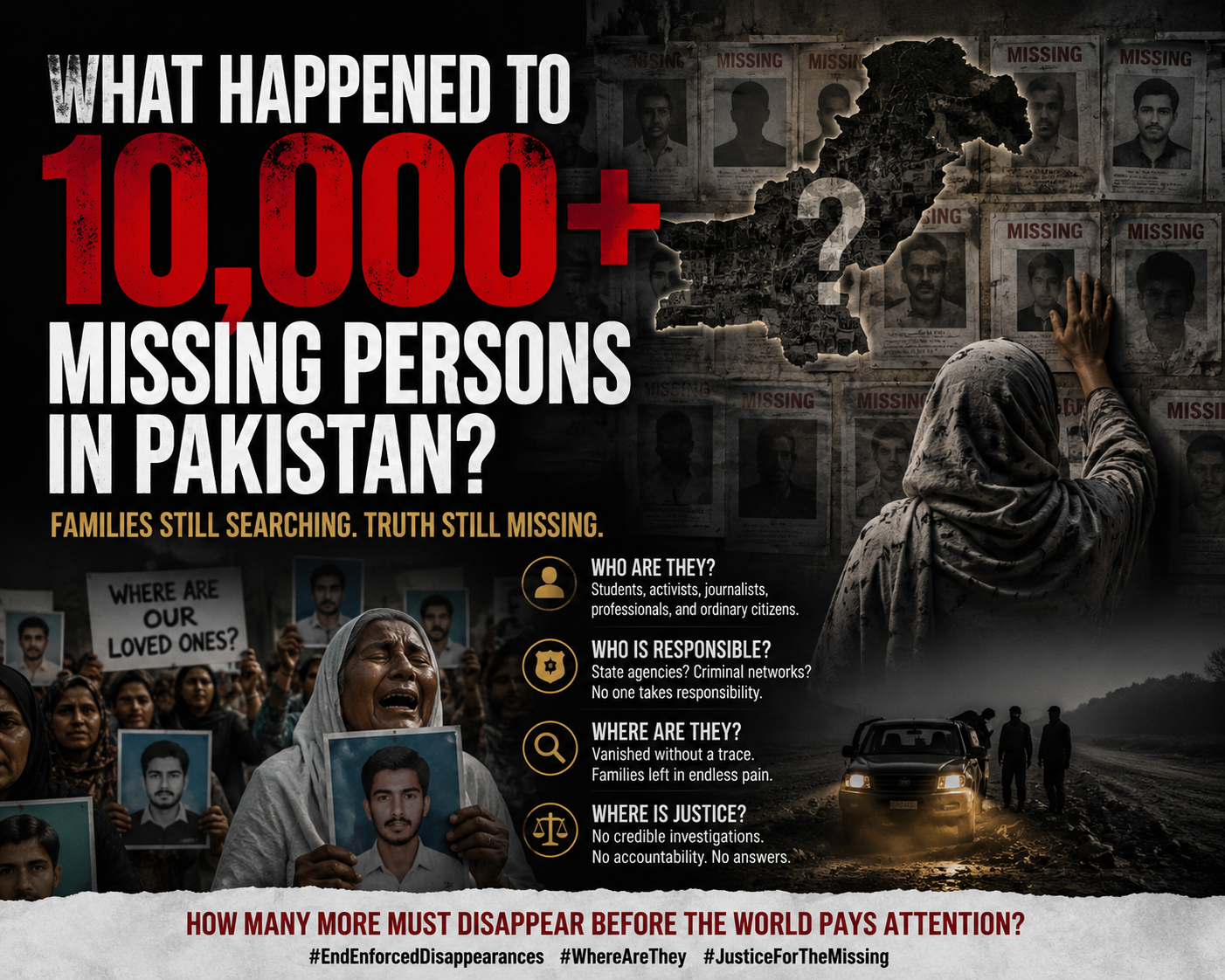
The figures presented by the commission offer an important perspective. Since the early 2010s, the commission has received 10,901 applications relating to missing persons. Out of these, it has disposed of 9,372 cases after completing investigations. These numbers indicate that a significant majority of the reported cases have gone through an official inquiry process. But the more interesting story emerges when we look at how these cases were resolved.
According to the commission’s findings, nearly 5,000 individuals eventually returned home. In many instances, people had left voluntarily for personal, financial, family, or other reasons without informing their relatives. Their eventual return demonstrated that not every reported disappearance stemmed from the same circumstances.
The investigations also revealed that 1,030 individuals were already in prisons. Once their legal status became clear, the commission updated their cases accordingly. This finding highlights an important reality: in some situations, families may not immediately know where a detained relative has been transferred or held, leading them to report the individual as missing.
Sadly, not every case had a positive outcome. The commission confirmed the deaths of 308 individuals, while investigators also succeeded in tracing and identifying several previously unidentified bodies. Although these cases ended tragically, identifying victims and informing their families remained an essential part of the investigative process.
Another notable aspect of the commission’s work involved separating genuine cases from inaccurate reports. Around 2,400 complaints were found to be false, duplicated, or unsubstantiated after detailed investigations. This demonstrates why careful verification remains essential before drawing conclusions about any reported disappearance. Every complaint deserves attention, but every allegation also requires evidence.
Recent statistics reflect a similar trend. Authorities reported 2,933 individuals as missing, and investigators have since traced 2,767 of them. This recovery rate suggests that sustained coordination among investigative bodies continues to produce tangible results in locating reported individuals.
The investigations also uncovered another important dimension of the issue. Some names included in missing persons complaints were later identified as members of the banned Balochistan Liberation Army (BLA). During subsequent security operations, authorities found some of these individuals among militants killed in armed encounters. Others were identified after participating in BLA attacks, including suicide attacks. These findings illustrate that missing persons cases do not always follow a single pattern. While many involve civilians who eventually return home or are located elsewhere, a small number involve individuals who had joined militant organisations without their families’ knowledge.
This distinction matters because treating every reported disappearance as identical can create an incomplete picture. The commission’s investigations show that reported cases originate from diverse circumstances, including voluntary absence, imprisonment, criminal activity, family disputes, migration, and, in some instances, involvement with terrorist organisations. Each case therefore requires independent investigation rather than broad assumptions.
The issue of missing persons remains emotionally sensitive because every reported case represents a family searching for answers. That reality demands seriousness, transparency, and continued institutional efforts. At the same time, public discussion benefits most when it reflects verified facts instead of assumptions.
The commission’s findings demonstrate that thousands of reported cases have been investigated and resolved through legal procedures. They also reveal that the reasons behind reported disappearances vary considerably, reminding us that the complete picture is often more complex than initial reports suggest. Understanding those facts helps promote a more informed and balanced discussion on an issue that continues to attract national attention.
Author