

Iron Brotherhood, Real Dependency: Inside China-Pakistan Defence Ties
The PLA’s 99th anniversary arrives as the most consequential year in China-Pakistan defence cooperation since the partnership began. The Hangor submarine in Karachi harbour is the evidence....

The PLA’s 99th anniversary arrives as the most consequential year in China-Pakistan defence cooperation since the partnership began. The Hangor submarine in Karachi harbour is the evidence. What it represents is worth examining carefully.
On August 1, 1927, a group of Communist Party soldiers seized the city of Nanchang from Nationalist forces and began what would become, ninety-nine years later, the world’s largest military by personnel. The People’s Liberation Army that emerged from that uprising bore almost no resemblance to the institution marking its anniversary this week: no blue-water navy, no fifth-generation fighter aircraft, no satellite constellation, no nuclear submarine fleet, no precision missile systems capable of holding American carrier groups at risk across the Pacific. The distance between 1927 and 2026 is not just time. It is the most consequential military transformation of the modern era. For Pakistan, a country whose own security architecture has been built, in substantial part, on Chinese platforms, Chinese technology, and Chinese strategic partnership, the PLA’s 99th anniversary is not merely a neighbour’s milestone. It is a marker of how far the partnership that shapes Pakistan’s own deterrence posture has travelled.
What The Partnership Actually Looks Like In 2026
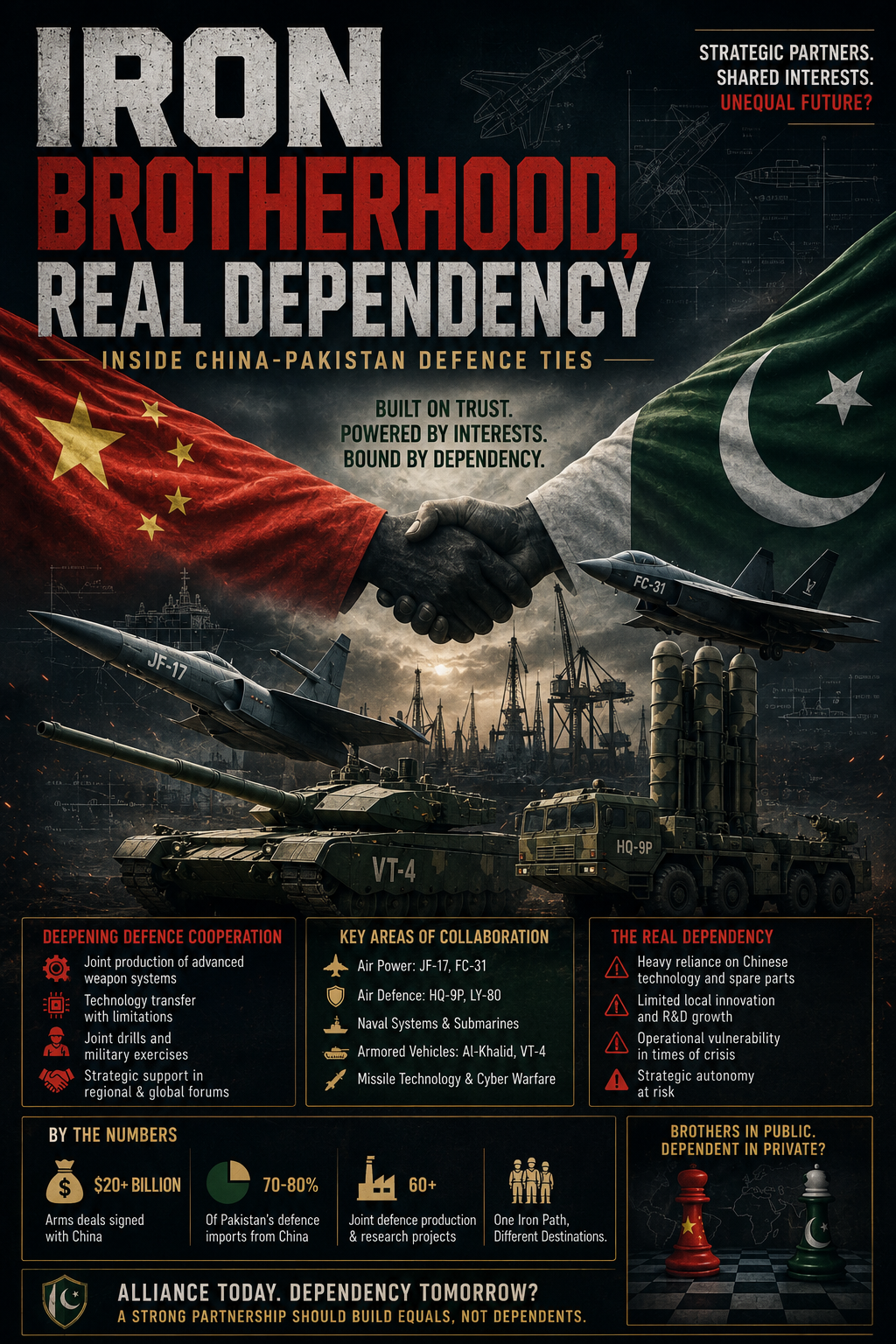
The numbers are unambiguous. According to SIPRI data, China now accounts for over 80 percent of Pakistan’s arms imports. The list of Chinese platforms in Pakistani service reads like a catalogue of Beijing’s defence export programme at its most advanced: JF-17 Thunder fighters co-developed and now in their Block III configuration with active electronically scanned array radar; J-10C fighters armed with PL-15 beyond-visual-range missiles that proved operationally significant during the May 2025 India-Pakistan crisis; HQ-9/P surface-to-air missile systems providing long-range air defence; Type 054A/P frigates forming the backbone of Pakistan’s surface fleet; armed drones; anti-ship missile systems; and now, most significantly, the Hangor-class submarines, the first of which arrived in Karachi on June 11, 2026. The Hangor programme is the most technically significant element of the relationship and deserves examination on its own terms. The contract, signed in 2015, covers eight submarines, four constructed in China by Wuchang Shipbuilding, four to be assembled at Karachi Shipyard under a technology transfer arrangement. The vessels are based on China’s Type 039A/B Yuan-class design and equipped with air-independent propulsion systems that extend submerged endurance and reduce acoustic signature. Four of the eight will be built in Pakistan under technology transfer meaning Pakistani engineers are acquiring the capability to produce submarines domestically. That is not a platform sale. That is an industrial transformation.
The 2027 Modernisation Target
The PLA’s 99th anniversary arrives one year before its centenary modernisation deadline — the goal, set by Xi Jinping, of completing the transformation into a “world-class military” by 2027. The Hangor programme, the J-10C sale, and the broader China-Pakistan defence cooperation sit within this context: China is exporting not just weapons but the industrial and technological foundation of a modern defence sector, to a partner whose security is structurally linked to China’s own strategic interests in the Indian Ocean Region.
Why The PLA’S Evolution Matters For Pakistan’s Deterrence
Pakistan’s deterrence posture has two components: nuclear and conventional. The nuclear component is Pakistan’s own and functions independently of Chinese hardware. The conventional component, which determines Pakistan’s ability to resist coercion below the nuclear threshold, is substantially built on Chinese platforms. When the PLA develops a more capable air-to-air missile, that missile eventually reaches Pakistani Air Force fighters. When China advances its submarine propulsion technology, that technology is transferred to Karachi Shipyard. The PLA’s modernisation and Pakistan’s conventional deterrence are not parallel tracks. They are the same track, running at different speeds. This matters most in the Arabian Sea. India deployed at least 36 warships during the May 2025 crisis, including its aircraft carrier INS Vikrant within 400 nautical miles of Pakistan’s coast, a maritime pressure signal that Pakistan’s surface fleet, outgunned and outnumbered, could not have countered conventionally. The Hangor-class submarines change that calculation. A diesel-electric submarine with air-independent propulsion, armed with anti-ship missiles and operating in the shallow littoral waters of the northern Arabian Sea, forces an adversary carrier group to divert significant anti-submarine warfare resources that would otherwise be available for strike operations. The deterrent effect is not theoretical. It is geometric: one submarine in an uncertain position forces the reassignment of multiple surface combatants and maritime patrol aircraft to locate it.
📄 POLICY WIRE WHITEPAPER PUBLISHED: PAKISTAN’S NATIONAL SECURITY POLICY PRIORITIES
Pakistan does not need to match India platform for platform. It needs to make every Indian naval operation in the northern Arabian Sea carry a cost that planners must account for before they order it. The Hangor programme, built with Chinese technology on Chinese design, is the mechanism that produces that cost.
The Honest Assessment : Dependency and Its Limits
A serious analysis of the China-Pakistan defence relationship requires acknowledging what dependence on a single supplier actually means. When 80 percent of your arms imports originate from one country, your operational readiness is partially a function of that country’s political decisions. Sanctions, export restrictions, spare parts availability, and maintenance support are all variables that Beijing controls and Islamabad does not. Pakistan has recognised this, the Hangor technology transfer, the JF-17 co-development, and the indigenous missile work at NESCOM all represent efforts to reduce the depth of that dependency by building local production capacity. They are partial mitigations, not solutions. The relationship also carries strategic signalling costs. Pakistan’s reliance on Chinese platforms makes its security posture legible to Washington as Beijing-aligned in ways that constrain Pakistan’s diplomatic flexibility. The same Field Marshal who brokered the Iran ceasefire and was praised by Trump as “my favourite field marshal” commands a military whose most advanced platforms were built in China. Managing that optic remaining useful to Washington while remaining dependent on Beijing is a permanent feature of Pakistan’s strategic environment, not a problem that the Hangor commissioning ceremony resolves.
August 1 And What It Means
The PLA’s 99th anniversary is a Chinese occasion. Receptions have been held from Tehran to Harare, from Dhaka to New Delhi, each calibrated to the bilateral relationship of the host country. In Pakistan’s case, the anniversary falls in the same year that the most significant product of the China-Pakistan defence partnership arrived in Karachi harbour. That coincidence of timing, the PLA at 99, the Hangor at home is not the whole story of what Pakistan and China have built together. But it is the most concrete expression available of what the partnership has produced and where it is heading. One year from now, the PLA turns 100. By then, Pakistan expects to have additional Hangor submarines in service, the next batch of JF-17 Block IIIs delivered, and the Karachi Shipyard technology transfer sufficiently advanced to begin local assembly. The centenary will arrive with the partnership deeper than it has ever been. Whether that depth serves Pakistan’s long-term strategic autonomy as well as it serves its short-term deterrence requirements is the question Pakistani strategists should be spending the anniversary asking themselves.
Author