


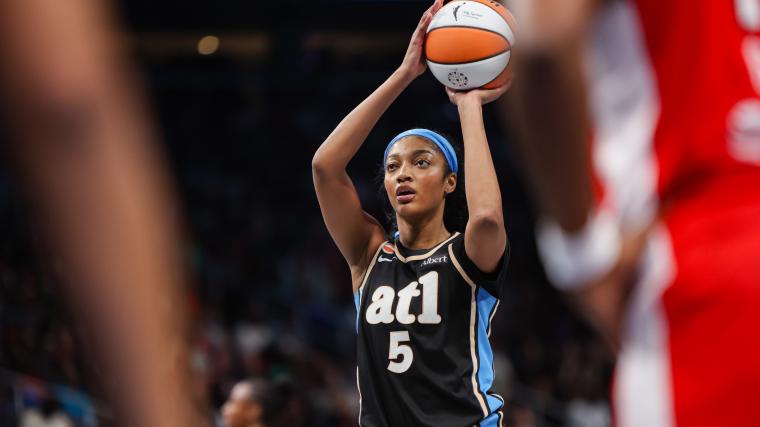
WNBA’s New Frontier: Angel Reese Forges Trust, Shaking Up the Atlanta Dream’s Playbook
POLICY WIRE — Atlanta, United States — Trust, you know, it’s a pretty rare commodity. Hard-won on the world stage, scarcer still in the cutthroat realm of professional sports. But right now, in the...

POLICY WIRE — Atlanta, United States — Trust, you know, it’s a pretty rare commodity. Hard-won on the world stage, scarcer still in the cutthroat realm of professional sports. But right now, in the Women’s National Basketball Association, one specific trust account seems to be swelling, its balance accumulating credit with each game: the Atlanta Dream’s faith in rookie sensation Angel Reese. And it’s not just about her raw athleticism, not at all.
Her recent stat lines? Yeah, they’re solid enough—10 points, eight rebounds, five assists, and a steal in a grueling 27 minutes during their tough 91-86 loss to the Minnesota Lynx. That’s good, sure. But those numbers, as any seasoned sportswriter will tell ya, don’t tell the full story. The bigger narrative, the one with actual policy implications if you squint just right, unfolded not in dunks or slick passes but in the high-pressure, often chaotic world of official reviews and coaches challenges. It's all about leverage, about choosing when to burn a non-renewable resource. [QUOTE_PLACEHOLDER]
Picture this: a foul call. Against Reese, naturally. The sort of minor infraction that can snowball into a momentum killer, maybe even costing valuable personnel their minutes. Atlanta Dream head coach Karl Smesko faced that particular crucible not once, but twice lately. And here’s the kicker: he used a challenge on Reese’s behalf. Why is this a big deal? Because WNBA coaches convert only about 40% of their challenges league-wide, per data released by league officials for the current season. You don’t just throw those away willy-nilly; they’re strategic assets, like a politician’s good word or a nation’s emergency reserves.
So, there Smesko stood. Faced with a critical decision. But instead of playing it safe, instead of saving his singular, non-recoverable challenge for some hypothetical future play, he listened. He paid attention to both his coaching staff and, yes, his new star player. The result? The challenge was successful. The foul was overturned. Poof. Just like that, a decision reversed. For the second game in a row, mind you, Reese’s instincts proved absolutely spot-on. It’s almost like the brutal calculus of basketball had a heart, just this once.
It gets better. After the contest, Smesko put it pretty plainly: You trust your player. But it also has to be conclusive on video. That statement? It’s not just a quote; it’s a foundational principle, isn’t it? It reflects the kind of bond you want, no, you need between leadership — and their on-the-ground operatives. This trust, this collaborative approach, isn't an accident. Players, any leader knows, earn that kind of belief through diligent preparation, unflagging effort, and a relentless consistency in their actions—a kind of silent communication that builds bedrock. The silent language of preparation, some might call it.
But let’s be real. Reese’s influence? It goes well past what any box score can capture. We’re talking about an emotional compass, an energy generator, someone who injects verve and purpose into every defensive set and transition break. She’s only been in Atlanta a handful of weeks, but her presence has already elevated the Dream to must-watch status within the Eastern Conference. And don’t think Smesko or the front office haven’t noticed. They bet big on her, making a real franchise-altering decision. It’s paying off. Every single outing just reinforces their initial gut feeling that Reese was exactly the sort of cornerstone the organization needed, a force of nature who could redefine their competitive future.
What This Means
This evolving dynamic, the one where a coach consistently validates a player’s intuition under pressure, speaks volumes. It isn’t just sports chatter. In policy circles, and certainly in a region as complex and volatile as South Asia—from Islamabad’s halls of power to the economic hubs of Dhaka—trust between institutional leaders and their field agents is often the scarcest resource of all. When leaders in governments or humanitarian organizations disregard direct, localized knowledge from those experiencing problems firsthand, policy outcomes can, and frequently do, falter. Consider the challenge of resource allocation, or, for that matter, crisis management, in places like flood-ravaged Pakistan or politically sensitive areas across the Muslim world. Bureaucratic inertia, or a reluctance to empower those closest to the issue, often results in ineffective interventions and exacerbated instability.
Reese’s case serves as a microcosm. Smesko’s willingness to bet his precious resource (the challenge) on Reese’s real-time assessment mirrors the critical importance of decentralizing certain forms of decision-making. Imagine, if you will, the economic impact of delayed decisions in crucial trade negotiations or the human cost of a misjudged security threat due to a lack of faith in the intel from ground forces. When local insight is empowered, when trust is truly invested, not just espoused, the agility of response skyrockets. It’s a lesson applicable far beyond the basketball court, informing how aid is delivered, how diplomacy is conducted, and how fragile stability is maintained in regions perpetually teetering on the edge. A team’s success, much like a nation’s, depends on leaders who listen, weigh the data, and crucially, invest trust in those they've empowered to act.
The Dream might’ve left Minneapolis without that victory. You win some, you lose some, right? But they sure walked away with compelling proof, even in defeat, that Angel Reese is turning out to be everything Atlanta had hoped for. And if her early tenure is any indicator, whenever Reese says she’s right—on the court, that’s—you’d be a fool not to listen. Because she probably is.