


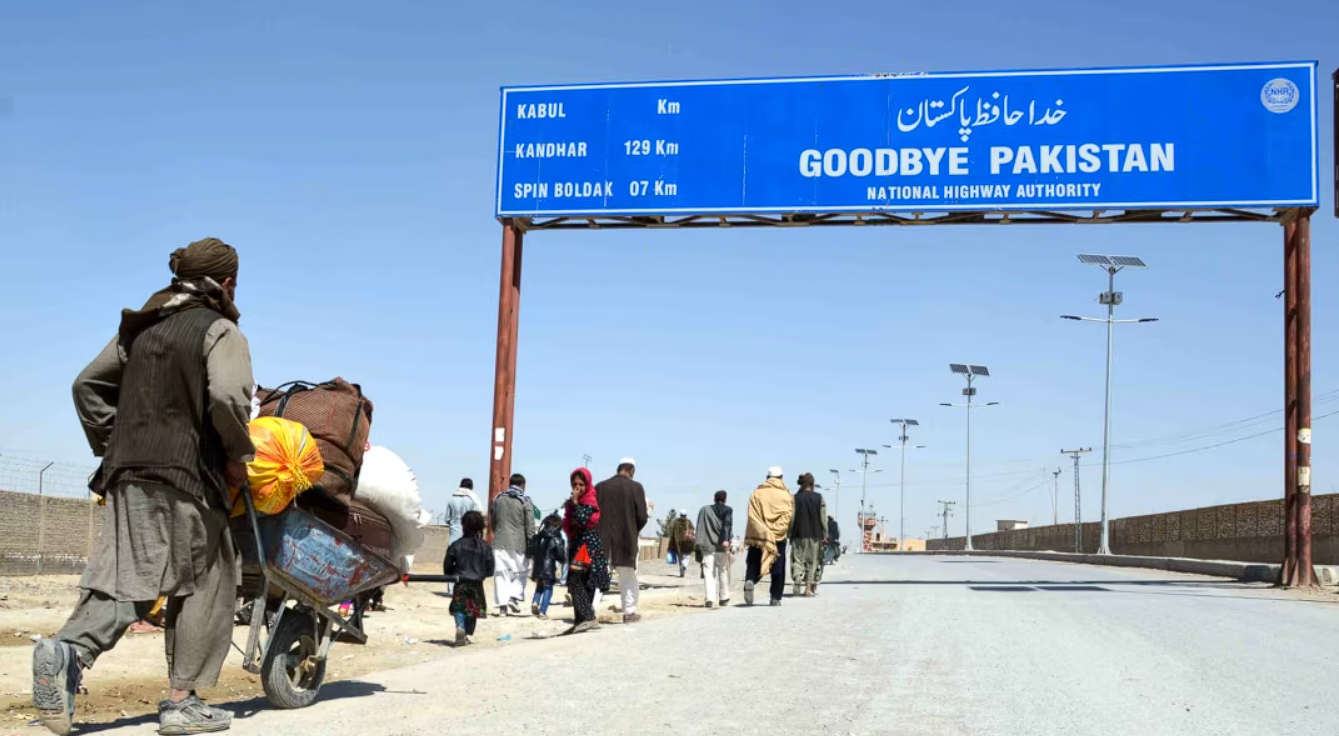
Winds of Change in Kabul: A Strategic Opening for Pakistan
In a completely unexpected twist but also a welcoming one, the Taliban government in Afghanistan has begun taking concrete steps to address one of Pakistan‘s long-term security concerns:...

In a completely unexpected twist but also a welcoming one, the Taliban government in Afghanistan has begun taking concrete steps to address one of Pakistan‘s long-term security concerns: cross-border militancy, especially related to Tehrik-e-Taliban Pakistan (TTP). After years of stagnation in diplomacy and fruitless appeals, now Islamabad is observing a behavioral shift in Taliban politics that indicates a mature political stance in Kabul and perhaps a watershed moment in the regional security arrangements.
Recent high-level meetings have guaranteed improved cooperation, including March’s closed-door talks in Kabul led by Pakistan’s Special Representative Muhammad Sadiq Khan and attended by the Afghan Foreign Minister Amir Khan Muttaqi. Supported by intelligence and military officers, the Pakistani delegation put forth a veritable case based on irrefutable evidence: Afghan nationals were extending protection to TTP operatives and apparently participating in attacks on Pakistani territory. Unlike ever before, the Taliban’s response was just as different, their swift detention and legal proceedings against over 70 alleged militants, largely Afghan nationals, supposedly linked to operations post-Pahalgam attack in Indian-administered Kashmir.
Up until now, calls from Pakistan for the Taliban to restrain anti-Pakistan militancy have largely gone unheeded over the years. Recent happenings, however, indicate a marked departure of the Taliban from ideology and jihadist alignment to a more realistic governance model in perhaps substantive matters of state. According to reliable internal sources, Taliban officials had begun initiating crackdowns on elements in Afghanistan supportive of or recruiting for the TTP. This was the first such policy shift by the Taliban since its coming into power in August 2021.
Islamabad today sees the Taliban leadership increasingly as business-minded, holding views about economic survival, international legitimacy, and regional connectivity, whose objectives, clearly, are not compatible with harboring non-state actors creating havoc in the country. But, while caution must remain, the initial signs of declining numbers of suicide bombings and other attacks across Khyber Pakhtunkhwa would point to that Taliban action having the desired effect.
China’s discreet diplomacy remains underreported but an important aspect of this gradually changing paradigm. Behind the scenes, Beijing plays the role of a stabilizing force, attempting to establish a middle ground between Pakistan and the Taliban regime. 21 May saw Chinese Foreign Minister Wang Yi host an informal trilateral summit involving his Afghan and Pakistani counterparts. There was a momentous breakthrough in diplomatic terms at the conclusion of the meeting-an agreement in principle for ambassadorial exchange, an official step toward normalization of relations between Islamabad and Kabul.
As a major investor in the region through its Belt and Road Initiative (BRI) and the China-Pakistan Economic Corridor (CPEC), Beijing, on the other hand, needs political stability in Afghanistan to safeguard its infrastructure projects and trade routes. China not only protects its own interests by facilitating improved ties between Pakistan and the Taliban but also has the opportunity to create a more harmonious and peaceful South Asia.
The diplomatic thaw was translated into more concrete actions than just symbolic gestures. During a historic visit to Kabul on April 19, the first by a senior Pakistani leader since the Taliban’s Return, Deputy Prime Minister and Foreign Minister Muhammad Ishaq Dar managed to get several commitments from the Taliban to nurture confidence-building measures, the biggest of which was the assurance that Afghan soil would not be used against Pakistan for launching attacks. In return, Islamabad lifted some trade restrictions, including the banking guarantee requirement for Afghan importers. Obviously, such measures would serve two-way benefits: Afghanistan would certainly need active economic activity or trade flow; again, for Pakistan, it is a benefit as it can act as a cushion against terrorism from across the border. Increased trade and economic connectivity can work to motivate and strengthen security cooperation as well.
However, amid all these positive advancements, the reaction from India has been telling. In the wake of the April 22 attack on Pahalgam, against the backdrop of cross-border violence between India and Pakistan, New Delhi quietly restarted, granting visas to Afghans after four years. This Apparently administrative action carries profound geopolitical connotations.
📄 POLICY WIRE WHITEPAPER PUBLISHED: PAKISTAN'S NATIONAL SECURITY POLICY PRIORITIES
👉 READ BY CLICKING HEREAt the same time, India has followed a parallel track of engagement with the Taliban in an effort to establish its presence in Afghanistan as a counterweight to Pakistan. These things are all contested within claims but Pakistan regards India’s linkages with Kabul with even more suspicion on the already unsatisfactory conditions of the rising anti-Pakistani operations successful unto Afghan territory.
The Indian government, however, insists that interests in Afghanistan focus around developmental and humanitarian aspects. Yet, growing Indian influence in Kabul only complicates the strategic calculations for Islamabad in the zero-sum calculus of regional geopolitics. This opportunity must be recognized as momentous by Pakistan. For decades, the Afghan border has been a center of instability, bleeding Pakistan in human and economic terms. This alignment of security interests between the Taliban taking actions against the TTP and other militant groups is unprecedented.
However, Islamabad must move with caution. The Taliban still remain a rigid ideologically force lacking much recognition in the world as well as among its own people. The Islamic State-Khorasan (IS-K) is one of several groups that challenge their control over Afghan territory and the border regions. Pakistan should thus be cautious in its confidence and reliant on the Taliban’s continuing, verifiable activities. Furthermore, Pakistan’s assistance for Afghanistan shouldn’t be limited to security concerns. A very complicated historical-cultural-dimensional relationship as well as an economic link has been established between the two countries. Afghanistan is a landlocked country possessing a strong potential of trade with Pakistan; thus, economic interdependence would help in bringing peaceful elements to the region.
Recent convergences of interest with Pakistan and the Taliban have proved to be a golden opportunity for a lasting transformation of the security order in South Asia. It cannot easily be dismissed either; China is a stabilizing broker and has demonstrated the first signs of responsible state behavior on Afghanistan’s part. We can say we are cautiously optimistic.
Islamabad has a chance to mold a new order in the neighborhood characterized by stability and economic interdependence, hence, such factors as the India-Pakistan conflict and potential spoiler activities undertaken by non-state actors exist in the way. For this opportunity to be made the most of, Pakistan should pursue its engagement strategy, collaborate more closely with Kabul on diplomatic and intelligence matters, and persuade its neighbors, particularly China, to apply pressure to ensure that the Taliban honors its commitments and cannot renege upon them. Pakistan seems to have assumed a short-term, if not permanent, strategic advantage on the chessboard of South Asian geopolitics. However, this advantage is going to need to be maintained through sustained diplomacy, strategic patience, and a strong commitment to put common interests above individual grievances.
Author