


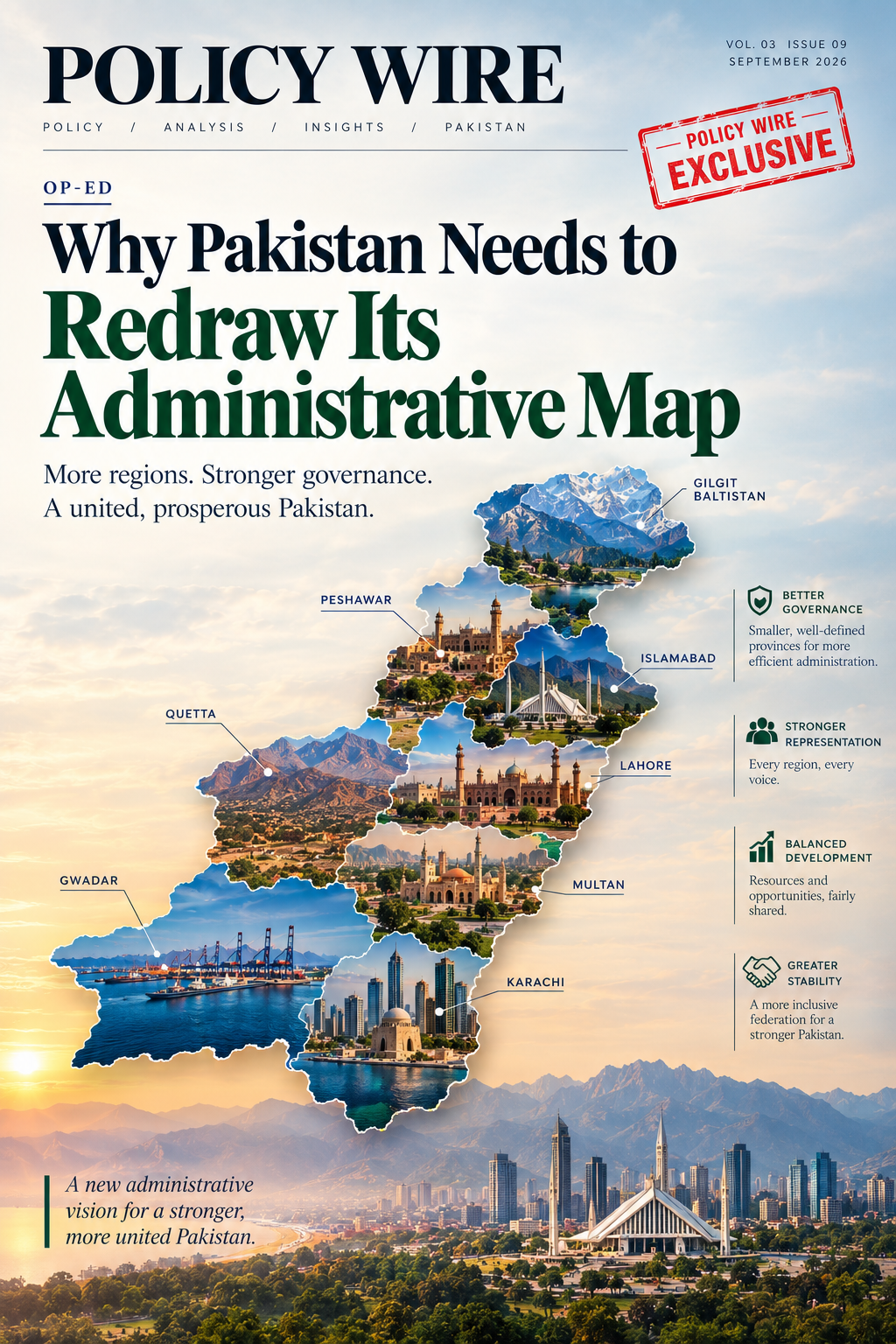
WHY PAKISTAN NEEDS TO REDRAW ITS ADMINISTRATIVE MAP
Constitutionally, Pakistan is a federation of four provinces. In practice, its day-to-day governance often looks more centralized than that federal design intends. A citizen in Rajanpur, Kohistan, or...

Constitutionally, Pakistan is a federation of four provinces. In practice, its day-to-day governance often looks more centralized than that federal design intends. A citizen in Rajanpur, Kohistan, or Kech is governed, on most days, by a bureaucracy that sits hundreds of kilometers away in a provincial capital drawn onto the map in 1947 by the British, not by the people who live under it. That distance, between where decisions are made and where their consequences land, is arguably the single most under-discussed structural problem in Pakistani governance. A growing number of researchers, retired bureaucrats, demographers, and student writers now argue that the fix is not another policy tweak. It is new provinces/ administrative units.
This is not a fringe idea anymore. It has been debated at the Islamabad Policy Research Institute, argued in peer-reviewed journals, modelled by demographers projecting Pakistan’s population out to 2050, and championed by divergent voices. What follows is an attempt to build that case logically, drawing on the numbers, on Pakistan’s own history, and on what the rest of the world has already done.
Provinces the Size of Countries
Start with scale, because scale is where the problem becomes almost self-evident. Pakistan’s population stood at 241.5 million in the 2023 census and is estimated at well over 250 million today; the National Institute of Population Studies projects it will reach somewhere between 372 and 390 million by 2050. Punjab alone, at roughly 127.7 million people in the 2023 census, is not just Pakistan’s largest province. Its population today exceeds that of every country in Europe except Russia; in Africa, only Nigeria and Ethiopia are larger; and in the Americas, only the United States, Brazil, and Mexico are. It is on track to reach 190 to 200 million within 25 years. Sindh, meanwhile, has swelled from housing 17.6% of Pakistan’s population in 1951 to about 23% today, driven by sustained internal migration into Karachi and Hyderabad.
Compare that to how the rest of the federal world is built. No other federation on earth lets a single constituent unit hold more than roughly a quarter of the national population; it is treated almost as an unwritten rule of stable federal design.
Break the provinces down further and the case sharpens. Within Punjab, individual administrative divisions already range from 6 million to 24 million people, meaning some existing divisions, not provinces, are already more populous than several UN member states. Within Sindh the range is 4 to 20 million. In Khyber Pakhtunkhwa it is 3 to 10 million. These are not natural, indivisible units held together by some organic logic. They are colonial-era lines, frozen in place since a Pakistan that had a fraction of today’s population, today’s cities, and today’s demands on the state.
A Governance Gap, Not Just a Map Problem
The deeper argument for new provinces is not really about map lines. It is about the distance between government and citizen that those lines create, and about how long it takes a decision made in a provincial capital to actually reach the people it is meant to help. A citizen living hundreds of kilometers from that capital experiences government very differently from a resident of the capital itself: slower bureaucratic decisions, thinner access to institutions, weaker infrastructure. That imbalance becomes self-reinforcing. Weak government service discourages investment. Weak investment means fewer jobs. Fewer jobs push people toward the same two or three cities that are already straining under the weight of that migration, while the districts they leave behind stay poor.
There is also a simpler, less-discussed cost to running everything from a handful of provincial capitals: local potential that nobody in the capital fully understands gets left on the table. Every province has areas with real economic strengths, whether it is a river system, a mineral belt, a crop, or a trade route, but the ministers deciding how to develop that area often sit hundreds of kilometres away and have limited first-hand sense of what that specific district needs or is good at. A smaller, closer administrative unit is far more likely to actually know its own potential and act on it, rather than waiting years for a policy written for the whole province to eventually trickle down.
The same distance shows up as delay on national issues, not just local ones. Pakistan’s recurring disputes over inter-provincial water sharing are a good example: the same disagreements resurface every few years, consensus takes far too long to build, and in the meantime the underlying problem does not wait for the political process to catch up. Whatever the merits of any particular water-sharing formula, the pattern itself, of major issues stalling for years for want of timely provincial-level decision-making, is a governance cost that a leaner, more responsive administrative structure could genuinely help reduce.
Pakistan’s own Human Development Index map illustrates the same gap in a different form. The country ranks 168th out of 193 nations on HDI (having slipped from 164th two years earlier), and within that already low ranking, development is heavily concentrated around Punjab’s urban core, cities like Lahore, Islamabad, Rawalpindi, and Faisalabad, with a scattering of secondary high-HDI pockets in Karachi, Peshawar, and Quetta. Everywhere else, especially along provincial peripheries, HDI collapses. Southern Punjab is the clearest domestic case study. The three divisions of Multan, Bahawalpur, and Dera Ghazi Khan cover 48.5% of Punjab’s total land area and hold 28.2% of its population, yet Pakistan’s own economic surveys have repeatedly shown that poverty runs noticeably higher there than in central and northern Punjab, despite south Punjab sitting inside the country’s wealthiest province.
What the Rest of the World Already Figured Out
Pakistan is, by global standards, a significant outlier in not having done this already. Today, roughly 28 countries housing about 40% of the world’s population operate as federations of one kind or another, and the trend among nearly all of them, over decades, has been toward more constituent units, not fewer.
India is the most instructive comparison, because it started from almost the same colonial inheritance and the same ethnic and linguistic complexity as Pakistan. India began with a small number of provinces at independence and has been reorganizing ever since. The linguistic reorganization of 1956 created Andhra Pradesh, Madhya Pradesh, Kerala, and Karnataka. Bombay split into Maharashtra and Gujarat in 1960. Punjab gave rise to Haryana in 1966. Himachal Pradesh, Manipur, and Meghalaya gained statehood through the 1970s. Chhattisgarh, Jharkhand, and Uttarakhand were carved out in 2000. Telangana split from Andhra Pradesh as recently as 2014. India now governs through roughly 28 states rather than treating its founding-era boundaries as sacred. Indian policymakers have used geography, language, culture, and history, separately or in combination, as legitimate grounds for a new state, and the reorganizations have generally reduced separatist pressure rather than inflaming it, by giving aggrieved linguistic and regional communities their own seat at the table instead of a permanent minority status inside someone else’s.
Nigeria offers perhaps the closest structural parallel to Pakistan, with comparable population scale, comparable ethnic diversity, and a comparable colonial-era administrative inheritance. Nigeria began independence in 1960 with just four regions. It now has 36 states and 774 local government areas, engineered specifically so that no single ethnic group could dominate any one unit the way the old regional blocs had. Nigerian analysts credit that expansion with improving resource allocation and easing, though not solving, regional inequality in a country that otherwise shares many of Pakistan’s fault lines.
Turkey restructured its provinces around administrative need rather than purely historical inheritance, ending up with 81 provinces, and the reform is credited with improving the responsiveness of local government and social cohesion. Indonesia, an archipelago nation facing its own version of the “distant capital” problem, governs through 38 provinces. Smaller advanced federations tell the same story at a different scale. Switzerland runs 26 cantons and is frequently cited as one of the world’s most cohesive multi-ethnic, multi-lingual states precisely because power sits close to the canton rather than the confederation. Austria, a country whose population of 8.8 million is close to that of Khyber Pakhtunkhwa alone, governs through nine provinces and posts a GDP per capita around $50,000. France, with 67.8 million people, operates 18 regions (13 in mainland France plus five overseas, down from 22 before a 2016 reform merged several of them) and a GDP per capita of roughly $44,100, and commentators point to that devolution as part of what keeps French citizens meaningfully connected to their government rather than governed at arm’s length from Paris.
None of this is proof that more provinces automatically produce prosperity. Correlation is not the same as causation, and plenty of other policy choices separate Switzerland from Nigeria. But the direction of travel across federations of every size, wealth level, and region of the world is unmistakable. As populations grow and administrative demands multiply, functioning federations subdivide. Pakistan is one of the very few multi-ethnic federations of its size that has not.
What This Should Not Become
Any honest version of this argument has to say clearly what it is not proposing. It is not a call to build new, expensive layers of government, complete with new governor’s houses, new fleets of official cars, and new tiers of ministries duplicating what already exists. Pakistan cannot afford that, and nobody serious is asking for it. The case for new provinces only holds up if the resulting units are lean: right-sized administrations built to bring decision-making closer to people, not bloated new bureaucracies built to create more seats of power.
It is also not, and should not become, a project to redraw Pakistan’s map along ethnic or linguistic lines. The country’s existing four provinces were themselves drawn largely on ethnolinguistic grounds during and after colonial rule, and that has already left minorities within each province, Saraiki speakers in Punjab, Hindko speakers in Khyber Pakhtunkhwa, Urdu speakers in Sindh, feeling like they do not fully belong to the province that officially represents them. Redrawing the map, a second time along ethnic or linguistic criteria risks repeating that same mistake at a smaller scale. The stronger, more defensible version of this argument, and the one that most of the recent research on the subject converges on, is that new administrative units should be justified purely on administrative grounds: population size, geography, distance from the existing capital, and economic viability. Identity should not be the organizing principle. A division that works well administratively will, almost incidentally, also relieve much of the ethnic and linguistic tension that language-based provincial boundaries created in the first place, without ever needing to draw a line based on who speaks what.
The Honest Obstacles
The constitutional path is genuinely difficult by design. Article 239 of Pakistan’s constitution requires any bill to create a new province to pass both houses of Parliament by a two-thirds majority and secure the consent of the relevant provincial assembly before it can even reach the President. Article 1, which names the four existing federating units, would itself need amendment. That is not an accident. It was built to be hard to change. In 2012, the National Assembly did pass a resolution in favor of a South Punjab province, moved by the federal law minister on May 2, and the Punjab Assembly followed a week later, on May 9, with its own unanimous resolution. A commission set up that August by the Speaker of the National Assembly went on to propose a Bahawalpur-Janoobi Punjab province with its capital at Bahawalpur. None of it went anywhere in practice. The process eventually stalled, and years later it was replaced by a much smaller South Punjab Secretariat, with limited administrative and financial powers, rather than an actual province.
Political incentives cut the same way. Pakistan’s major parties have each built durable vote banks inside the existing four provinces, the PPP in Sindh, the PML-N in Punjab, and any serious proposal to redraw a province threatens to hand a rival party fresh territory to contest. That is part of why proposals for new provinces in Pakistan tend to surface loudly before elections and then go quiet afterward.
There is also a fair fiscal question to answer honestly. New administrative structures cost something to set up and run, and Pakistan’s federating units already argue hard over how National Finance Commission funds are split (the federal government’s share fell to 42.5%, against 57.5% for the provinces, after the 7th NFC Award tied to the 18th Amendment). This is precisely why the design has to stay lean. A right-sized administrative unit built for faster decision-making and fairer resource distribution can pay for itself in efficiency terms. A new province built as a showpiece, with a full duplicate government, cannot.
What It Could Actually Look Like
Several concrete proposals already exist, and they differ mainly in scale. Demographer Dr. Mehtab S. Karim has proposed grouping Pakistan’s existing administrative divisions into roughly 18 to 20 new provinces: six carved from Punjab, three from Sindh, four from Khyber Pakhtunkhwa, and five from Balochistan, plus separate status for Gilgit-Baltistan and Islamabad. He argues this avoids both the unwieldy extreme of declaring all 32 existing divisions provinces outright and the status quo of four population-giants. A more modest proposal from Islamabad’s ISSRA suggests three to four provinces carved from Punjab and two to three each from Sindh, KP, and Balochistan, with Lahore and Karachi potentially designated as independent metropolitan units similar to Islamabad, plus provisional provincial status for Gilgit-Baltistan and Azad Jammu and Kashmir. Both are built around population size and administrative reach, not language or ethnicity, and both are meant to be run leaner than the current four provinces, not as an additional expensive layer on top of them.
Several commentators have also called for a standing constitutional commission to review provincial boundaries every ten to twenty years, based purely on population and administrative need, so the question does not have to be re-fought from zero every time a movement gains momentum and then loses it to the next election cycle. That kind of periodic, rules-based review is itself a way of keeping the process administrative rather than political or ethnic.
The Bottom Line
Pakistan’s four provinces were drawn for a country of roughly 75 million people in 1947. They are now being asked to govern a country headed toward 400 million, with cities the size of small nations, peripheries that are statistically decades behind their own provincial capitals, and national disputes, like water sharing, that keep stalling for lack of timely decision-making. Nearly every other large, diverse federation on earth has responded to comparable pressure by moving power and administration closer to its citizens, not further away, and by keeping the resulting units lean rather than turning them into new centres of patronage. Pakistan does not need a map redrawn out of ethnic sentiment, and it does not need another expensive tier of government. What it needs is what federalism was always supposed to deliver in the first place: decisions made closer to the people they affect, resources distributed more fairly, and each province’s own strengths developed by people who actually understand them, rather than administered from a distance by ministers who do not. That, in the end, is simply what democracy means when it is taken seriously: power that sits with the people, for the people. The question is no longer really whether Pakistan should have more provinces. It is whether Pakistan can keep affording not to.
Author