

Why Pakistan Needs More Provinces?
Pakistan is a big country. According to the 2023 census, it has a total population of about 241.5 million people, making it the fifth most populous nation in the world. But this huge population is...

Pakistan is a big country. According to the 2023 census, it has a total population of about 241.5 million people, making it the fifth most populous nation in the world. But this huge population is managed by only four provinces, along with Islamabad Capital Territory, Azad Kashmir, and Gilgit-Baltistan. Many experts, political leaders, and ordinary citizens now believe that this old structure is no longer enough. Pakistan needs more provinces to run the country better, bring government closer to the people, and give every region a fair share in development.
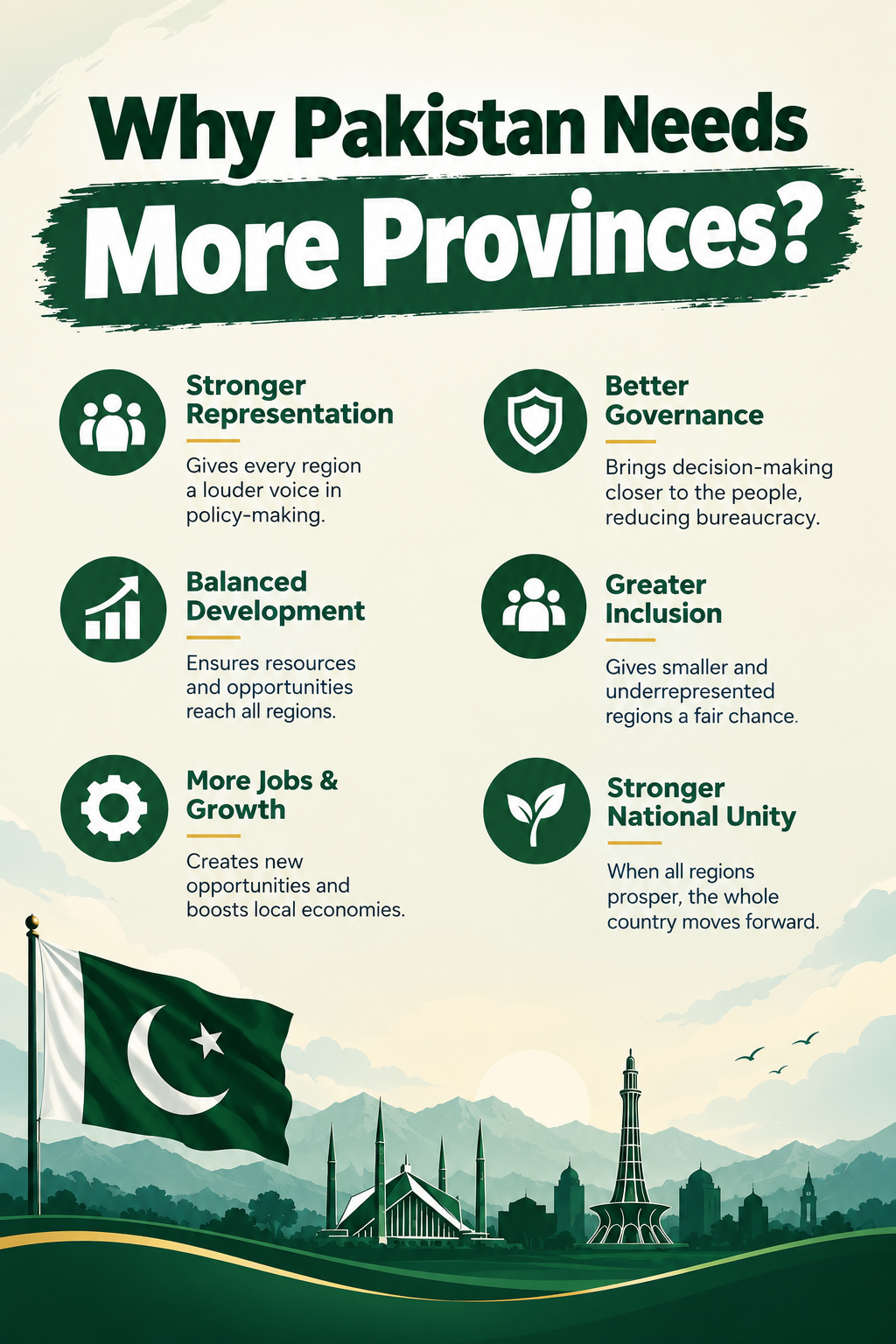
The biggest reason for this demand is the huge size of Punjab. Punjab alone has a population of nearly 127.7 million people, which is more than half of Pakistan’s entire population. One province governing so many people from a single provincial capital, Lahore, creates serious problems. Far-off areas like Bahawalpur, Multan, and Dera Ghazi Khan in South Punjab often feel neglected because all the attention, funds, and development projects go mainly to the central and northern parts of the province. This is why there has long been a strong demand for a separate South Punjab or Seraiki province, so that local people can manage their own resources, appoint local administrators, and plan development according to their own needs.
Smaller provinces also mean better and faster governance. When a province has a smaller population and area, the government can reach every district more easily. Roads, schools, hospitals, and police stations can be planned and built faster because decisions do not have to travel through many layers of a huge administrative system. Countries around the world, from India to the United States, have shown that smaller administrative units often lead to more efficient service delivery and quicker response to local problems, such as floods, health emergencies, or law and order issues.
Another strong argument is fair representation. Right now, some regions like Hazara in Khyber Pakhtunkhwa and Bahawalpur in Punjab have their own separate history, culture, and language, but no separate administrative identity. Creating new provinces for such regions would give local communities a stronger voice in decision-making and a bigger share in the National Finance Commission Award, which is the formula used to distribute money between the federal government and the provinces. More provinces would mean more seats at this table, and a fairer share of resources for smaller and less developed areas.
New provinces can also help reduce the feeling of being ignored, which sometimes creates unnecessary political tension. When people feel that their area has almost no say in a large province’s decisions, resentment grows over time. Giving such regions their own province, within Pakistan’s constitutional framework, actually strengthens national unity, because people feel more included and valued as equal citizens of the country. This is not about dividing Pakistan; it is about organizing Pakistan in a way that serves every citizen better, in line with the spirit of a federal, democratic state as envisioned in the Constitution of 1973.
There are also economic benefits. Smaller provinces can focus on their own local industries, agriculture, and trade opportunities without competing internally for the same limited provincial budget. For example, a separate South Punjab province could focus on improving its cotton and mango industries, while a separate Karachi or Hazara province could focus on urban development or tourism, according to their own local strengths.
Of course, creating new provinces is not simple. It requires a two-thirds majority in Parliament and agreement from the relevant provincial assembly, as set out in Article 239 of the Constitution. It also needs careful planning for new infrastructure, budgets, and staff. But these challenges should not stop Pakistan from considering reform. Many respected leaders across different political parties have supported the idea of new provinces at different times, showing that this is not a one-sided demand but a shared national conversation.
In conclusion, Pakistan’s population has grown enormously since independence, but its provincial map has stayed almost the same. Creating new, smaller provinces would bring governance closer to the people, ensure fairer distribution of resources, and strengthen the federation by making every citizen feel equally represented. It is a reform that could make Pakistan stronger, more efficient, and more united in the years ahead.
Author