


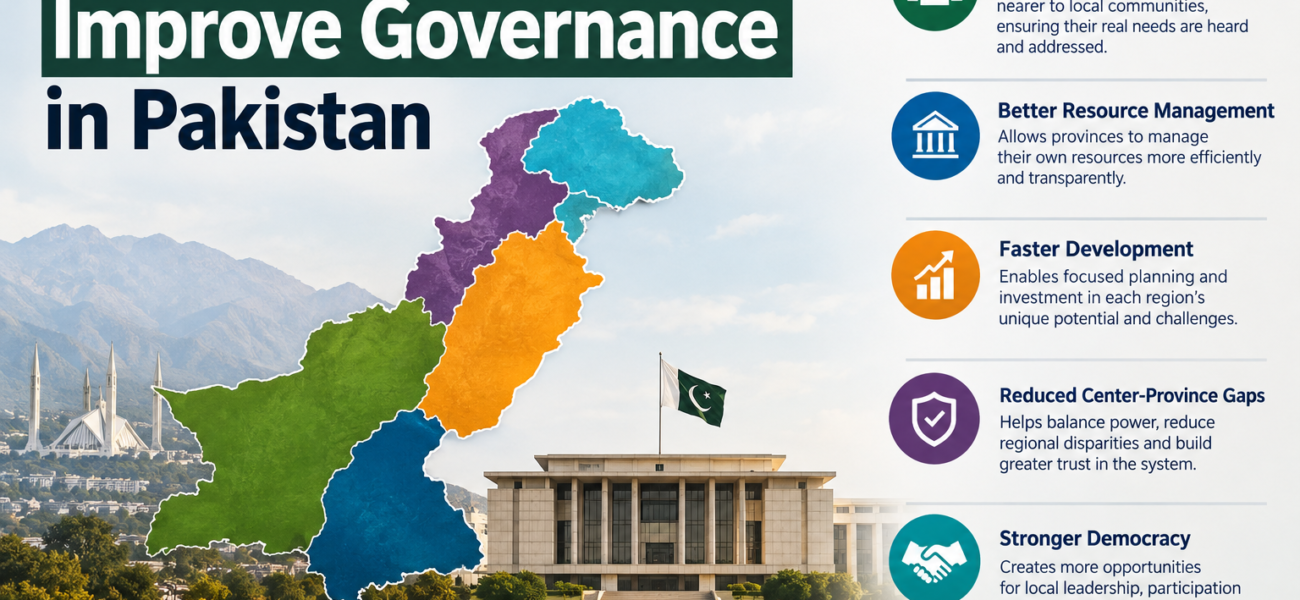
Why New Provinces Could Improve Governance in Pakistan
Pakistan has changed dramatically since independence. Its population has grown from around 33 million in 1951 to more than 240 million today, while its basic provincial structure has remained largely...

Pakistan has changed dramatically since independence. Its population has grown from around 33 million in 1951 to more than 240 million today, while its basic provincial structure has remained largely unchanged. The question, then, is whether administrative arrangements designed for a mid-twentieth-century population remain suitable for managing one of the world’s most populous nations.
The argument for creating new provinces is fundamentally an argument about governance efficiency and public service delivery. Under the current four-province model, administrative capitals manage massive territories and vast populations. In Punjab, a single provincial government in Lahore oversees more than 120 million people—a population larger than most European countries combined. Similar administrative stretch exists in Sindh, Khyber Pakhtunkhwa and Balochistan.
Designing Provinces Carefully
Creating new provinces would require careful planning. Administrative expansion should not automatically mean creating unnecessarily large bureaucracies or duplicating institutions. A phased approach could allow the viability of proposed provinces to be assessed before implementation. Economic capacity, population, geography, infrastructure, access to services and administrative feasibility could all be considered when evaluating proposals.
Fiscal arrangements would also require attention. New provinces would need functioning institutions, sustainable revenue arrangements and clearly defined responsibilities with the federal government and existing provinces.
Most importantly, any restructuring would need broad constitutional and political consensus. Article 239 of the Constitution establishes a demanding procedure for altering provincial boundaries, including approval by the relevant provincial assembly and Parliament. This provides a constitutional framework through which such changes can be debated and considered.
A Structure for the Future
Pakistan’s existing provinces have played an important role in the country’s development. The question of additional provinces should therefore be approached not as a rejection of the existing federation, but as a discussion about how its institutions can respond to a much larger and more diverse population.
If carefully designed, smaller administrative units could bring government closer to citizens, make development planning more locally focused and strengthen representation. The success of such a reform, however, would depend on sound boundaries, sustainable finances, capable institutions and constitutional consensus.
A growing country may eventually require an administrative structure that reflects the realities of its population and geography. The debate over new provinces is ultimately a debate about how government can remain accessible, representative and responsive as Pakistan moves toward the decades ahead.
Author