
Why Bangladesh Joining the Mecca Defence Pact Makes Strategic Sense
A case for closer Dhaka-Islamabad-Riyadh-Ankara defence cooperation When Saudi Arabia, Pakistan, and Turkiye signed the Mecca Joint Defence Agreement in Makkah on August 7, 2026, they created what...

A case for closer Dhaka-Islamabad-Riyadh-Ankara defence cooperation
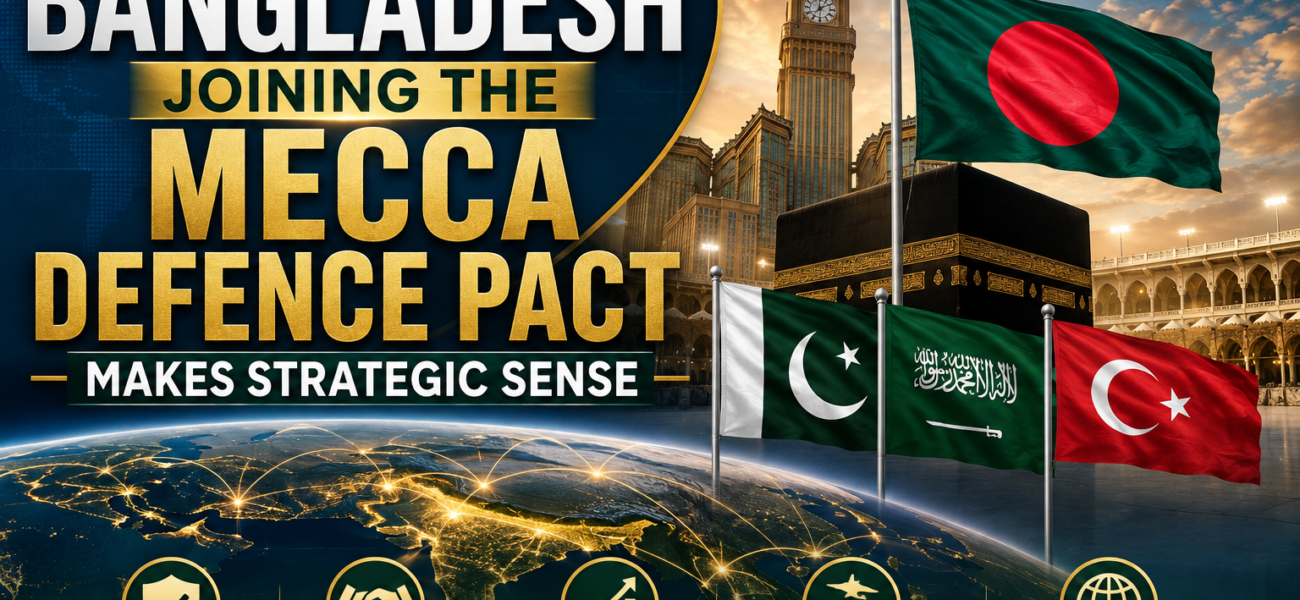
When Saudi Arabia, Pakistan, and Turkiye signed the Mecca Joint Defence Agreement in Makkah on August 7, 2026, they created what several commentators have already dubbed an “Islamic NATO“, a formal mutual-defense framework in which an armed attack on any one signatory is treated as an attack on all three. Bangladesh’s subsequent signal, delivered by two junior foreign ministers within weeks of the pact’s signing, that Dhaka is “open” to joining marks a potentially significant shift in South Asian and West Asian geopolitics. There is a credible, interest-driven case for why Bangladesh should pursue this path seriously.
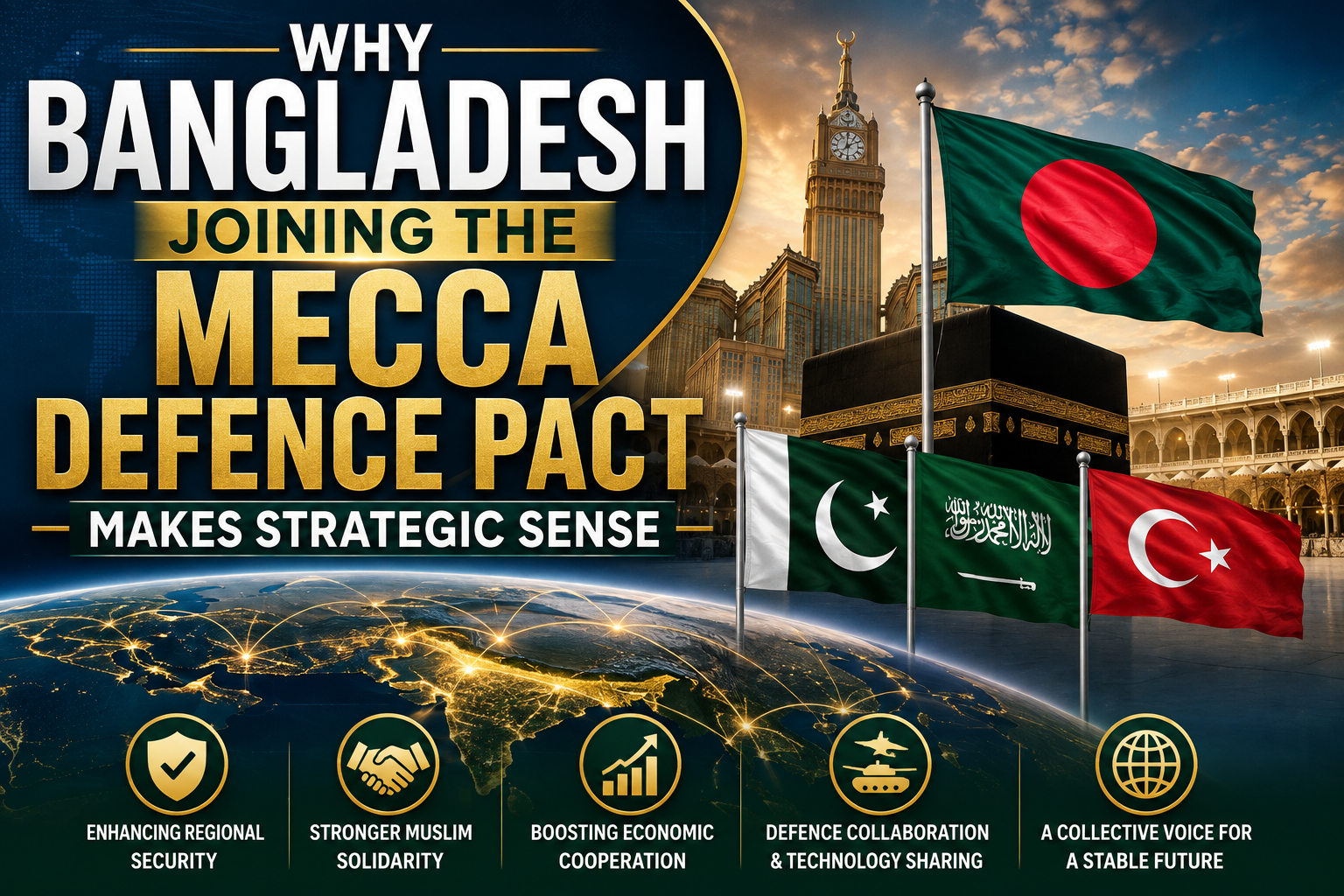
Supporters of Bangladeshi accession point first to the natural complementarity of the founding members’ capabilities. Saudi Arabia brings deep financial and energy resources, backed by the world’s largest crude oil reserves and sovereign wealth capacity. Pakistan brings a large, combat-tested military, approximately 660,000 active troops, 1,369 military aircraft (including 469 combat aircraft) and 117 warships giving it a full-spectrum deterrence posture and the world’s #15-ranked armed forces by aggregate strength. Turkiye, meanwhile, brings a mature, export-oriented defence industry with proven drone and precision-strike technology, plus a large NATO-trained standing army. For a country like Bangladesh, the world’s eighth most populous nation but one without a nuclear or expeditionary military tradition of its own, alignment with a bloc that pools petro-financial depth, and modern arms manufacturing is, proponents argue, a rational hedge in an increasingly multipolar security environment.
The move also fits neatly within Dhaka’s own stated foreign policy doctrine, rather than reading as narrow bloc symbolism. The interim/BNP-led government under Prime Minister Tarique Rahman has explicitly framed its foreign policy around a “Bangladesh First” approach, a doctrine adviser has called a “paradigm shift” in the country’s strategic outlook. State minister Humayun Kobir was careful to frame the pact not as narrow bloc politics but as an economic-and-security opportunity tied to “the changing dynamics of the global economy and trade.” Framed this way, joining is less about idealizing 1971-era religious or historical ties and more about diversifying Bangladesh’s strategic partnerships broadly, consistent with how other mid-sized states elsewhere, such as Egypt, are reportedly also weighing membership as they position themselves amid West Asian realignment.
Importantly, this is not purely aspirational. Trade and defence-industrial ties between Bangladesh’s prospective partners have been building real momentum, giving the political overture some economic substance rather than being purely symbolic. Pakistan-Bangladesh bilateral trade recently crossed the $1 billion mark, up roughly 20% year-on-year, according to Bangladesh’s Deputy High Commissioner to Pakistan. Turkiye-Bangladesh defence-industrial cooperation has been deepening rapidly as well: in July 2026, Turkiye’s Secretary of Defence Industries, Prof. Haluk Gorgun, visited Dhaka’s Army Headquarters to discuss technology transfer, and Bangladesh’s Chief of Army Staff has expressed interest in co-producing modern military equipment locally with Turkish support. Bangladesh became the top buyer of Turkish defence equipment in 2022, underscoring an already-existing procurement relationship the pact would formalize rather than invent. On the Saudi side, Crown Prince Mohammed bin Salman has personally invited PM Tarique Rahman to Riyadh, with the visit reportedly scheduled for October 20–22, 2026, a sign the relationship is being elevated at the highest level, not left to junior-minister rhetoric alone.
Advocates of the move also argue it need not be read as a confrontational maneuver aimed at any particular power. Regional analysts, including Ankara-based strategist Nihat Ali Ozcan, have suggested the pact’s primary orientation is toward counterbalancing Iran’s regional influence in West Asia. From this lens, Bangladesh’s interest is best understood as classic strategic hedging: a mid-sized power-seeking security guarantees and defence-industrial access from multiple directions rather than betting its security entirely on any single partner. Bangladeshi officials have repeatedly stressed this balancing framing, Shama Obaed Islam noted that any decision would rest solely on “whether Bangladesh’s interests and the interests of the Bangladeshi people are protected.”
Finally, timing matters. Since the original Saudi-Pakistan Strategic Mutual Defence Agreement was signed in September 2025, later expanded into the trilateral Mecca Pact in August 2026, the framework has already drawn interest from the United States, with President Trump publicly welcoming it as evidence that regional states are “finally progressing to defend themselves in a meaningful way.” A Bangladesh that joins early, rather than as a late entrant, is positioned to shape the pact’s evolving institutional architecture, membership terms, industrial-offset arrangements, and burden-sharing rules, rather than simply accede to terms set by others later.
To be fair to the debate, this reading is contested, and any responsible account should note the pushback. Bangladesh accepting a mutual-defense clause, however carefully hedged, is, some analysts argue, a “considerably more consequential” step than routine bilateral diplomacy, since collective-deterrence commitments can carry unforeseen obligations down the line. Skeptics also note the practical economic case remains modest so far: Bangladesh-Pakistan trade, while growing at a healthy clip, is still under $1 billion in absolute terms, meaning the near-term economic upside of formal alignment may be smaller than the political weight being placed on it. And officials themselves have stopped short of commitment, “open to” is explicitly not “committed to,” and both ministers repeatedly conditioned any move on unspecified “national interest” calculations still being worked out.
Author