

July 4th Washout: Climate’s Humbling of US Celebrations
East Coast storms ruined July 4th celebrations, exposing economic vulnerabilities and public disappointment. Explore how climate change is humbling America's predictable routines.

POLICY WIRE — Washington, D.C. — Independence Day revelries across the United States typically conjure visions of meticulously choreographed fireworks and sun-drenched parades. Yet this year, as storm fronts converged over the East Coast, America’s grand celebration wasn’t just momentarily paused; it was, in key metropolitan centers like Washington, D.C., New York, and Philadelphia, effectively humiliated by an uncontrollable, indifferent force: the weather.
It’s not just rain. It’s a statement, you might say, delivered by the atmosphere itself. A peculiar kind of cosmic irony, really, that on a day meant to commemorate a nation’s absolute sovereignty, a simple shift in barometric pressure could grind public jubilation to a soggy halt. Millions, who’d planned their picnics and primed their patriotic spirit, instead found themselves shuffling indoors, scanning smartphone alerts for event cancellations—a less-than-heroic tableau, wouldn’t you agree? [QUOTE_PLACEHOLDER]
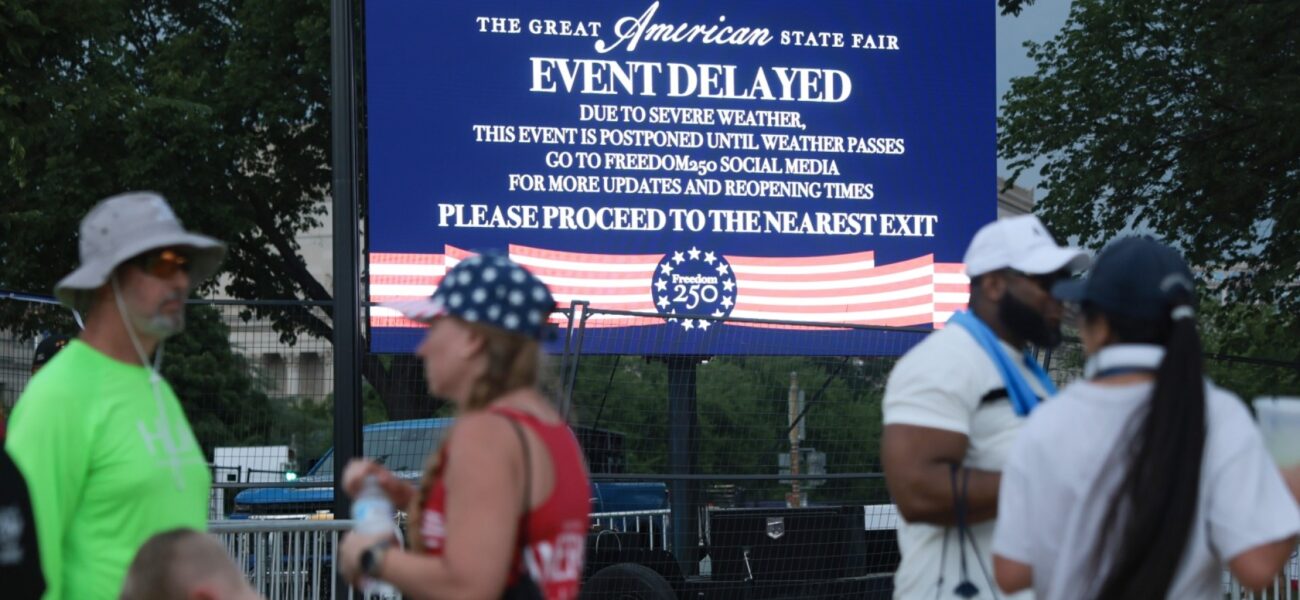
Local authorities, faced with the inevitable, had little choice but to pull the plug on numerous public events. From grand concerts on the National Mall to local block parties, organizers issued advisories and, later, outright cancellations. Nobody wanted a repeat of previous years’ mishaps, certainly, or the public outcry that comes when safety is seemingly an afterthought. But what does it mean for a nation when its collective annual exhale is quite literally washed away?
It means disruptions, obviously. Big ones. We’re talking about everything from lost revenue for street vendors to frustrated families. And it isn’t just a quaint national inconvenience. Think about the micro-economies surrounding these events: the hot dog stands, the souvenir sellers, the temporary parking attendants—they don’t just lose a day’s takings; they lose a year’s most profitable opportunity, an economic punch in the gut many won’t quickly recover from. A single Fourth of July event, particularly in major cities, can generate millions in localized economic activity, money that vanished faster than a smoke bomb in a thunderstorm.
But the real rub is in the optics. The world watches, whether they admit it or not, when America celebrates itself. And when those celebrations falter under a gray sky, it offers a peculiar, fleeting mirror to nations far beyond its borders. Just as a heavy monsoon or an unexpected heatwave can disrupt Eid al-Adha festivities in, say, Lahore or Karachi, forcing communities indoors, breaking collective plans, and sometimes even threatening lives, this damp squib of an American holiday highlights a common, fragile human vulnerability to the elements.
And those elements? They aren’t exactly getting kinder. The National Oceanic and Atmospheric Administration (NOAA) noted that July 2023 was the hottest July on record globally, making extreme weather occurrences, like those that plagued American cities, more frequent and more intense. This isn’t just bad luck; it’s a symptom, writ large across the national psyche, that our predictable routines are increasingly subject to nature’s caprice.
📄 POLICY WIRE WHITEPAPER PUBLISHED: PAKISTAN'S NATIONAL SECURITY POLICY PRIORITIES
👉 READ BY CLICKING HEREThe cancellations, naturally, stirred a predictable blend of grousing — and resignation. Folks on social media griped about the forecasts, questioned official preparedness, and then just—went home. There’s a subtle lesson there: sometimes, even the mightiest civic plans must yield to the undeniable force of the elements. It’s a moment that strips away the performative patriotism, revealing a much more pedestrian reality beneath the surface. For all our technological marvels, our ability to orchestrate mass joy is still dependent on clear skies.
It’s the subtle psychological cost, I think, that warrants attention here. The symbolic disappointment. People need these shared rituals—they do—to reinforce social cohesion, to blow off steam, to simply feel connected. When those rituals get undermined by a weather system, it chips away at something intangible. It’s a reminder that even in an age of abundant information, we’re, after all, mere players on a stage often dictated by an unpredictable scriptwriter. Grand spectacle washes out, highlighting logistical realities not just for event organizers but for collective spirits.
What This Means
This weather-induced national holiday debacle isn’t just a statistical blip on the annual calendar; it holds broader implications for governance and public sentiment. Economically, the hit isn’t just about vendors. Large-scale event cancellations can ripple into local tourism, hospitality, and public transport sectors, revealing vulnerabilities in our city economies often overlooked. It’s a microcosm of the echoing global economic realities that climate change imposes, where planned events—whether a national celebration or an agricultural harvest—are increasingly at the mercy of unpredictable atmospheric shifts. Politically, while a rainy day won’t spark a revolution, the repeated disappointment associated with climate-driven disruptions can subtly erode public trust in systems, a feeling of helplessness against forces too vast to control. And it provides a strange solidarity with nations, like Pakistan, who’ve long contended with more extreme versions of such environmental indignities disrupting their public life and celebrations with tragic regularity. These aren’t just inconveniences; they’re symptoms of a world demanding a different kind of preparation, one where the old blueprints for celebration simply won’t do.