

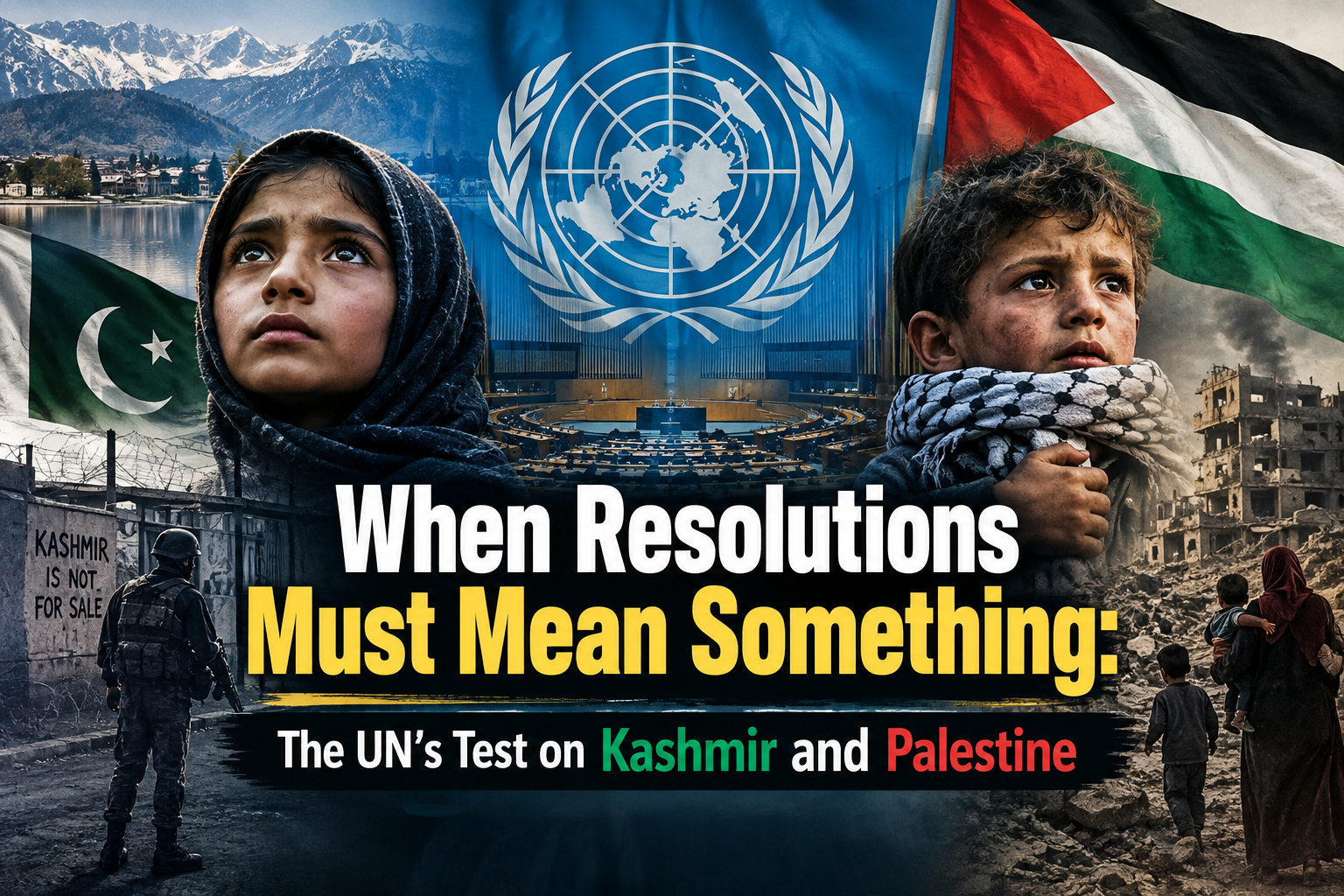
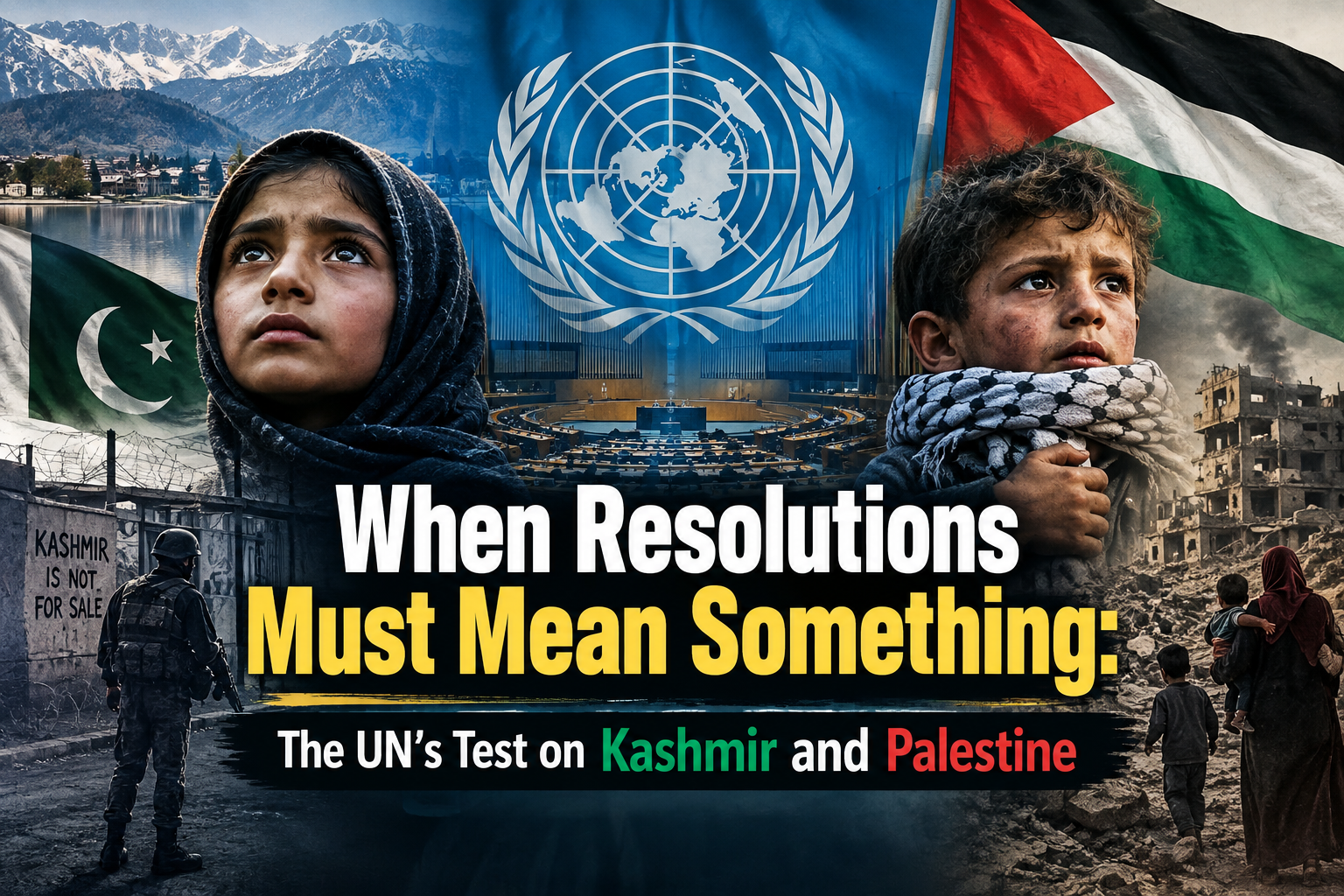
When Resolutions Must Mean Something: The UN’s Test on Kashmir and Palestine
The credibility of the international system depends not only on the resolutions it adopts, but on whether those resolutions are actually implemented. Pakistan’s renewed call for the implementation of...

The credibility of the international system depends not only on the resolutions it adopts, but on whether those resolutions are actually implemented. Pakistan’s renewed call for the implementation of United Nations Security Council resolutions on Palestine and Jammu and Kashmir therefore raises a broader question that extends beyond any single dispute: can the multilateral system remain credible when international commitments are applied inconsistently?
Pakistan’s Deputy Prime Minister and Foreign Minister Ishaq Dar raised this issue during his meeting with Olara Otunnu, Uganda’s nominee for the next United Nations secretary-general, alongside Uganda’s special envoy Ruhakana Rugunda. According to Pakistan’s Foreign Office, Dar stressed the importance of respecting international law and implementing Security Council resolutions, particularly those concerning Palestine and Jammu and Kashmir. The discussion comes at an important moment, as the United Nations prepares for a leadership transition in 2027.
The timing matters. The next secretary-general will inherit a multilateral system facing wars, geopolitical rivalries, humanitarian crises and declining confidence in international institutions. The challenge will not simply be to manage crises, but to restore faith in the principle that international rules should apply consistently.
For Pakistan, the issue of Kashmir has remained closely connected to the United Nations framework since the dispute first reached the Security Council. Pakistan’s position has consistently emphasized the relevance of UN resolutions and the principle of allowing Kashmiris to determine their political future. Palestine presents another long-standing challenge in which questions of self-determination, occupation, civilian protection and international law remain central to global diplomacy.
Yet the significance of Pakistan’s position extends beyond these two disputes. The larger argument is about the authority of international institutions. If Security Council resolutions become political statements rather than commitments capable of producing meaningful action, the legitimacy of the entire multilateral architecture is weakened.
This is particularly important for smaller and middle powers. Their influence depends heavily on institutions, rules and diplomacy. A functioning rules-based order therefore provides countries such as Pakistan with a platform through which diplomatic engagement can carry greater weight.
Pakistan’s contribution to UN peacekeeping also gives it a practical stake in strengthening this system. Pakistani personnel have for decades participated in international peacekeeping missions, making the country one of the prominent contributors to global peace and security efforts. Recognition of this contribution by international partners, including during Otunnu’s meeting with Dar, reinforces the value of Pakistan’s continued engagement with multilateral institutions.
The forthcoming UN leadership transition offers an opportunity to turn these principles into a wider diplomatic agenda. The next secretary-general should not be expected to solve longstanding conflicts alone. However, the office can play an important role in defending the authority of international law, encouraging dialogue and ensuring that the UN remains relevant when diplomacy is most difficult.
Pakistan’s call is ultimately about consistency. International law gains strength when principles are applied universally, not selectively. Whether the issue is Kashmir, Palestine or another conflict, the credibility of the United Nations depends on its ability to translate adopted principles into meaningful diplomatic and political action.
For Pakistan, sustained engagement with the UN is therefore not merely about advocating individual national positions. It is also an opportunity to champion a stronger multilateral system, one in which resolutions carry weight, diplomacy remains meaningful and international law is treated as a common standard rather than a selective instrument.
Author