


What is Geomagnetic Storm? Dancing Lights and Digital Shadows:
On June 2, 2025, our planet was swept by a powerful celestial event that straddled the line between beauty and danger. It was a G4-class geomagnetic storm triggered by a substantial coronal mass...

On June 2, 2025, our planet was swept by a powerful celestial event that straddled the line between beauty and danger. It was a G4-class geomagnetic storm triggered by a substantial coronal mass ejection (CME) from sunspot AR4100. The Earth’s magnetosphere, often an invisible guardian, was lit ablaze by ribbons of colored plasma streaking across the night sky. For billions, it was a rare spectacle. For scientists and policy makers, it was a sobering warning.
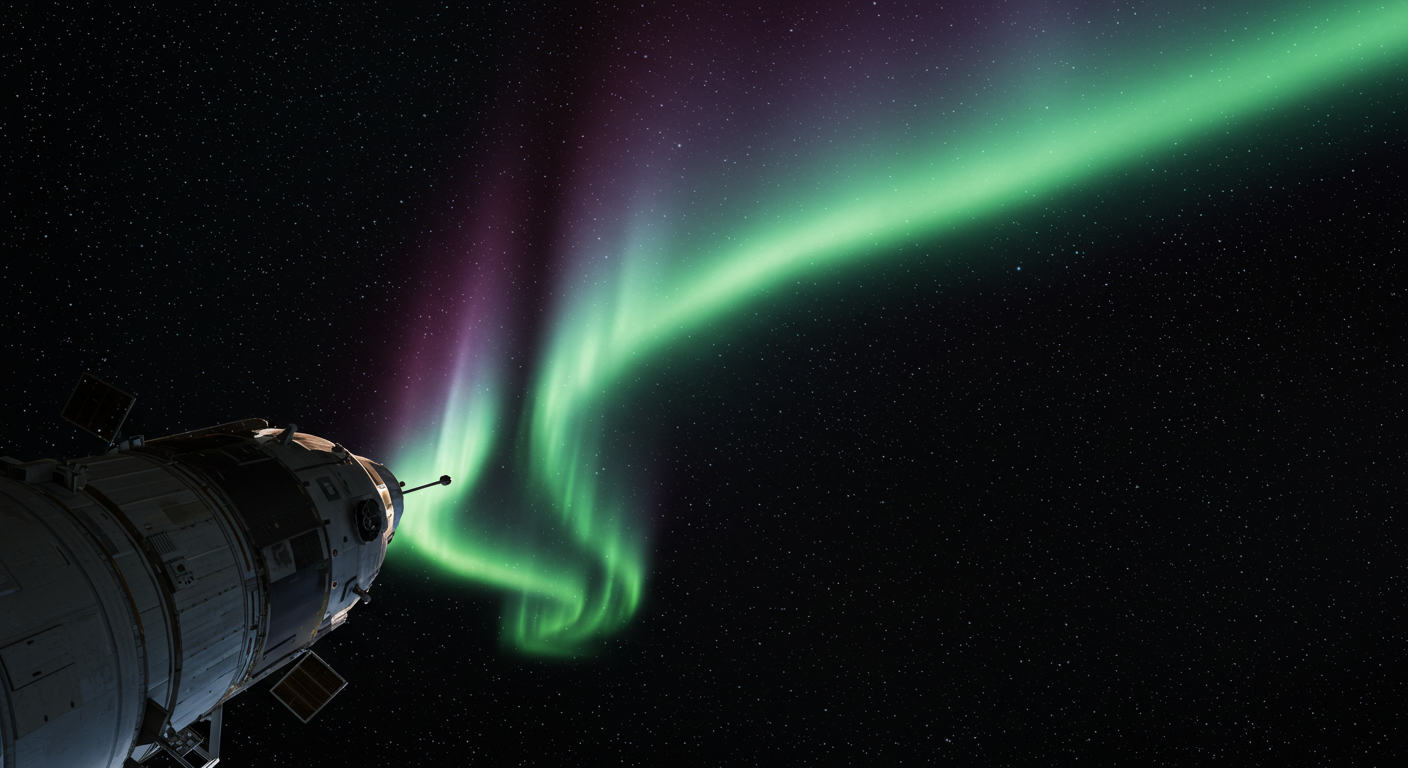
The auroras themselves were a wonder. Observers from southern Canada to Texas and from Scotland to Germany shared photos of the northern and southern lights flooding the skies with hues of crimson, green, and violet. In Australia, the aurora australis was visible from as far north as Queensland, a phenomenon rarely experienced in the subtropics. Social media timelines turned into galleries of cosmic art. Hashtags like #SolarStorm2025 and #AuroraWatch trended globally. These lights are formed when energetic particles from the sun collide with Earth’s atmosphere, channeled along the magnetic field lines toward the poles. But they are only the visible tip of a much deeper and darker disruption.
What the average stargazer may not have realized is that this same solar storm had the power to compromise entire systems of modern civilization. The same energy that creates the aurora borealis also has the capacity to interfere with power grids, disrupt satellite functions, jam high-frequency radio communication, and induce current surges in pipelines and undersea cables. This is not speculative. It is historical. The infamous March 1989 storm, rated similarly to the recent one, blacked out the entire province of Quebec in just 90 seconds. In the aftermath, studies showed that a larger event, like the 1859 Carrington Event, could cripple vast portions of today’s digitally connected society.
In 2025, we are more vulnerable than ever. Our lives are integrated with systems heavily reliant on uninterrupted electromagnetic stability. From civilian aviation that relies on GPS navigation to global finance systems operating across high-frequency trading networks and undersea fiber-optic cables, everything rests on a delicate digital infrastructure. Any major geomagnetic disturbance that interferes with satellite telemetry, navigation signals, or data synchronization could lead to catastrophic operational failures. Airlines have already begun rerouting transpolar flights to avoid radio blackouts. Telecommunications companies are bracing for equipment recalibrations. Power utilities are monitoring transformer loads to prevent cascading failures.
The reality is grimly simple. We are a Type 1 civilization in aspiration, but a pre-industrial society in preparation when it comes to space weather. And space weather, unlike traditional meteorology, does not heed borders, alliances, or economic classes. A solar flare has no politics. It burns indiscriminately.
Yet, geomagnetic storms also hold immense scientific value. Every such event is a live laboratory for researchers in astrophysics, magnetospheric science, and climate modeling. Solar observatories, from NASA’s Solar Dynamics Observatory to the European Space Agency’s Solar Orbiter, train their eyes on the sun to decode patterns and precursors of these solar flares and CMEs. Satellites like the Deep Space Climate Observatory (DSCOVR) and NOAA’s GOES provide crucial advance warnings of incoming space weather. But prediction remains a complex endeavor. The sun is a chaotic system. The exact speed, orientation, and density of a CME are difficult to calculate with high precision. What we can do, however, is develop redundancy in our systems just as we do with natural disasters.
Governments have known this for years. In 2015, the United States issued its National Space Weather Strategy and Action Plan, followed by several other international initiatives. The UK’s Met Office established a dedicated space weather forecasting center. Japan, India, and China all have expanding programs to monitor solar activity. But preparedness remains limited. Much of the critical infrastructure in both the Global North and Global South remains unshielded from electromagnetic induction or lacks the protocols necessary to function during extended outages. If we were to experience a Carrington-level event today, the cost could exceed $2 trillion globally, according to Lloyd’s of London.
The recent June storm must be seen as a red flag. It flutters not above battlefields but above server farms, launch pads, and data centers. We must adopt a planetary perspective. Collaboration between space agencies, meteorological bodies, and even private tech companies like SpaceX, Amazon (via Project Kuiper), and OneWeb is no longer optional. It is urgent. The more satellites we launch, the more we must harden our low-Earth orbit infrastructure against solar threats. The more reliant our cars, drones, and communication tools become on real-time positioning systems, the more exposed they are to minute distortions in geomagnetic fields.
There is also a deeply philosophical lesson here. For all our technological prowess, we remain at the mercy of a star 150 million kilometers away. Our ancestors worshipped the sun, fearing its power. Today, we understand it better, but we have perhaps become too complacent. The storm of 2025 reminds us that civilization is not guaranteed by innovation alone. It is sustained by resilience.
Public engagement must be part of the strategy going forward. Citizens need to be aware of what space weather is, what alerts mean, and how it could affect their lives. Just as we have alerts for hurricanes or wildfires, global institutions should integrate geomagnetic risk into public information campaigns. Schools should include it in science curricula. Media should treat space weather alerts with the seriousness they deserve, not as footnotes in science journals but as front-page stories with broad implications for agriculture, aviation, national security, and finance.
Equity must also be considered. Not all countries have the infrastructure or capacity to monitor and respond to space weather events. As with climate change, it is the Global South that will suffer disproportionately in the event of large-scale outages or navigation failures. Thus, any space weather defense architecture must be multilateral and inclusive, offering satellite data, forecasting tools, and response strategies to all nations, regardless of economic strength.
The June 2025 geomagnetic storm is both a marvel and a mirror. A marvel in what it reveals about the celestial ballet of our universe. A mirror in what it reflects about the fragility of our modern existence. The solar winds are not sentient, but their impacts cut to the heart of our civilization’s structural design. Are we prepared for the next one? The beauty of the aurora must not distract us from the storm behind it.
We often say that we live in the information age. But information is nothing without infrastructure. And infrastructure is nothing if it can be silenced by the sun.
Author