

What is Badr Pact Now?
The ink had barely dried in Doha when the label arrived. “Another Muslim NATO,” some headlines said. Analysts rushed to draw maps and count armies. They looked for a clause that promised...

The ink had barely dried in Doha when the label arrived. “Another Muslim NATO,” some headlines said. Analysts rushed to draw maps and count armies. They looked for a clause that promised war. They found none. That is the story.
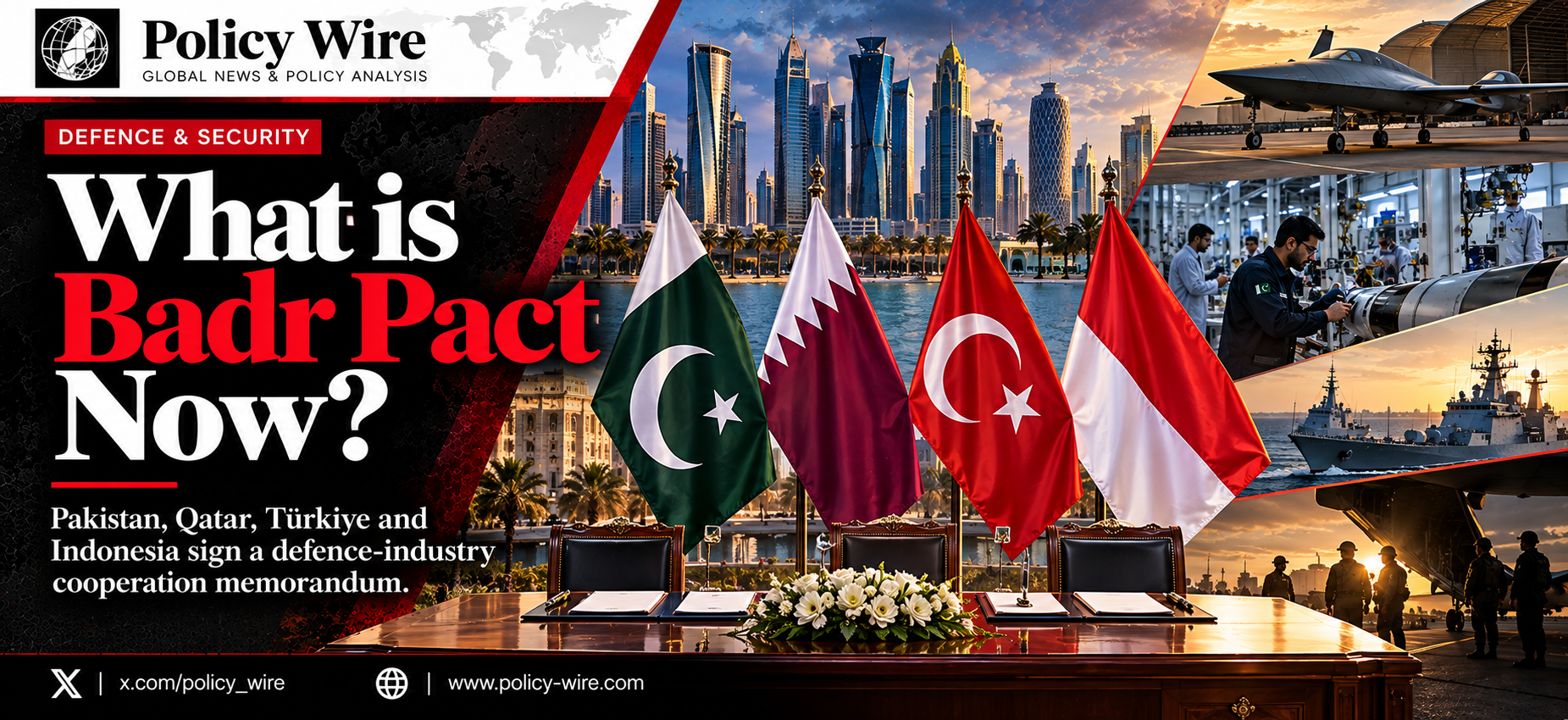
On Wednesday, Turkiye, Qatar, Pakistan and Indonesia signed the Badr pact, a defence-industry memorandum. The defence ministers of Qatar, Pakistan and Turkiye signed it, and Indonesia sent its deputy defence minister. The deal covers joint production, research and development, and military training. It has no mutual-defence clause. It does not ask who will fight. It asks who will build. For Pakistan, that question opens a big door.
What Is the Badr Pact?
The Badr pact turns separate defence projects into one shared framework. Badr means full moon, and Turkish officials say the name reflects how the four countries’ efforts complement each other. A full moon needs a complete circle to shine, and each partner adds a piece.
Do not confuse Badr with the Makkah Joint Defence Agreement. Saudi Arabia, Turkiye and Pakistan signed Makkah on 7 August, and its core promise is simple: an attack on one is an attack on all. Makkah answers who stands with whom. Badr answers who builds what. Together, they form a two part strategy. One protects, and the other produces.
Pakistan Already Builds
Badr stands on real work. Turkiye delivered two Babur-class corvettes built in Istanbul, and Karachi Shipyard was upgraded to finish the other two. Pakistani yards and Pakistani workers now complete modern warships. That is proof of skill, not a promise.
Other projects show the same pattern. Turkiye builds the KAPLAN MT tank with Indonesia’s Pindad. In Qatar, Aselsan and Barzan Holdings run BARQ, which makes weapon systems on Qatari soil. Qatar’s defence minister said last week that a domestic defence production hub is coming. Badr links these efforts under one roof.
Pakistan’s Double Role in Regional Security
Here is the most important fact about the Badr pact. Pakistan sits in both frameworks. In Makkah, it serves as a security provider. In Badr, it serves as an industrial partner. Few nations hold both roles at once.
That position gives Pakistan a voice in how the region defends itself and how it equips itself. It also brings real economic gains. Joint production creates work for engineers, welders, designers and technicians. Shared research builds new skills. Training programs raise the quality of the force. Every Pakistani workshop that joins a Badr project adds to national strength.
Why the Timing Makes Sense
Gulf capitals have learned hard lessons. The 2017 blockade of Qatar, the 2025 Israeli strike on Doha and this year’s US-Israeli war on Iran all taught one thing. Relying on far away suppliers is a risk. Spare parts, software and maintenance matter as much as the platform itself.
Badr answers that risk. Partners can build, repair and upgrade together. Dependence turns into self-reliance. A country that fixes its own equipment controls its own defence.
Saudi Arabia Is Not Left Out
Some observers noticed that Riyadh did not sign Badr. That is no snub. Saudi Arabia already cooperates with Ankara and Islamabad on defence industry through the Makkah framework. The two pacts fit together like two halves of one plan.
Who Could Join Next?
Badr has not been presented as an open club, and no joining process has been announced. Even so, interest in the wider circle is growing. Egypt is the most mentioned candidate for Makkah. Bangladesh and Syria have said that membership is under consideration, and analysts see Qatar as a natural fit. Industrial pacts widen more easily than treaties. Countries that already buy Turkish systems may look at Badr with real interest. The memorandum also aims to serve allied and partner countries, which points toward exports.
How the World Will See Badr
India said it is closely following the Makkah pact and studying what it means for national security. An Israeli official called Makkah an alliance aimed at Israel. Expect similar talk about Badr. But the text tells a calmer story. A memorandum about factories, research and training threatens no one. It builds strength for its members and offers partnership to others. The world should judge Badr by what it makes, not by what it is called.
The Road Ahead
The next steps are clear. Launch a project that involves at least three members. Share jobs and production work fairly. Turn signatures into assembly lines. Pakistan has the shipyards, the engineers and the track record to lead that effort.
A full moon lights the night, and the real test is whether it keeps shining. With Karachi’s shipbuilders, Pakistan’s engineers and three determined partners, the Badr pact has every reason to rise higher.
Author