


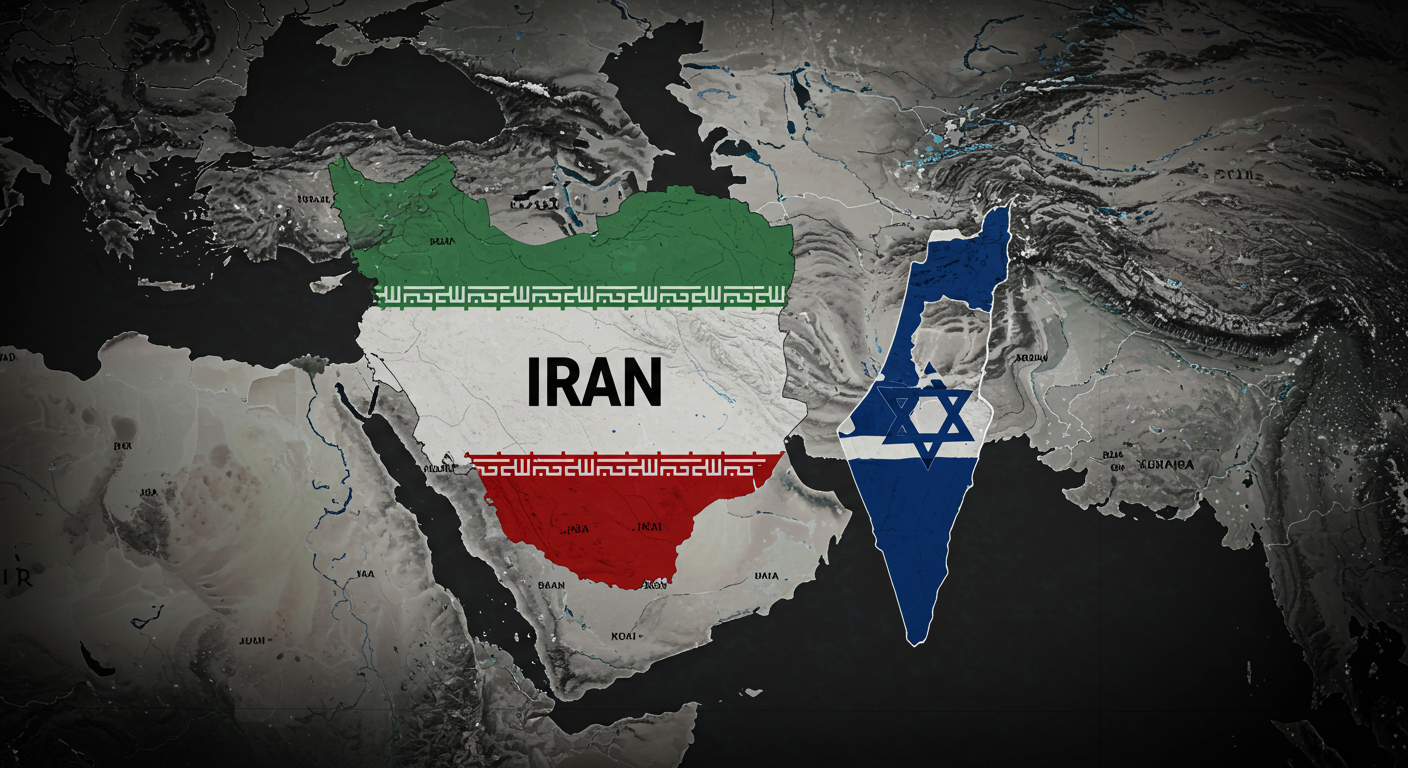
War Without Losers: The Strategic Balance of the 2025 Iran–Israel Conflict
The June 2025 Iran–Israel conflict marked a pivotal moment in Middle Eastern geopolitics. Unlike past wars defined by territorial conquest or regime change, this twelve-day confrontation evolved into...

The June 2025 Iran–Israel conflict marked a pivotal moment in Middle Eastern geopolitics. Unlike past wars defined by territorial conquest or regime change, this twelve-day confrontation evolved into a conflict shaped by limited military engagement, strategic messaging, and political maneuvering. The key actors, Israel, Iran, and the United States, entered the conflict with both declared intentions and hidden agendas. What emerged was not a zero-sum contest with clear winners and losers, but a complex web of partially fulfilled objectives that resembled a positive-sum outcome. Each party achieved some of its goals while absorbing manageable costs. Framed through the lens of game theory and Thomas Schelling’s strategic conflict theory, the war revealed a new equilibrium: a modern battlefield where perception, deterrence, and symbolic gains outweigh outright victories.
Game theory provides a powerful tool to understand the logic behind each actor’s decisions. In such strategic interactions, outcomes depend not solely on one’s own moves, but on the anticipated reactions of others. This is especially true when actors operate under conditions of incomplete information, deliberately concealing intentions while signaling deterrence or escalation. Traditional war models often assume zero-sum dynamics: what one actor gains, another loses. However, modern conflicts increasingly reflect positive-sum dynamics, where multiple actors can derive strategic benefit if calibrated properly. In the 2025 conflict, this dynamic played out clearly. Schelling’s framework suggests that wars can be instruments of bargaining rather than tools for annihilation, states often engage in limited confrontation to reshape the strategic environment without total war. This framework is especially relevant in a conflict where missiles, drones, cyberattacks, and diplomacy were used as much for signaling as for destruction.
Publicly, each actor presented clear goals. Israel aimed to degrade Iran’s nuclear capabilities, deter its regional influence in Syria and Lebanon, and reinforce national security during a politically unstable time. Iran, in turn, asserted its right to defend itself from Israeli aggression, project regional strength, and retaliate for what it perceived as continuous sabotage and assassinations of its scientists. The United States, caught in a delicate position as Israel’s staunch ally and regional power broker, sought to prevent regional escalation, protect oil routes and U.S. forces in Iraq and Syria, and support Israel without becoming directly entangled in another war. These objectives were used to justify military actions and frame diplomatic positions. They shaped media narratives and were echoed in speeches, press briefings, and official communiqués, helping build domestic and international legitimacy for wartime decisions.
Yet beneath these visible goals lay more complex, latent objectives that defined the real strategic depth of the war. Israel’s unstated aims included testing the United States’ commitment under newly revised defense protocols, strengthening domestic political unity in the face of mass protests, and undermining Iran’s morale through covert cyber operations targeting infrastructure and financial institutions. For Iran, the war was an opportunity to consolidate internal legitimacy through a nationalist rally-around-the-flag effect. It also allowed the regime to divert public attention from economic woes, inflation, and recurring protests, while reinforcing strategic ties with Russia and China. The United States, meanwhile, used the opportunity to reassert its regional dominance in the post-Afghanistan era, leveraging Israeli action to contain Iran without deploying its own troops. Additionally, Washington’s measured intervention signaled to Beijing and Moscow that U.S. alliances in the Middle East remain functionally tight and responsive, despite growing global competition.
The outcomes of the conflict reflect this mixture of pronounced and hidden goals. Israel succeeded in temporarily disrupting Iran’s nuclear infrastructure through sophisticated cyberattacks and drone strikes. It also enhanced operational cooperation with moderate Arab states, strengthening the post-Abraham Accords diplomatic framework. Yet it failed to fully neutralize Iran’s nuclear program, deep facilities like Fordow remained untouched, and came under international criticism for collateral damage and legal violations. Domestic unrest, though temporarily silenced, resurfaced in the form of political factionalism, especially as far-right groups criticized the government for not pushing further. Iran, for its part, demonstrated robust retaliatory capability by launching missiles at key Israeli and U.S. targets, including a strike on Al Udeid Air Base in Qatar. The regime successfully leveraged the crisis to unify a fragmented population and resist external pressure. Nonetheless, the economic cost was immense. International sanctions were intensified, vital infrastructure suffered lasting damage, and Iranian cooperation with the IAEA was partially suspended, deepening Tehran’s diplomatic isolation.
The United States achieved some of its goals by brokering a ceasefire and preventing the conflict from expanding into the Persian Gulf, which could have threatened global energy markets and regional stability. The use of missile defense systems such as THAAD and Patriot, alongside Israel’s Arrow-3, was hailed as a technical success. However, the U.S. struggled to restrain Israel’s initial escalation and suffered credibility erosion in the eyes of key regional partners like Jordan and Iraq, who felt sidelined or endangered by American complicity. While the Pentagon succeeded in preventing the need for boots on the ground, the strategic cost of alliance mismanagement and perceived double standards lingered in the diplomatic corridors of the region. Still, each actor emerged from the conflict claiming partial success, a classic example of a positive-sum game. According to game theory, the war settled into a Nash equilibrium: no player could improve their post-war position by changing strategies unilaterally without provoking a costlier response.
But the notion of a war without losers must be treated cautiously. The civilian cost was immense. Iranian cities faced missile strikes and internal displacement. Israel experienced economic disruption, particularly in the north. Oil prices fluctuated and regional markets reeled from the instability. Hundreds died, and thousands were injured. Critical infrastructure, energy facilities, roads, communication towers, was damaged or destroyed. Yet, despite these costs, no government fell, no borders changed, and no army collapsed. This reflects the evolution of modern warfare: states increasingly avoid total war in favor of calibrated engagements designed for symbolic gain. The logic is strategic: show strength, avoid escalation, and emerge from the confrontation with political capital, not smoking ruins. Schelling’s vision of limited war as an extension of diplomacy through threat manipulation played out in near textbook fashion. Each side escalated only to the point where further escalation would be costlier than restraint.
In conclusion, the 2025 Iran–Israel conflict revealed a new kind of geopolitical paradox: a destructive confrontation that nonetheless fulfilled some strategic ambitions for all key players. This was not a war of occupation or regime change, but a conflict of signaling, messaging, and limited strikes, what some call “wars of perception.” Israel enhanced deterrence, Iran reinforced internal resilience, and the U.S. managed crisis without major entanglement. But “no loser” does not mean “no suffering.” The lives lost, homes destroyed, and economies disrupted remain a sobering reminder of the cost of even limited wars. Still, from a geopolitical standpoint, the war reaffirmed a new strategic reality: that in the age of advanced technology, nuclear ambiguity, and global interdependence, war can be waged, and even concluded, without clear victors or vanquished. The 2025 conflict may thus stand as a prototype for future strategic confrontations, where gains are measured not in conquests, but in narratives, alignments, and the temporary recalibration of power.
Author