


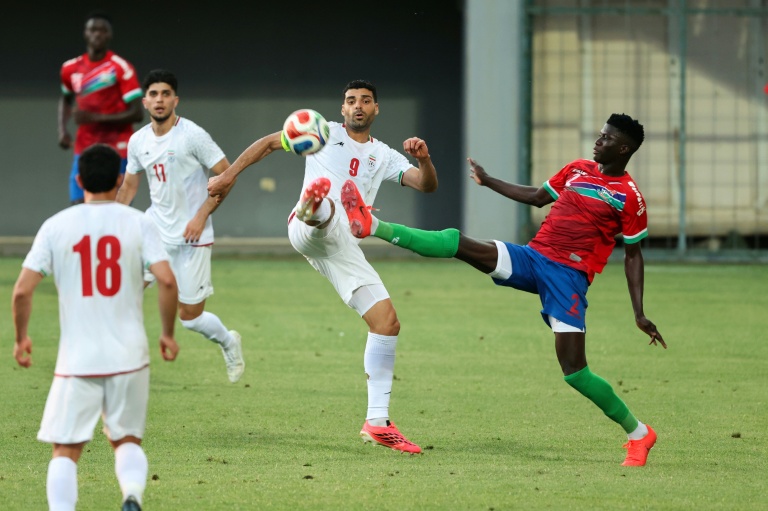
Visa Ball: Geopolitics Tackles Iran’s World Cup Hopes at US Border
POLICY WIRE — Antalya, Turkey — It’s a cruel twist when the universal language of football clashes head-on with the prickly vernacular of international diplomacy. Iran’s national squad, ‘Team...

POLICY WIRE — Antalya, Turkey — It’s a cruel twist when the universal language of football clashes head-on with the prickly vernacular of international diplomacy. Iran’s national squad, ‘Team Melli,’ isn’t just heading to the World Cup; it’s embarking on a 20-hour odyssey under the heaviest cloud imaginable, their cleats scraping the ground of geopolitical tension even before touching down in North America. This isn’t about winning or losing on the pitch—not yet, anyway. This is about who gets to play the game, — and who decides.
After a three-week training camp, largely a visa waiting room in Antalya, Turkey, the team finally lifted off Saturday for Tijuana. That much was certain. But the celebratory cheers of departure were muted, overshadowed by a distinctly American cold shoulder. The players — and their direct technical staff eventually secured their visas, sure. But then, as always, there’s a catch, a bureaucratic snag with teeth.
A significant chunk of the administrative and executive brass – a reported 15 individuals, including the head of the Iranian Football Federation, Mehdi Taj – were left grounded. Visas denied. That’s right, a global sporting event, jointly hosted, — and a competing nation finds its supporting cast marooned. But don’t worry, the US State Department wasn’t quiet about why. “We won’t allow the Iranian team to abuse this system to sneak terrorists into the United States under false pretences,” an official clarified, sidestepping the inconvenient detail of actual players being allowed in. It’s quite the allegation, isn’t it, to paint FIFA World Cup logistics as a clandestine entryway for nefarious actors?
The Iranian Embassy in Turkey didn’t just blink; it came out swinging. “You have now escalated the deliberate and discriminatory treatment against Iran’s national football team to its highest level,” they posted on X. But why stop there? “FIFA must hold the US accountable for violations of its rules and for the discriminatory treatment of Iran’s national football team.” That’s a bold demand, tossed at a global sports body often accused of being more interested in profit margins than moral stands. The Iranian Football Federation itself didn’t pull any punches either, labelling the decision as “political interference in sport in its worst form.” They’re right; it’s a spectacle, not a game.
This whole kerfuffle — part diplomatic chess, part administrative quagmire — feels less like an isolated incident and more like a predictable symptom of the festering US-Iran relationship. The backdrop is, naturally, the broader ‘Middle East war’ that’s flared anew, its grim tendrils reaching even into sporting aspirations. Tensions are running higher than ever, inflamed by recent exchanges of fire since a fragile April 8 ceasefire came under pressure. This World Cup, jointly hosted by the US, Mexico, and Canada, was always going to be fraught for the Iranian delegation. Their initial training base, Tucson, Arizona, became politically untenable. But of course it did. Who expects a warm welcome when bombs are flying elsewhere? So, they decamped to Tijuana, a safer bet, culturally and geopolitically, though it means flying into the US for each match. What a logistical headache, eh?
📄 POLICY WIRE WHITEPAPER PUBLISHED: PAKISTAN'S NATIONAL SECURITY POLICY PRIORITIES
👉 READ BY CLICKING HEREConsider the perception across the Muslim world, from Cairo to Karachi. These sorts of diplomatic snubs, dressed up as security concerns, only serve to harden existing narratives about Western hypocrisy and aggression. In Pakistan, for instance, a nation grappling with its own complex ties to both Iran and the US, this incident isn’t just about football; it’s a tangible example that fuels sentiment. It doesn’t look like an even playing field when politics can so brazenly dictate who crosses a border for a universally adored sport. Because for many, sport transcends politics, but not when politics is so aggressively assertive.
What This Means
This visa fracas isn’t just about a few denied entry permits; it’s a diplomatic gut punch disguised as security protocol. Economically, this could mean FIFA rethinks its future hosting decisions, wary of situations where a sovereign nation’s political spats hijack a global spectacle. That might push big tournaments toward nations less prone to such high-stakes maneuvering—or conversely, demonstrate FIFA’s lack of true political clout. But then, we’ve seen how global football’s fierce economics often trump political posturing. Policy-wise, the US risks further alienating Iran and, by extension, a swath of global public opinion. It strengthens Iran’s narrative that Washington seeks to systematically undermine it, even on the athletic stage. It doesn’t exactly scream ‘soft power.’
And for FIFA? Their silence, so far, has been deafening. They preach unity and universality, but when confronted with a direct challenge to their principles – discriminatory treatment allegations, denying key personnel entry – the global football body often resembles a deer in headlights, or worse, an accomplice through inaction. Team Melli’s schedule in the US includes games against New Zealand, Belgium, — and Egypt. One can only wonder what other non-football related skirmishes await them off the pitch, as they navigate a tournament where every kick is now layered with international intrigue. It’s a far cry from just the love of the game, isn’t it?