


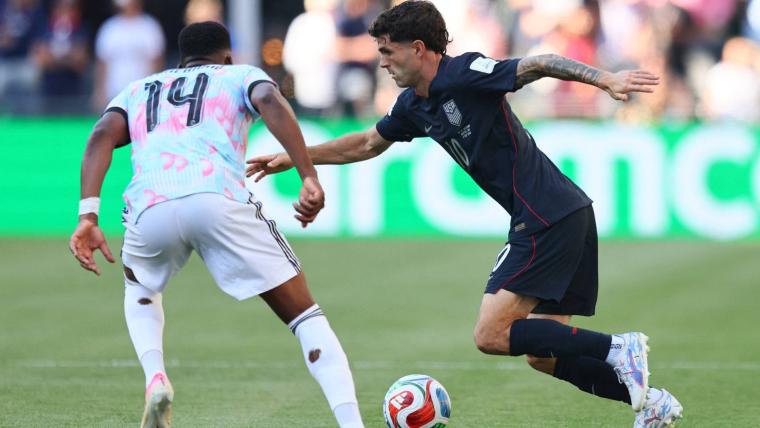
USMNT’s Familiar Knockout: Soccer’s Glass Ceiling Remains Firm for American Aspirations
POLICY WIRE — Washington D.C. — Another tournament, another round-of-16 exit. For anyone tracking the peculiar, often frustrating trajectory of American soccer, this week’s World Cup departure...

POLICY WIRE — Washington D.C. — Another tournament, another round-of-16 exit. For anyone tracking the peculiar, often frustrating trajectory of American soccer, this week’s World Cup departure felt less like a shock and more like a practiced, if still painful, formality. It wasn’t the hero’s journey many in the sports media—and certainly, the fan base—had been peddling; it was, quite frankly, business as usual for the USMNT. The dream, as it always seems to, just faded. Or, perhaps, was never really all that vivid to begin with.
The stage was set, absurdly, in Seattle, thousands of miles from the tournament’s heart. It’s a peculiar quirk of modern soccer’s global sprawl. Here, under a familiar sky but facing a distant, more experienced foe, the United States entered Monday with a ton of pressure to keep its World Cup dream alive, but Belgium had other ideas. Big ideas, apparently. They delivered an impressive 4-1 victory, cementing the USMNT is officially eliminated from the 2026 World Cup. A sobering dispatch for a side that had started so brightly, topping Group D and offering a fleeting glimpse of potential. That glimmer? It proved just that: fleeting. [QUOTE_PLACEHOLDER]
The post-mortem is already underway, a ritual as ingrained in American sporting culture as oversized sodas. After what tournament organizers confirm as a 3-0-2 record, finishing with an overwhelming 4-1 loss, the collective gaze shifts from shattered ambitions to the next quadrennial promise: 2030. But who will lead this charge? Mauricio Pochettino, hired specifically for this World Cup, is free to look for employment elsewhere. And he probably will. You’ve got to wonder if he sees the writing on the wall, etched in the perpetual frustration of what could be, but rarely is. Any smart manager will weigh their options—you know, places where real football triumphs are a legitimate aspiration.
This cycle of hope and familiar disappointment isn’t unique to soccer, of course, but it’s particularly pronounced in the American context. There’s always the promise of youth, the potential of nascent talent. Players like Christian Pulisic, Weston McKinnie, Tyler Adams, Falorin Balogun, and Mark Tillman are all still set to be in their prime for the next tournament, if the current narrative holds. But isn’t that what we always hear? The future is bright, just over the next hill, beyond the next four years. It’s a comfortable mantra that postpones genuine accountability.
The veteran guard, such as it was, saw its swansong. Tim Ream, at 38, stands as the oldest player on the team. He’s a stark reminder of the age gap between seasoned campaigners and the promising youngsters—a blend that, this time around, just didn’t quite gel. The historical ledger isn’t much kinder; the USMNT has only advanced beyond the Round of 16 twice. Think about that for a second. Twice. Once in the inaugural tournament back in 1930, — and then again in 2002. That’s a pattern, not a blip. It’s a consistent ceiling.
What This Means
From a purely policy standpoint, this recurring inability to break through the World Cup’s upper echelons has quiet, insidious implications for American soft power. When a nation consistently performs below global expectations in the world’s most popular sport, it subtly erodes the perception of its capabilities—not just on the pitch, but in broader international arenas. Soccer, or football as the rest of the world knows it, transcends sport; it’s a barometer of national organizational prowess, youth development infrastructure, and cultural integration into global norms. While many American fans believed this USMNT could do special things, that wasn’t the case on Monday night.
Economically, another early exit means less sustained interest, potentially fewer lucrative sponsorship deals for future endeavors, and certainly a lower global profile for Major League Soccer, America’s domestic league. It restricts the kind of broad cultural export that would further entrench American soft power in regions like South Asia. Countries such as Pakistan, for instance, a nation steeped in its own rich sporting traditions, have long grappled with developing a robust national football identity amidst overwhelming cricket passion. Success for the USMNT could, in theory, foster deeper cultural exchanges, inspiring development programs, and promoting the American brand of sporting enterprise abroad. But without sustained competitive relevance, that door remains only ajar.
And let’s be honest, it puts the screws on policymakers in sports organizations. There’s enormous broadcast money on the table; global football’s commercial footprint is staggering. Without consistent performance, those investments become riskier bets. They become “hopes” rather than “sure things” for investors — and advertisers alike. This USMNT’s current narrative continues a streak that means American football isn’t yet a serious global player.
So, where does the USMNT go now? Now that the United States is eliminated from the World Cup, the team’s eyes turn to the 2030 tournament. They’ll likely search for a new coach, one who can theoretically “build off this run”—a common refrain for squads exiting earlier than hoped. It’s not just about finding a better tactician, but someone capable of fostering a resilient winning mentality that can navigate the immense pressures of knockout football. It’s about breaking a seemingly ingrained cycle, an American tendency to flirt with greatness but retreat at the moment of truth. Will 2030 finally be different, or will it be another verse in the same familiar song? Only time, — and a serious re-evaluation of long-term development strategies, will tell.
For more critical analysis on this recurring pattern, read USMNT’s World Cup Exit: Another Policy Failure Dressed as Sporting Misfortune.