


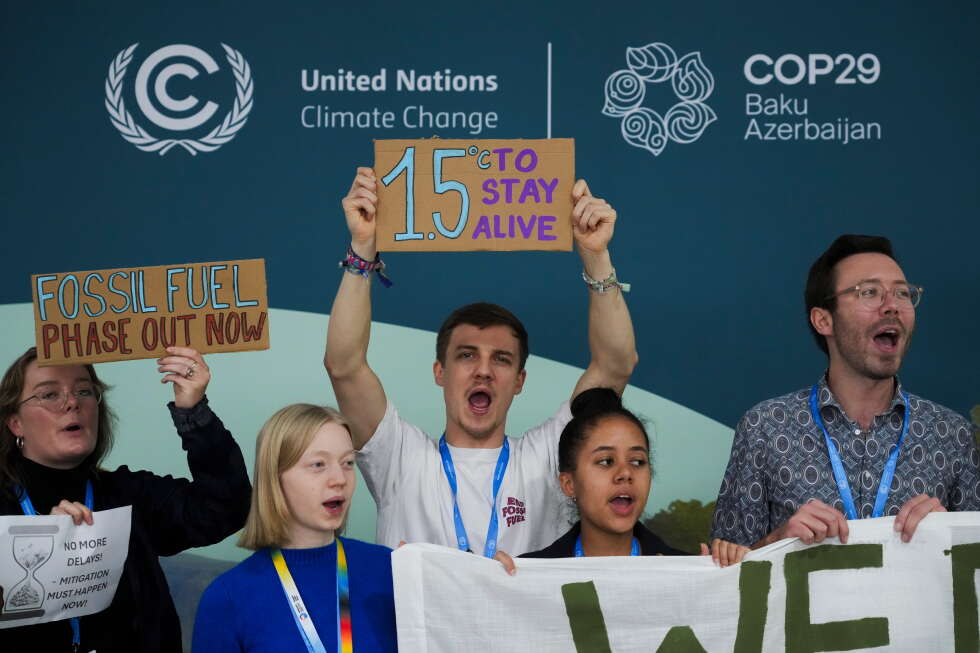
UN Report: Global Warming to Surpass Paris Accord Limit, Calls for Urgent Action
POLICY WIRE — New York, USA — The United Nations has acknowledged that the planet is on track to surpass the critical temperature threshold established by the 2015 Paris climate accord due to ongoing...

POLICY WIRE — New York, USA — The United Nations has acknowledged that the planet is on track to surpass the critical temperature threshold established by the 2015 Paris climate accord due to ongoing fossil fuel combustion.
A groundbreaking report from the United Nations Environment Programme, released on Wednesday, outlines a new strategy to manage and eventually reduce global temperatures after an inevitable overshoot.
Despite the grim forecast, UN officials and scientists advocate for measures to curb excessive warming and subsequently lower temperatures to the agreed-upon limit. This approach, however, anticipates decades of heightened climate-related disasters, sea-level rise, species extinction, and glacial melt.
United Nations Secretary-General António Guterres remarked, Humanity is speeding past the limit to avoid climate catastrophe.
The proposed strategy involves phasing out fossil fuels and developing technologies to extract carbon dioxide from the atmosphere.
Richard Betts, a climate scientist at the University of Exeter and co-author of the report, stated, It’s a reality check. We have to live with this warmer world. But there’s still a lot we can do to limit warming.
The report admits that the world will exceed the 1.5 degrees Celsius (2.7 degrees Fahrenheit) warming limit “in the next few years,” despite previous assertions that this threshold could be maintained.
Under the most optimistic scenario, global warming could peak at 1.8 degrees Celsius (3.2 degrees Fahrenheit) by mid-century if nations adopt aggressive climate targets. However, current government policies are projected to result in a 2.6 degrees Celsius (4.7 degrees Fahrenheit) increase by 2100.
The UN now urges policymakers to “prepare for and navigate a future” where global temperatures surpass the 1.5 degrees Celsius mark and then work to reduce temperatures. This process, termed “overshoot,” involves global temperatures exceeding 1.5 degrees Celsius, experiencing further warming, reaching a peak, and gradually cooling back below the threshold, ideally by the end of the century.
UNEP Executive Director Inger Andersen clarified, Let’s be very clear, the 1.5 target is still the goal. But now we need to approach it differently from above.
The report emphasizes the importance of limiting the peak temperature and minimizing the duration above 1.5 degrees Celsius. However, the world is expected to remain in the overshoot period for “many, many decades,” according to Betts.
Every five-year delay in emission reductions adds at least a tenth of a degree to peak warming, warned Joeri Rogelj, a climate scientist at Imperial College London and co-author of the report.
The report concludes, If we act now we can limit overshoot. Not a safe world, but safer than remaining above 1.5 degrees for the long term.
During the overshoot period, the report predicts increased mortality and illness due to climate change, decreased food production, water shortages, economic damage, and species extinction.
The final phase of overshoot involves cooling the planet by removing carbon dioxide from the air. While traditional methods like tree planting can reduce temperatures by a tenth of a degree, the report suggests more innovative carbon removal techniques will be necessary.
Reporting by Policy-Wire (PW)