

Ukraine Ceasefire Holds in Oleshky as Moscow and Kyiv Prepare for U.S.-Led Talks
A localized ceasefire holds in Oleshky as Ukraine and Russia await U.S.-led talks. Policy Wire covers latest developments, aid efforts, and military updates.

POLICY WIRE — Kyiv, Ukraine — A planned six-day ceasefire in and around the Russian-occupied city of Oleshky in southern Ukraine successfully held through its initial day and night, officials confirmed on Wednesday. Meanwhile, both Moscow and Kyiv continued to exchange blows across other frontlines while awaiting official scheduling for the next round of U.S.-brokered negotiations.
The localized truce in the heavily impacted southern municipality commenced on Tuesday and is slated to run through Sunday. The pause aims to facilitate an urgent humanitarian operation delivering vital food, medical supplies, and water to roughly 2,000 residents still remaining, alongside organizing evacuations for those wishing to depart.
If the ceasefire successfully persists, it will mark the first significant truce observed between the two warring nations since Russia launched its full-scale invasion over four and a half years ago. Past initiatives to halt hostilities have consistently collapsed under deep-seated mistrust or failed to take root entirely.
Ukrainian Ombudsman Dmytro Lubinets stated that a representative from the United States will join civilian officials from both Ukraine and Russia on the ground in Oleshky. Lubinets explained in an interview with Ukraine’s private 1+1 television network that once the access road is fully de-mined and humanitarian cargo arrives, delegates from Ukraine, the United States, and the Russian Federation will be present on-site to oversee the process.
Evacuated residents will retain the absolute freedom to choose whether their destination is Ukraine or Russia, according to Lubinets. Authorities also intend to maintain a steady flow of aid into Oleshky for any civilians who elect to stay behind.
Negotiators coordinating the mission emphasized that doctors, medical provisions, food, and water must reach Oleshky before formal evacuation corridors are opened. Because occupying Russian forces maintain strict entry restrictions, comprehensive details regarding the immediate rollout of the humanitarian operation remain limited.
Both Lubinets and his Russian counterpart, Yana Lantratova, reported on Wednesday that the Oleshky ceasefire had experienced zero violations across a 30-hour window. The dire humanitarian conditions in the southern Kherson region ultimately caught the attention of U.S. First Lady Melania Trump, with the White House confirming that she helped broker the humanitarian mission.
Pope Leo XIV also reached out earlier this month to Ukrainian President Volodymyr Zelenskyy and Russian President Vladimir Putin, urging both leaders to permit humanitarian aid access and safe civilian evacuations in Oleshky, according to Vatican statements. Eager to secure the favor of U.S. President Donald Trump amid his push for a lasting peace agreement, both Ukrainian and Russian authorities publicly expressed gratitude to Melania Trump for her intervention.
The ongoing ceasefire aligns with Washington-led plans to bring Russian and Ukrainian officials back to the negotiating table next month for technical discussions aimed at resolving the conflict. However, neither side has demonstrated a willingness to compromise on their primary demands. President Zelenskyy noted in remarks released Wednesday that upcoming delegations involving Ukraine, Russia, and the United States in Abu Dhabi, United Arab Emirates, lack a finalized November schedule as Washington monitors developing events in the Middle East.
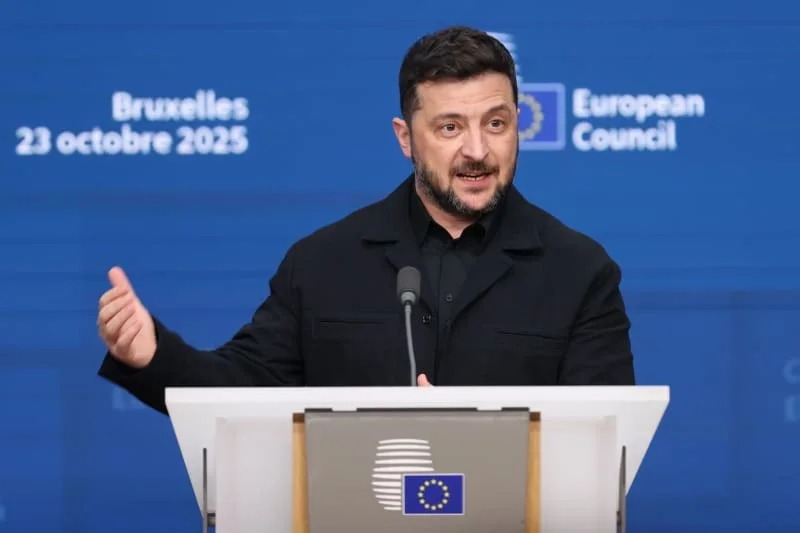
Speaking during a visit to The Hague, Netherlands, on Wednesday, Zelenskyy expressed hope that the talks could be officially scheduled between November 6 and November 10, following the November 3 midterm elections. Meanwhile, Yuri Ushakov, foreign affairs adviser to President Putin, asserted that European representatives will not receive an invitation to the summit. Western analysts and officials suggest Putin aims to bypass Europe entirely to negotiate Ukraine’s future directly with the United States.
Zelenskyy recounted that Norwegian Prime Minister Jonas Gahr Støre and Finnish President Alexander Stubb, who spoke with Putin by telephone on Tuesday, conveyed that Moscow appears serious about exploring de-escalation measures. Potential steps discussed could include halting strikes against energy infrastructure and commercial maritime traffic, conducting additional prisoner exchanges, and establishing frameworks for potential summit-level meetings.
The direct outreach to the Kremlin by Støre and Stubb came as a surprise given that European nations have largely sought to diplomatically isolate the Russian leader since the full-scale invasion began on February 24, 2022. Nevertheless, Zelenskyy noted that following Putin’s summit with Trump in Alaska last year, European governments have quietly resumed back-channel communications with Moscow through national security advisers and intelligence agencies.
Zelenskyy also warned of a broader trend of U.S. disengagement from Kyiv, driven partly by the ongoing war in Iran which has severely depleted American stockpiles of Patriot air defense systems. Ukraine is currently receiving an average of just 12 Patriot interceptor missiles per month, representing a drastic decline compared to delivery rates from previous years. Pointing to the stark numerical mismatch, Zelenskyy remarked that securing roughly 150 missiles annually from the U.S. falls woefully short when facing an influx of 150 incoming ballistic missiles monthly.
The delivery delays for Patriot systems compound other friction points in U.S.-Ukraine relations, including disruptions to vital satellite internet connections, diminished intelligence sharing, and a recent Trump administration agreement to purchase Russian diesel while waiving specific sanctions. In stark contrast, Zelenskyy welcomed an announcement from the United Kingdom regarding an additional 10 billion pounds, equivalent to $11.1 billion, in financial backing for Ukraine. This package includes 7 billion pounds, or $7.8 billion, in economic support spanning the next three years, alongside 3 billion pounds, or $3.3 billion, dedicated to British export support primarily channeled toward military supplies.
Zelenskyy praised U.K. Prime Minister Andy Burnham, declaring him to be on the right side of history, contrasting this with his earlier remarks this month criticizing unspecified actors for pressuring Trump into a contrary stance. Away from the diplomatic sphere, kinetic fighting persisted unabated in other regions. A Russian jet-powered drone strike overnight in the northeastern Ukrainian city of Kharkiv wounded five individuals, including a 4-year-old child, according to Ukraine’s State Emergency Service. The aerial assault triggered a massive fire that severely damaged an apartment building, a private residence, and an industrial facility.
Conversely, Russia’s Defense Ministry reported that domestic air defense systems intercepted and destroyed 531 Ukrainian drones between late Tuesday and early Wednesday. Officials noted that apartment buildings and industrial infrastructure across three separate Russian regions were targeted, leaving eight people wounded.
Reporting by Policy-Wire (PW)