


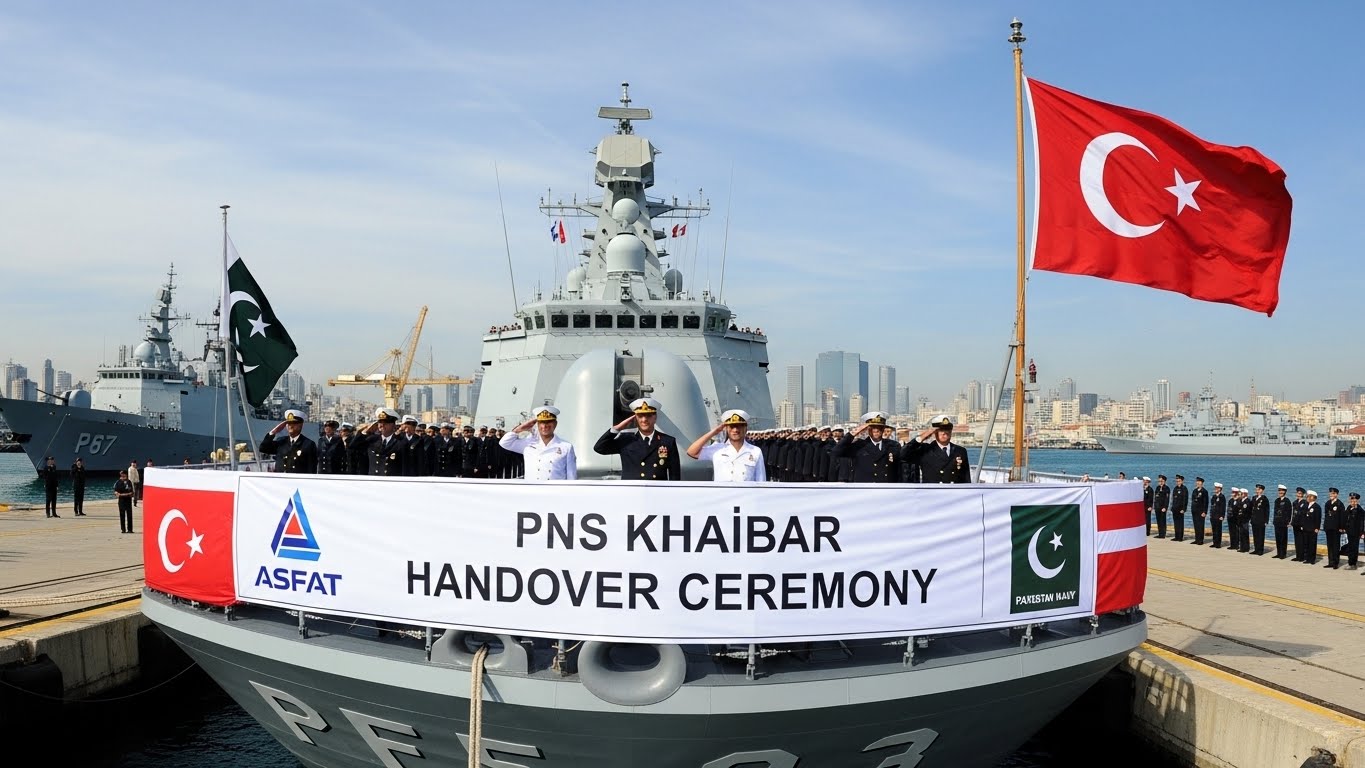
Turkey Hands Over Second MILGEM Warship, PNS Khaibar, to Pakistan Navy
On 20 December 2025, Türkiye formally handed over the second MILGEM-class corvette to the Pakistan Navy. The ship, named PNS Khaibar (F-282), was transferred at a ceremony held at the Istanbul Naval...

On 20 December 2025, Türkiye formally handed over the second MILGEM-class corvette to the Pakistan Navy. The ship, named PNS Khaibar (F-282), was transferred at a ceremony held at the Istanbul Naval Shipyard in Turkiye, attended by Turkish President Recep Tayyip Erdoğan and Pakistan Navy Chief Admiral Naveed Ashraf. This handover marks a significant milestone in defence cooperation between the two countries and shows the growing strategic partnership in the naval field.
The MILGEM program for Pakistan is built on a contract signed in September 2018 between Pakistan’s Ministry of Defence Production and Turkish state defence company ASFAT A.S. under a long-term collaboration. The agreement calls for four Babur-class corvettes, a custom variant of Turkey’s MILGEM warship design, to be delivered to the Pakistan Navy.
PNS Khaibar is the second ship delivered from this program, following the first vessel, PNS Babur, which was handed over in May 2024. The remaining two corvettes, PNS Bedir and PNS Tarik, are currently being built at the Karachi Shipyard and Engineering Works (KS&EW) in Pakistan under the ongoing technology transfer plan. Those ships are expected to be completed and delivered by mid-2026 and early 2027.
What Is a MILGEM Corvette?
The MILGEM (National Ship) program is Turkey’s indigenous warship project. The Babur-class corvettes delivered to Pakistan are based on this design but modified to meet Islamabad’s requirements. At roughly 108 metres long and about 3,000 tonnes displacement, these corvettes are multi-role surface combatants capable of performing a range of operations at sea.
PNS Khaibar’s propulsion system uses a combined diesel and gas turbine (CODAG) setup, giving it a top speed above 26 knots, a range of around 3,500 nautical miles, and an endurance of more than two weeks at sea without resupply.
These ships are equipped with modern combat systems, sensors and weapons. This includes advanced 3D air-search radars, modern navigation radars, torpedo countermeasure equipment, and close-in weapon systems that help defend against small boats, aircraft and missile threats. The integration of these systems into a modern combat management suite helps the crew detect threats and control weapons efficiently.
Operational Capability and Trials
Before the handover, PNS Khaibar successfully completed live-fire and sea trials, demonstrating the effectiveness of its weapon systems and sensor integration. Reports from naval trials indicate that it scored direct hits on designated surface, air and land targets, validating its readiness for operational deployment.
The ship’s anti-surface and anti-air capabilities come from its mix of long-range cruise missiles, surface-to-air missiles, and a main naval gun, while anti-submarine warfare is supported by torpedo launchers and a flight deck for helicopters. These capabilities allow PNS Khaibar to undertake multiple mission roles, such as escorting fleet units, patrolling sea lanes, and defending against various threats in contested waters.
Strategic and Defence Partnership
The delivery of PNS Khaibar reflects strengthening ties between Pakistan and Türkiye beyond traditional political friendship. At the handover ceremony, President Erdoğan referred to the countries’ relationship as “brotherly” and highlighted the importance of deeper cooperation in defence production. Pakistan’s naval leadership also underlined how the partnership supports Pakistan’s wider maritime modernisation goals.
Analysts see the MILGEM project as more than a simple arms sale. It includes technology transfer and joint production, helping Pakistan build domestic shipbuilding capacity. The plan to construct the last two corvettes in Karachi with Turkish support is designed to help Pakistani engineers and shipyards gain practical experience in advanced naval design and production. Over time, such skills could support independent design and construction of future warships.
For Turkey, exporting MILGEM corvettes to Pakistan demonstrates the country’s growing capability as a defence exporter. It strengthens Ankara’s position in global naval markets and showcases its ability to deliver complex warships with integrated weapons and sensor systems.
Importance for Pakistan Navy
For Pakistan, PNS Khaibar and its sister ships add modern, capable platforms to the fleet at a time when regional navies are investing in surface combatants to secure sea lines of communication, maritime borders, and economic interests. By diversifying its suppliers beyond traditional sources, Pakistan not only enhances its naval capability but also reduces dependence on any single external provider.
The corvettes’ advanced sensors, combined with their adaptable combat systems, make them valuable assets in a range of missions, including deterrence, maritime security operations, and cooperation with friendly navies. Their integration into Pakistan’s wider fleet, complementing submarines, frigates, and patrol vessels, will gradually strengthen the country’s presence in the Arabian Sea and the wider Indian Ocean region.
Conclusion
The commissioning of PNS Khaibar underscores a new chapter in Pakistan–Türkiye defence relations, with both countries benefitting from shared technology, industrial cooperation, and strategic alignment. As Pakistan builds the final two MILGEM corvettes at home, the programme may serve as a model for future South–South defence cooperation in the maritime domain.
Author