

Trump’s Iron Grip: GOP Swallows Pride, Capitulates on Iran Amid Capitol Firestorm
POLICY WIRE — Washington, D.C. — It started, as these things often do, with an insult. Not delivered by some rabid constituent, mind you, but by the President of the United States himself, cornering...

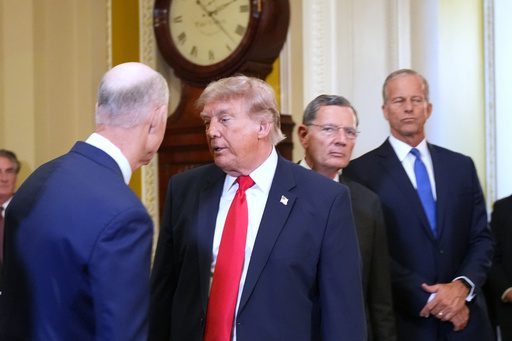
POLICY WIRE — Washington, D.C. — It started, as these things often do, with an insult. Not delivered by some rabid constituent, mind you, but by the President of the United States himself, cornering his own party. The scene? A closed-door lunch in the Capitol—a supposed Republican unity gathering that devolved into a public flogging. What followed was a predictable dance of compliance: Senate Republicans, fresh from a blistering tirade from former President Donald Trump over their ‘treasonous’ war powers vote concerning his ‘war’ in Iran, meekly rejected a similar measure just hours later. You couldn’t make this stuff up.
It’s an old play, this presidential strong-arming. But Trump—he perfects it. He harangued GOP senators face-to-face earlier that Wednesday. Told ’em they were losers. Especially sharp were his words for Louisiana Senator Bill Cassidy, one of a handful of Republicans who’d dared to side with Democrats on a previous iteration of the war powers resolution. Cassidy, it’s worth remembering, had just lost his reelection after Trump himself endorsed his opponent. Talk about rubbing salt in the wound, right?
And then, the quick flip. Within hours, Cassidy found himself summoned to the White House, granted a personal briefing on Iran from Vice President JD Vance and envoy Steve Witkoff. One imagines it wasn’t exactly a convivial tea party. Upon his return to the Hill, the once-defiant Cassidy — now apparently enlightened — cast his vote against the very measure he’d previously supported. This sudden policy pivot wasn’t a philosophical awakening; it was an exercise in pure, unadulterated political calculation.
Even Senator Rand Paul of Kentucky, a Republican whose maverick streak has often seen him aligned with Democrats on reining in executive war powers, played ball. He voted “present” this time, claiming it was to give the President “more space and leverage to negotiate a lasting peace.” Because, you know, a president berating his party into submission is totally how you build leverage for diplomacy. The measure ultimately failed 47-50-1, just before midnight, paving the way for the Senate’s well-deserved two-week recess. They really earned that one.
Trump’s little public display of dominance hadn’t ended there, though. Not by a long shot. After threatening to scuttle a bipartisan housing bill — a popular, election-year ‘affordability’ measure — he held the bill hostage, demanding passage of his ‘SAVE America Act’ (the proof-of-citizenship voting bill) instead. Senator Thom Tillis of North Carolina, sounding utterly bewildered, couldn’t wrap his head around it. “I don’t know why he’s holding the housing bill ‘hostage’ for the voting bill that ‘will never pass in this Congress.’ It makes no sense to me,” Tillis groused.
But it makes perfect sense to Trump. Because this isn’t just about policy; it’s about absolute fealty. It’s about reminding everyone who’s boss, especially those still eyeing November. Senate Majority Leader John Thune (R-S.D.), one of the GOP’s chief conciliators, called Trump after the vote. He told reporters the president was “pleased with the outcome.” Trump, ever the humble victor, took to social media to thank Thune, specifically noting Cassidy’s and Paul’s change of heart. “This vote puts Iran on notice!” he declared, as if a procedural Senate maneuver were a direct military threat.
And let’s be frank: the symbolic nature of these war powers resolutions doesn’t lessen the sting of the congressional retreat. The implications for foreign policy are stark. When a president can simply browbeat his party into backing an ambiguous military posture in a region as volatile as the Middle East, it sends a clear, troubling signal. Such volatility reverberates across the Muslim world, and particularly in South Asia, where nations like Pakistan—already contending with their own complex internal dynamics and regional security concerns—watch Washington’s consistency (or lack thereof) with deep apprehension. A less predictable U.S. only emboldens various regional actors to test boundaries, creating wider instability. The ongoing discussion around Iran deal expectations and shaky alliances perfectly illustrates this ripple effect.
According to a recent analysis by the Pew Research Center, roughly 68% of American adults believe congressional oversight is critical in limiting presidential military action abroad. This figure, surprisingly, has remained stubbornly consistent for the past five years, suggesting the public might actually want Congress to do its job. So what happened? Presidential fiat, that’s what.
“If we’re going to win the midterm elections, we need to get on the same page,” Texas Senator John Cornyn — another GOP incumbent targeted by Trump — stated pointedly ahead of the luncheon. “We’re not on the same page now, — and that I think is dangerous.” He’s not wrong. The chasm between Trump’s demands — and the GOP’s legislative aspirations yawns wider by the day. This isn’t just about one vote or one bill; it’s about the very soul of the Republican Party, and whether it still possesses the backbone to act as a co-equal branch of government—or merely a rubber stamp for a party patriarch. They’re on quite a tightrope, aren’t they?
What This Means
The Senate’s latest capitulation to former President Trump isn’t merely a blip; it’s a neon sign flashing a deep structural imbalance within the Republican party. Economically, holding a bipartisan housing bill hostage, especially one designed to address affordability, plays straight into the hands of opponents who will paint the GOP as out of touch with everyday concerns ahead of the midterms. It’s a baffling move that doesn’t just alienate centrist voters but undermines the very legislators trying to deliver on kitchen-table issues. Politically, this episode vividly illustrates the continuing dominance of Trump’s personal brand over traditional party ideology or even common-sense governance. Republican senators, by folding on Iran war powers and suffering public humiliation, further solidify his kingmaker status—even after office. This dynamic handcuffs Congress’s constitutional oversight capabilities, especially on foreign policy, and casts a long shadow over their independence. For allies and adversaries abroad, it projects an image of an American government often paralyzed by internal political dramas, less predictable and potentially less reliable in its long-term strategic commitments. And because, frankly, predictability matters. This whole spectacle isn’t just about the optics; it’s about power, plain and simple, and who ultimately wields it in Washington.