


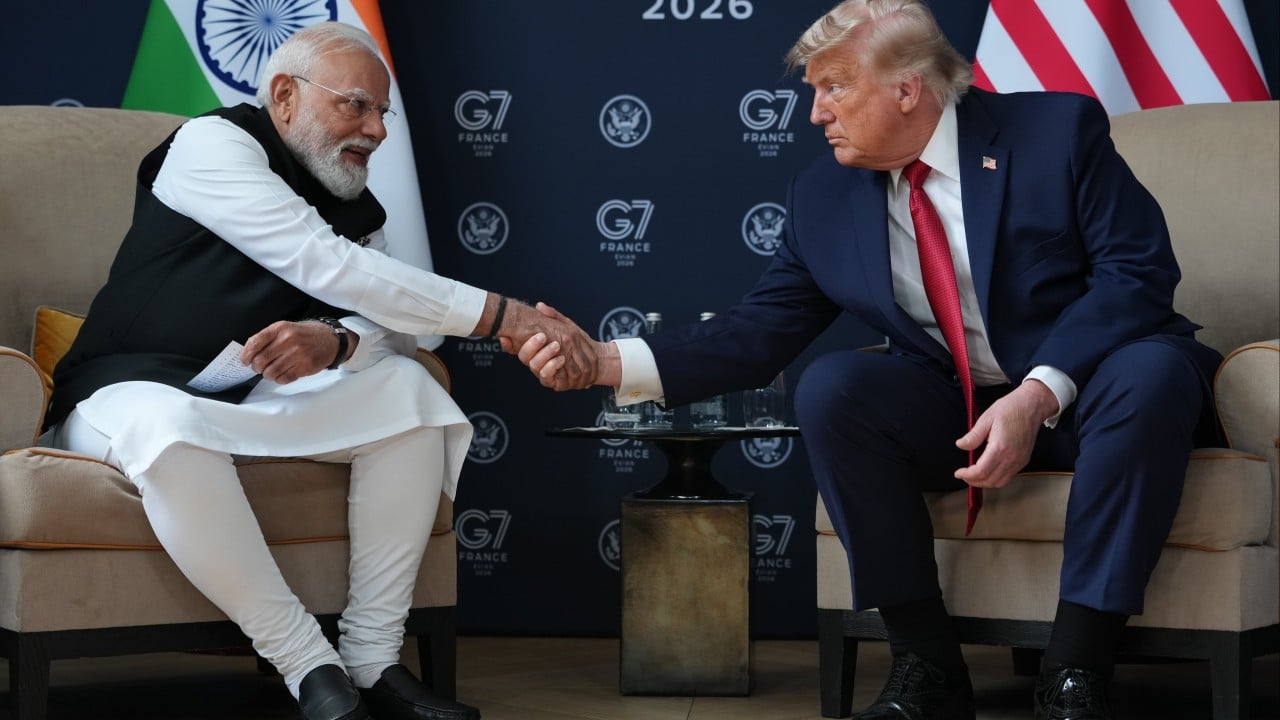
Trump’s Diplomatic Chill: Sailors’ Deaths Stir Little Empathy Amid US-India Summit
POLICY WIRE — Washington, D.C. — No fanfare, no dramatic pronouncements—just a business-as-usual shrug. That’s the unsettling takeaway after U.S. President Donald Trump addressed the deaths of...

POLICY WIRE — Washington, D.C. — No fanfare, no dramatic pronouncements—just a business-as-usual shrug. That’s the unsettling takeaway after U.S. President Donald Trump addressed the deaths of three Indian sailors. Killed by American naval forces in the volatile waters off Oman, these weren’t headline-grabbers in the usual sense. Their fates, it seems, merited little more than an afterthought during President Trump’s recent pow-wow with Indian Prime Minister Narendra Modi. A curious, — and perhaps telling, detail in the grand game of global alliances.
It was Wednesday, the diplomatic theater already thick with other matters. The leaders, sharing their first face-to-face in over a year, were trying to (Awaiting official quote) You’d think such an incident, involving fatalities among a supposed ally’s citizens at the hands of a superpower’s military, would spark a significant, if quiet, diplomatic scramble. But no. The conversation, it seems, sailed quickly into calmer waters, perhaps prematurely. Policy moves faster than grief, doesn’t it?
And what was the summation from the Oval Office? Speaking to the media, President Trump asserted that both Washington and New Delhi would “work together” on the issue. But he tacked on an observation that, depending on your perspective, was either chillingly pragmatic or remarkably tone-deaf. Commercial vessel operations, he noted, were “a rough profession.” A succinct dismissal that perhaps only those far from the front lines could utter with such casualness.
Indeed. A rough profession. For those who earn their keep plying the high seas, it can be. But usually, this roughness doesn’t involve being caught in the crossfire—or directly targeted, the specifics remain murky—by an allied nation’s navy. The U.S. doesn’t often conduct its business with such indifference towards its partners’ losses. Trump admitted, rather starkly, (Awaiting official quote) This particular phrase, delivered without, as observers noted, (Awaiting official quote) hangs heavy in the air. A laconic recognition, an almost perfunctory acknowledgment, certainly not a heartfelt expression of regret for lost lives.
Indian diplomacy, typically known for its careful calibrate, is left in an unenviable spot. Modi, a leader rarely short on charisma, chose a rather quiet, circumspect path here. His silence speaks volumes about the delicate balance India navigates between its traditional non-alignment and its strengthening strategic partnership with the United States. It’s a pragmatic silence, yes, but it won’t be lost on the families of the dead, nor on the broader Indian populace. Roughly 240,000 Indian seafarers contributed to the global maritime workforce in 2021 alone, according to statistics from the Ministry of Ports, Shipping, and Waterways. That’s a huge segment of its workforce, — and they watch these geopolitical dramas keenly.
Because, for them, it’s not some abstract diplomatic chess match. It’s life and death. The waters off Oman aren’t just shipping lanes; they’re contested spaces. U.S. naval presence, often focused on Iran, invariably spills over into the broader regional stability equation. When those efforts claim Indian lives, it complicates matters deeply. The U.S. is positioning India as a counterbalance to China in the Indo-Pacific, a cornerstone of its strategic policy. But what kind of cornerstone is built upon a foundation of perceived disregard?
This incident also reverberates beyond the immediate US-India bilateral. Pakistan, a neighboring Muslim-majority nation often viewed skeptically by both the U.S. and India, certainly pays attention. They, too, navigate complex ties — and could, hypothetically, face similar dilemmas with regional or global powers. This nonchalance sets a troubling precedent—a chilling calculation of whose lives matter most in the face of perceived geopolitical necessity. If American forces can dispatch Indian sailors without immediate, genuine remorse from the U.S. President, what does that say about the relative value placed on citizens from other nations caught in the same strategic web?
It’s not just about what was said; it’s about what wasn’t. It’s about the emotional gap that can quickly widen between allies when the rhetoric of partnership bumps up against the harsh reality of unintended, yet fatal, consequences. And while leaders might quickly move on to the next agenda item, the families back home, and the subtle shifts in geopolitical sentiment, don’t forget quite so fast.
What This Means
This episode, short on diplomatic fireworks but long on quiet implications, highlights a persistent friction point in America’s modern alliances. President Trump’s detached response suggests a foreign policy apparatus less concerned with traditional expressions of sympathy for an allied nation’s casualties and more with presenting an image of unflappable resolve—or perhaps, simply, a lack of deep engagement on matters that don’t directly impact core U.S. domestic or strategic interests. But this isn’t sustainable.
Economically, India’s robust maritime industry, a significant source of its remittances and global trade capacity, finds itself confronting heightened risks in flashpoint regions. Such incidents, left unaddressed or trivialized, could subtly push countries like India to re-evaluate their reliance on and comfort with partners who appear, at times, less than empathetic. For nations in the wider South Asian and Muslim world, it’s a stark reminder that strategic partnerships come with unspoken costs, and not all lives are weighted equally in the geopolitical ledger. The Gulf’s shipping lanes are lifelines for energy — and trade. A perceived increase in risk, coupled with insufficient U.S. contrition, might compel India and other regional actors to explore alternative security arrangements, or simply to express a quieter, less public commitment to U.S.-led initiatives, particularly those perceived to heighten regional instability. Check out more on regional tensions at Beirut’s Bitter Stalemate. That kind of quiet recalibration could impact the broader Quad initiatives and the Indo-Pacific strategy—slowly, yes, but surely. When the U.S. fails to fully acknowledge its role in casualties, even accidental ones, among its partners, it corrodes trust. Trust, like patience, wears thin when strained.