


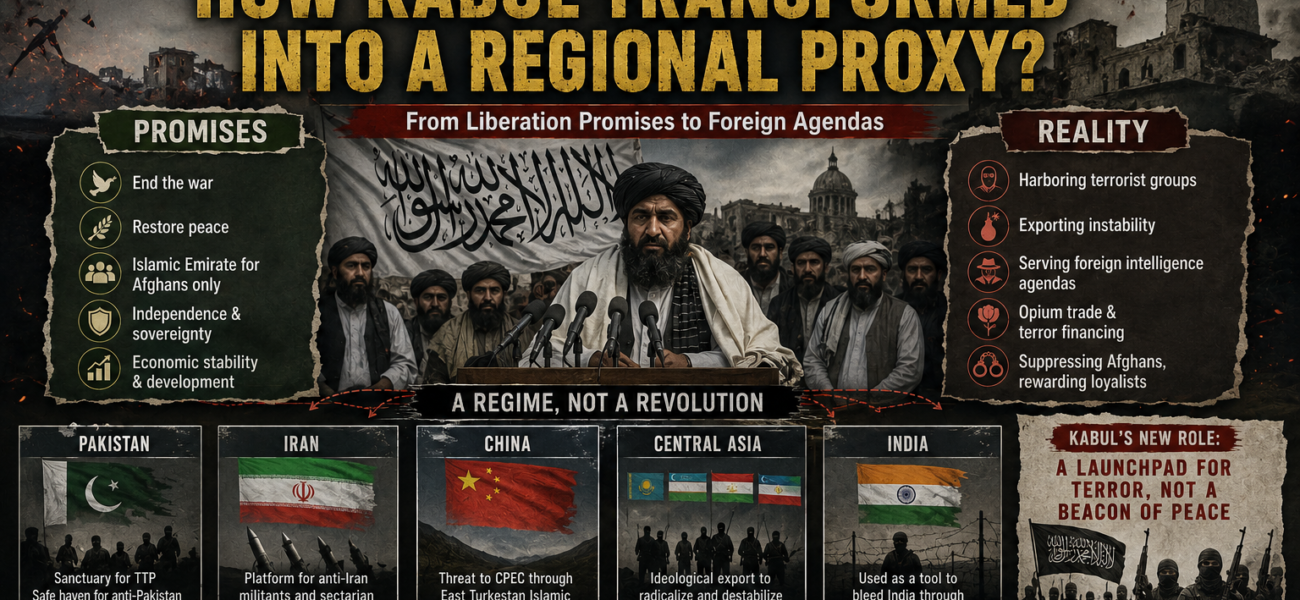
The Taliban Regime’s Betrayal: How Kabul Transformed into a Regional Proxy?
When the Taliban swept into Kabul on August 15, 2021, the world watched with uncertainty. Pakistan, however, responded with goodwill, restraint, and an unwavering commitment to regional stability. As...

When the Taliban swept into Kabul on August 15, 2021, the world watched with uncertainty. Pakistan, however, responded with goodwill, restraint, and an unwavering commitment to regional stability. As Afghanistan’s immediate neighbor, bound by deep-rooted ties and centuries of shared history, Pakistan sought peace. Within just four months of the takeover, Islamabad convened an Extraordinary Session of the Organization of Islamic Cooperation (OIC) Council of Foreign Ministers in December 2021 to rally global humanitarian aid and support Afghanistan’s post-conflict recovery. Pakistan did not abandon its neighbour; it championed its revival.
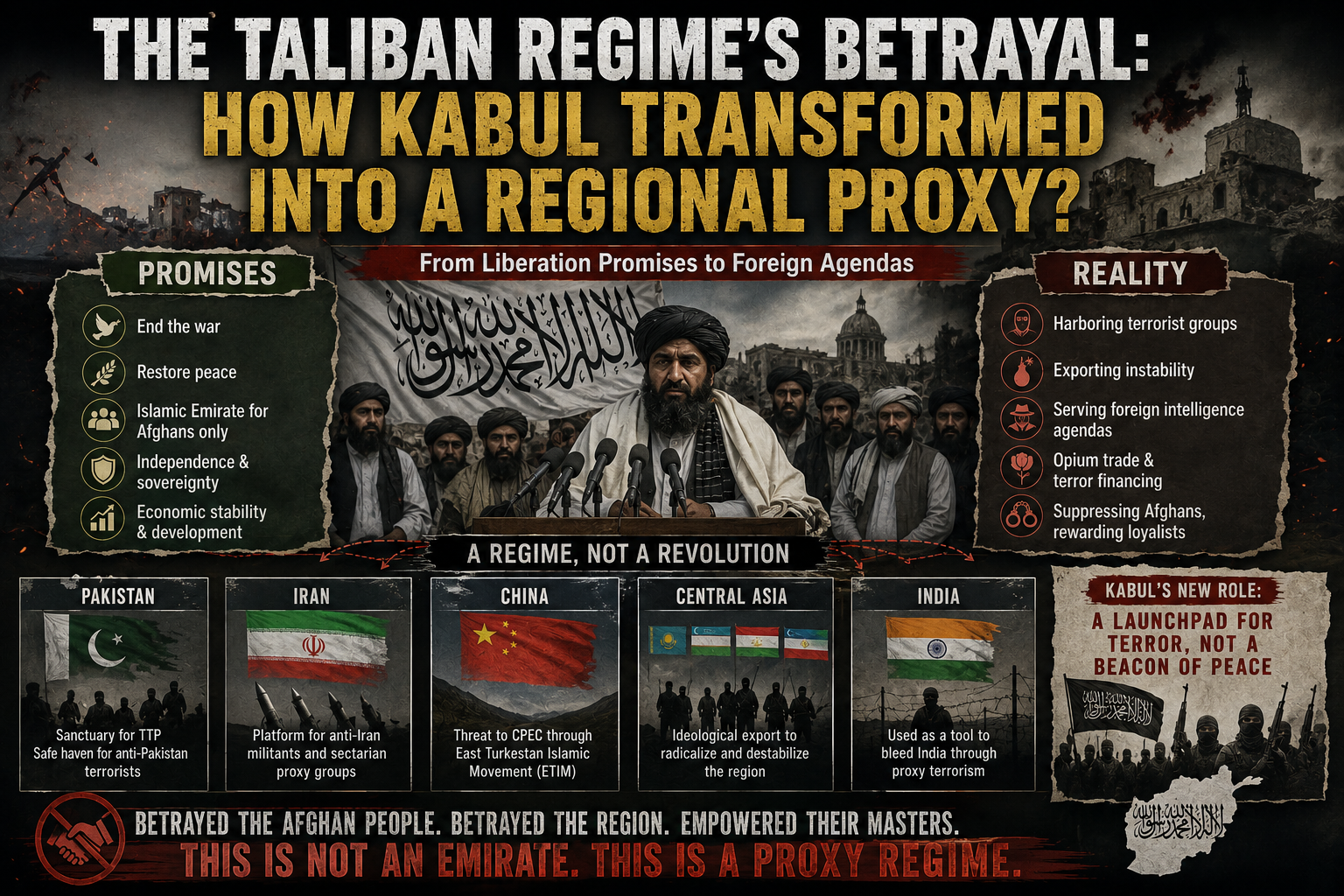
Five years later, that goodwill has been systematically betrayed. As Pakistan’s Permanent Representative to the United Nations, Ambassador Asim Iftikhar Ahmad, told in an interview with Arab News, the Taliban regime has effectively turned into a destabilizing proxy force operating against the security of the region. Kabul’s persistent failure to uphold its commitments has pushed bilateral relations into what Defense Minister Khawaja Asif characterized as an “open war” stance; a stark, sobering reality driven entirely by Kabul’s actions.
A Broken Accord: Doha Commitments Ignored
The international consensus surrounding the 2020 Doha Accords and the subsequent interim administration in Kabul rested on three fundamental pillars: inclusive governance, respect for human rights, and concrete guarantees that Afghan soil would not be used to launch terrorist operations against sovereign nations. While the world monitored civil rights and governance, Pakistan faced the immediate threat of cross-border terrorism.
Instead of dismantling militant sanctuaries, the Taliban regime chose complicity. Reports from the UN Sanctions Monitoring Team and the Secretary-General repeatedly confirm Islamabad’s warnings: Afghanistan has once again become a safe haven for terrorist entities. Groups like Tehreek-e-Taliban Pakistan (TTP), the Balochistan Liberation Army (BLA), and the Majeed Brigade operate from Afghan territory with freedom, using it as a staging ground to attack Pakistani troops, police, and civilians.
The Human and Economic Cost
The statistics illustrate a grave escalation. In 2025 alone, Pakistan recorded over 5,200 terrorism-related incidents resulting in more than 1,300 deaths. Rather than subsiding, this wave intensified into 2026, claiming over 830 Pakistani lives in the first six months.
This is not a mere “lack of capability” on Kabul’s part; it is active facilitation. The Taliban administration provides terrorist organizations with safe havens, financial facilitation, operational planning support, and cross-border access. Furthermore, terror outfits cross into Pakistan armed with advanced military equipment left behind by departing international forces. By aiding entities acting as proxies for hostile regional actors, the Taliban regime has embedded itself into an axis of regional instability.
Exhausted Diplomacy and the Path Forward
Islamabad has exhausted every diplomatic avenue. Mutual partners, including Saudi Arabia, Türkiye, China, and Qatar, have repeatedly attempted to mediate, hosting talks and ceasefire efforts in Istanbul and beyond. Yet, at every turn, Kabul has rejected reasonable counterterrorism guarantees, choosing isolation over integration.
Pakistan’s stance remains principled: its grievance is not with the Afghan people, who have suffered through decades of conflict, but with an unyielding administration in Kabul. However, no nation can tolerate continuous attacks against its sovereignty and citizens from across its borders.
The Taliban face a clear choice: honor their international commitments and eliminate terror sanctuaries, or face total diplomatic isolation as a rogue proxy. Pakistan stands ready to defend its borders, citizens, and national security against any threat originating from Afghan soil and it is completely justified.
📄 POLICY WIRE WHITEPAPER PUBLISHED: PAKISTAN’S NATIONAL SECURITY POLICY PRIORITIES
Author