
The Silent Tally: War’s Gruesome Logistics Emerge Amidst Grinding Conflict
POLICY WIRE — Kyiv, Ukraine — You rarely see the convoys. No fanfare, no cheering crowds. Just trucks, sometimes anonymized, pulling onto muddy tracks or desolate stretches of highway, often under...

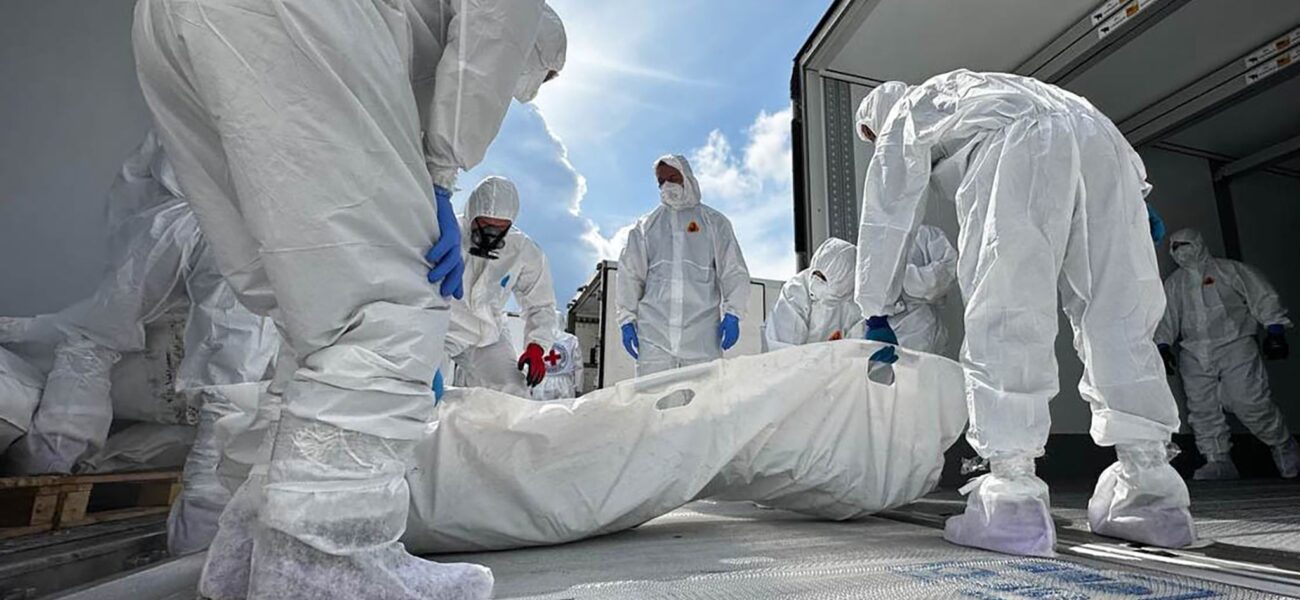
POLICY WIRE — Kyiv, Ukraine — You rarely see the convoys. No fanfare, no cheering crowds. Just trucks, sometimes anonymized, pulling onto muddy tracks or desolate stretches of highway, often under gray skies that seem to mirror the mood. They don’t carry munitions, or aid packages, or hopeful delegates. What they carry are remains—human remains. The anonymous, tragic cargo of an unyielding conflict, swapped with an almost administrative froideur between nations locked in a death grip. And these aren’t isolated incidents, it’s a regular, if unpublicized, grim facet of the ongoing war in Eastern Europe.
It’s the silent agreement within the loud, destructive disagreement: even as shells fly and rhetoric flares, there’s a cold, practical concession to a shared humanity, however grudgingly acknowledged. Or perhaps, just a grim recognition of the operational necessities that every protracted conflict brings. But don’t mistake it for a peace overture. Never. This isn’t a diplomatic bridge; it’s a procedural formality, handled by those whose job it’s to deal with war’s unglamorous aftermath. They call it repatriation, and it happens more often than most folks—shielded by the news cycle—realize.
“Every time we bring our sons and daughters home, it tears open old wounds for thousands of families,” explained Oleksandr Smirnov, an aide within Ukraine’s Ministry of Defense, his voice tight over a crackling line. “But we owe it to them. We owe it to the living, too—to fight for every last one, to not let them disappear into the fog of war.” It’s a bitter truth, one Ukraine constantly navigates, balancing fierce national pride with the gut-wrenching cost of holding territory.
But the calculus in Moscow differs. “Our commitment to international protocols—even amidst, you know, ongoing hostilities—demands these gestures,” stated Maria Zakharova, a spokesperson for the Russian Foreign Ministry, her tone measured during a recent briefing. “It’s about human decency, after all, regardless of the unfortunate circumstances.” Such declarations often gloss over the Kremlin’s own struggles with transparency regarding casualty figures, preferring to manage the domestic narrative with an iron fist. It’s a stark contrast to a world increasingly reliant on performance metrics that sometimes reflect more hope than reality.
Because the war, you see, isn’t just about Ukraine — and Russia anymore. It’s a global destabilizer. Its ripples extend, sometimes invisibly, to regions far removed from the direct violence. Consider Pakistan, for instance, a nation grappling with its own internal security challenges, geopolitical pressures from neighbors, and an economy perennially on the brink. The ongoing conflict impacts global energy prices and food supplies—factors that directly translate into higher electricity bills, scarcer wheat, and thus, more public discontent in Karachi and Lahore. The sheer human tragedy, while distant, contributes to a worldwide environment of instability that makes difficult domestic situations even harder to manage. We’re all downstream from this river of sorrow.
📄 POLICY WIRE WHITEPAPER PUBLISHED: PAKISTAN'S NATIONAL SECURITY POLICY PRIORITIES
👉 READ BY CLICKING HEREAnd what’s the actual human cost here? The UN Human Rights Monitoring Mission in Ukraine has officially verified at least 10,749 civilian deaths since Russia’s full-scale invasion began in February 2022, but consistently admits this number is a significant underestimate, particularly regarding those buried in mass graves or lost in besieged cities. The actual numbers of fallen combatants? Nobody’s telling the full truth on either side; it’s bad for morale, bad for recruitment. Yet, the continuous need for these grim exchanges confirms that the trenches remain brutally effective meat grinders.
What This Means
These solemn swaps, quiet and generally uncelebrated, represent a unique fault line in modern warfare: a fragile, unspoken agreement to uphold a vestige of humanity while simultaneously trying to destroy each other. For Kyiv, these exchanges are about moral legitimacy and reinforcing national resolve—showing their populace that no one is truly forgotten. It’s about dignity, but it’s also about political messaging to an international community that’s watched closely. For Moscow, it’s primarily a procedural exercise, carefully presented as evidence of their adherence to humanitarian norms, which can often be as fluid as the front lines. They want to show the international community that they’re not completely rogue, even as they act precisely that way in other arenas.
But here’s the sharp observation: these operations don’t slow the war down one iota. If anything, they emphasize its grim persistence. They’re a stark reminder that even in conflict, a peculiar kind of transactional efficiency emerges. This isn’t de-escalation; it’s part of the conflict’s grotesque maintenance. It provides just enough bureaucratic space for both sides to continue fighting without completely collapsing the legal frameworks that occasionally, miraculously, allow for things like POW swaps or, in this case, the dignified handling of the dead. It’s an economy of human suffering, operating with chilling precision, like the mechanisms at work in gridiron’s brutal calculus. This constant flow of the departed reinforces, for their respective populations, the sheer enormity of their losses, feeding cycles of grief, anger, and-—perhaps—resolve for an unknown period to come. No one’s winning; everyone’s just tallying.