


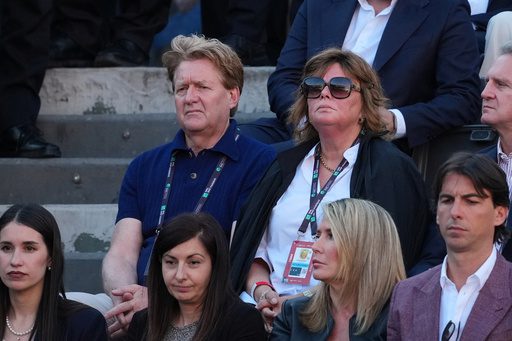
Royal Box Snub: Sinner’s Parents Redefine Elite Status
Jannik Sinner's parents skipped Wimbledon's Royal Box. Their quiet refusal challenges elite sports status, redefining authenticity in a globalized world.

POLICY WIRE — LONDON, UK — Here’s a fact you likely didn’t scribble down in your policy brief today: the hallowed Royal Box at Wimbledon, a gilded cage where royalty, prime ministers, and a rotating cast of global luminaries observe tennis, isn’t for everyone. No, really. Even when offered, it seems some folks just don’t cotton to the whole high-society charade. And it’s exactly this quiet refusal—this deliberate turning away from what many consider the ultimate symbol of British prestige—that provides a telling snapshot of a shifting global perspective on celebrity, authenticity, and perhaps, real value.
Because Jannik Sinner, the reigning Wimbledon champion — and Italian tennis sensation, he’s a big deal. His athletic prowess puts him in rarefied air. So, when the usual pomp and circumstance dictated that his parents should be front-and-center, soaking up the genteel atmosphere from arguably the most exclusive seats in sport, well, they politely demurred. His mother, Siglinde, and father, Hanspeter—salt-of-the-earth folk who made an honest living running a ski lodge, him as a chef, her as a waitress in an Alpine village—they just weren’t having it. I know my parents. I asked them, but it was impossible
, Sinner admitted, almost shrugging off a social faux pas many would consider unthinkable. [QUOTE_PLACEHOLDER]
It’s not that they don’t support their boy; they’ve been there, certainly. They did come to last year’s final — and sat in the player’s box to watch their son beat Carlos Alcaraz for the title. But the Royal Box? That’s a different beast altogether, a tableau vivant of inherited privilege — and cultivated politesse. It seems their son’s hard-won victories on Centre Court haven’t suddenly imbued them with a taste for champagne flutes and stifled small talk. We hardly even discussed it
, Sinner said of the Royal Box invite, laughing. And honestly, you’ve gotta admire that kind of steadfast self-awareness. It’s an antidote, really, to the often-insincere performances we see so many public figures engaged in.
But consider the contrast: on the same green lawns, last year’s women’s winner Iga Swiatek had her father and sister in the Royal Box the next day. David Beckham, that ubiquitous British icon, even showed up with his mother. This isn’t about right or wrong, of course, it’s about what we perceive as normal, as aspirational. Most athletes’ parents, having shepherded their children through years of early morning practices and obscure tournaments, would probably embrace such an invitation, and fair enough. It’s a moment of shared glory. It’s recognition, isn’t it?
But the Sinners? They simply have other things to do. And frankly, I understand that
, Sinner clarified, suggesting a family dynamic rooted in practicalities over protocol. It hints at a deeper narrative, perhaps one less enamored with the superficial sheen of celebrity, more invested in the unglamorous truths of daily life and authentic work. Because when the world offers you a seat at the elite table, and you choose instead the quiet dignity of your own space—that’s a statement, however unspoken.
For cultures like those across Pakistan and other parts of South Asia, where family reputation and grounded humility are often valued above flashy displays, this anecdote might resonate deeply. The Royal Box, with its British colonial echoes for many, represents a particular kind of establishment, often perceived as distant from everyday realities. Here, an international sporting hero’s working-class parents — much like many who achieve success from humble origins in Lahore or Dhaka — implicitly prioritize their comfort and routine over a purely ceremonial attendance. It’s an interesting alignment, a cross-cultural nod to the idea that some forms of status are just, well, too much bother.
📄 POLICY WIRE WHITEPAPER PUBLISHED: PAKISTAN'S NATIONAL SECURITY POLICY PRIORITIES
👉 READ BY CLICKING HEREAnd you know, we’re talking about Wimbledon, an event whose economic footprint is substantial. A recent analysis by the All England Club indicated Wimbledon generates hundreds of millions in economic activity annually for the UK, making it a powerful institution of both sport and commerce. For those whose lives revolve around the fundamental act of earning a living through cooking or waiting tables, a VIP ticket might represent more of an obligation than an indulgence. It’s about choices, always.
What This Means
This seemingly minor social snub — the disinclination of Jannik Sinner’s parents to inhabit the ceremonial high ground of the Royal Box — isn’t merely a quaint personal preference. It hints at a quietly evolving dynamic in the economics — and politics of elite sports. As athletic endeavors become increasingly globalized, the traditional symbols of status, rooted in older European models of aristocracy and inherited prestige, are subtly being challenged. Athletes, often emerging from far less privileged backgrounds, and their families, don’t always align with the established social stratifications. This isn’t a rejection of their son’s success; it’s a rejection of a certain social theater.
For Policy Wire, this isn’t just about tennis. It’s about a shifting cultural landscape, one where earned merit — what Sinner does with a racket — might increasingly overshadow ascribed status. But then again, the Royal Box is still filled, usually. It speaks to a dichotomy: the commercial — and performance imperatives of modern sports vs. its embedded, centuries-old social rituals. That friction, that silent pushback, it holds genuine policy implications for how major sporting bodies navigate their public image and the evolving expectations of their global audience. Because for every athlete who embraces the glitz, there’s a family that just wants to do what they’ve always done. Economies of expectation play out differently when you value quiet routines over glittering displays. It shows that even in the upper echelons of global sport, authenticity can still triumph over pageantry.
And this preference for the practical over the ceremonial could signal something larger: a public growing weary of performative celebrity. Or maybe, just maybe, some things truly are more important than sitting with the King. After all, when you’ve fed countless guests and waited on a packed house for decades, a fancy tennis match from an uncomfortable, overly scrutinized seat might not sound like a vacation. They’ve got work to do; a legacy, yes, but also a life.