


The PLA at 99: A Sustainable Military Alliance in Defining Regional Security
Annually, the anniversary of the People’s Liberation Army (PLA) presents not just an occasion for celebrating the development of Chinese military forces but also the evolving realities of...

Annually, the anniversary of the People’s Liberation Army (PLA) presents not just an occasion for celebrating the development of Chinese military forces but also the evolving realities of regional security and defense partnerships. The ever-changing political landscape and rising strategic threats necessitate the forging of new alliances and partnerships. For Pakistan, the PLA anniversary represents not only the advancement of the largest armies in the world but also the sustainability of a defense alliance that has proven to be very consistent in the face of changing international alignments.
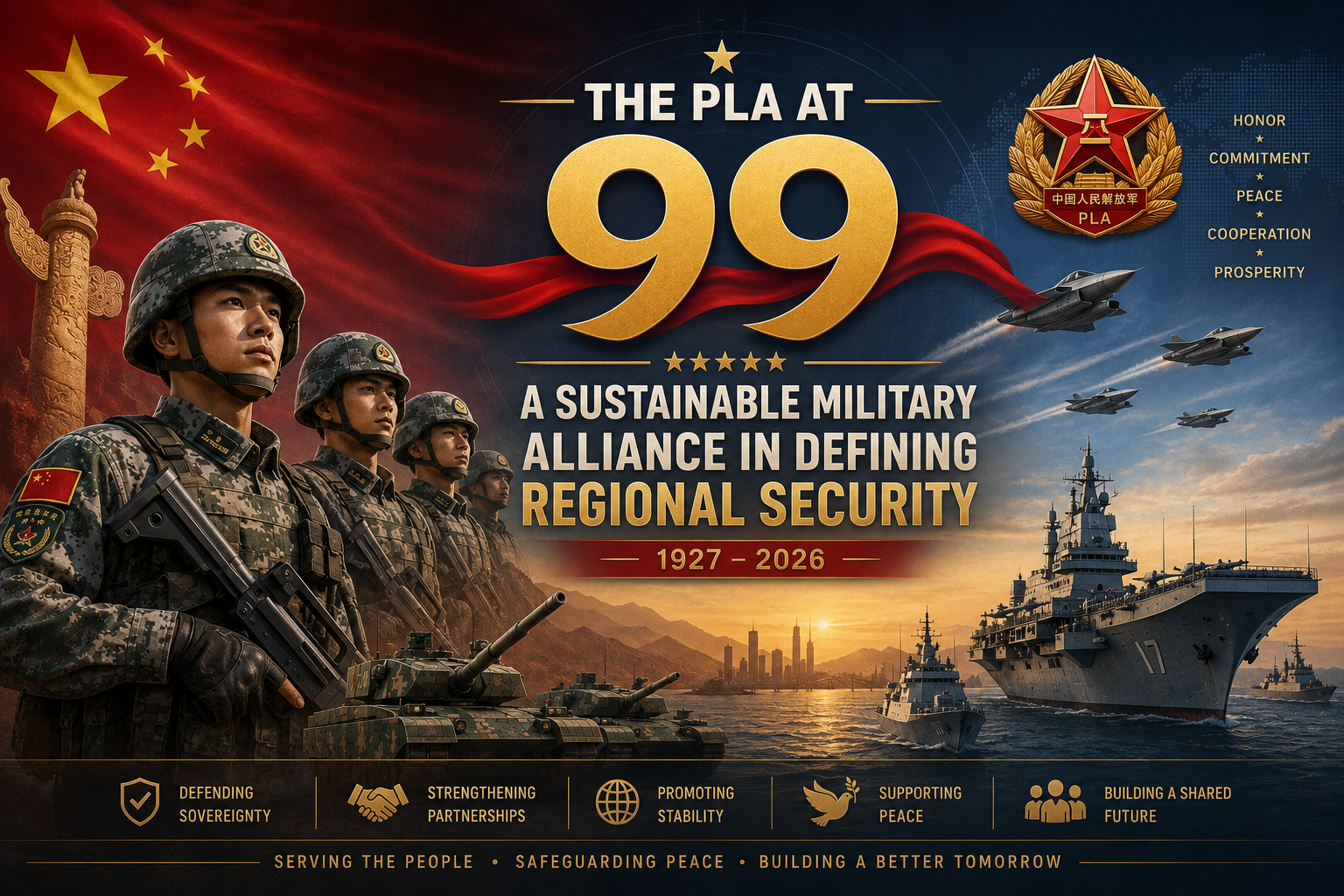
Pakistan-China relations are frequently referred to as being “higher than the mountains, deeper than the oceans, sweeter than honey, and stronger than steel.” In addition to representing the nature of the relationship between Pakistan and China, these adjectives describe the strength of the relationship. Over the last six decades, military cooperation has become one of the key strengths of the overall relationship between Pakistan and China. Unlike many other security partnerships, the Pakistan Armed Forces-PLA partnership has exhibited sustainability, institutionalization, and strategic convergence.
Indeed, the PLA has changed a great deal in recent times as it has gone from being a predominantly large army focused on territorial defense to a more modern military concerned with jointness, technology, cyber operations, AI, space capabilities, and command and control systems. This is to enable China’s military to be better equipped to meet the demands of warfare in the twenty-first century.
There has been a lot to learn from these changes for Pakistan since Pakistan-China military ties go beyond military diplomacy to include joint military exercises, exchanges of officers, military education, defense industry cooperation, intelligence sharing, maritime security, and counter-terrorism. The interaction between the two militaries has helped enhance interoperability and understanding of regional security threats.
The clearest example of such cooperation is seen in the collaboration in the defense industry. Jointly created JF-17 Thunder combat aircraft can be considered the greatest example of such collaboration of defense industries of two developing nations. In addition, the cooperation in terms of upgrading Pakistan Navy through acquiring frigates, submarines and other maritime equipment has allowed for strengthening the navy of Pakistan in the Arabian Sea and Indian Ocean Region. This indicates that this cooperation has gone beyond a mere buyer-seller relation into one that includes innovation, technology transfer and capacity building.
It should be mentioned that military cooperation has been complemented by a strategic partnership that involves the China-Pakistan Economic Corridor (CPEC). Being one of the key projects of the Belt and Road Initiative, CPEC has enhanced the strategic importance of Pakistan for China in terms of its connectivity strategy. Protection of infrastructure, ensuring safety of maritime routes and protection of investments in the economy have led to the increase of military cooperation between the two states.
An understanding of the military cooperation between the two states must not exclude the larger regional security context as well. Asia is currently experiencing strategic competition, military modernization, and changing security alignments. In this context, the presence of bilateral cooperation in a region serves as a deterrent due to reduced uncertainties and strategic predictability. The relationship between Pakistan and China has been characterized by cooperative and defensive measures in addition to mutual respect for sovereignty. Unlike other countries that tend to form military blocs and alliances against other states, Pakistan and China have supported dialogue and multilateral relations.
The aspect of counterterrorism is another very significant area where the two nations can cooperate militarily. They both have had security threats posed by extremist groups that could take advantage of their porous borders and the overall insecurity of the region. Thus, intelligence exchange and joint training as well as other defense activities against transnational terrorism have assumed increasing importance in recent years.
Emerging technology is likely to play an important role in shaping the future of the Pakistan-PLA relationship. Artificial intelligence, unmanned systems, cyber defense capabilities, quantum technology, and space capabilities are quickly revolutionizing military competition. With the two nations increasingly investing in technological modernization, it can be reasonably anticipated that the importance of cooperation in scientific research and defense innovation is going to increase further.
On the occasion of yet another anniversary of the founding of the People’s Liberation Army, it is not only the Chinese nation that has reason to rejoice. For Pakistan, this event is a reminder of its close military relationship with China that has evolved over many years of strategic trust and consistency in policy. The relationship of Pakistan Armed Forces and PLA is a clear indication that successful defense relationships have more to do with politics than with mere military cooperation alone.
In times of uncertainty and strategic competition, the Pakistan-China defense relationship still remains a source of stability. With both armies gearing up to fight modern wars while increasing collaboration in conventional and non-conventional fields, this relationship is expected to remain a significant aspect of Asia’s changing strategic environment. Thus, in celebrating the birthday of the PLA, it not only commemorates the modernization of the Chinese military but also the significance of the relationship which has become integral to Pakistan’s national security policy.
Author