


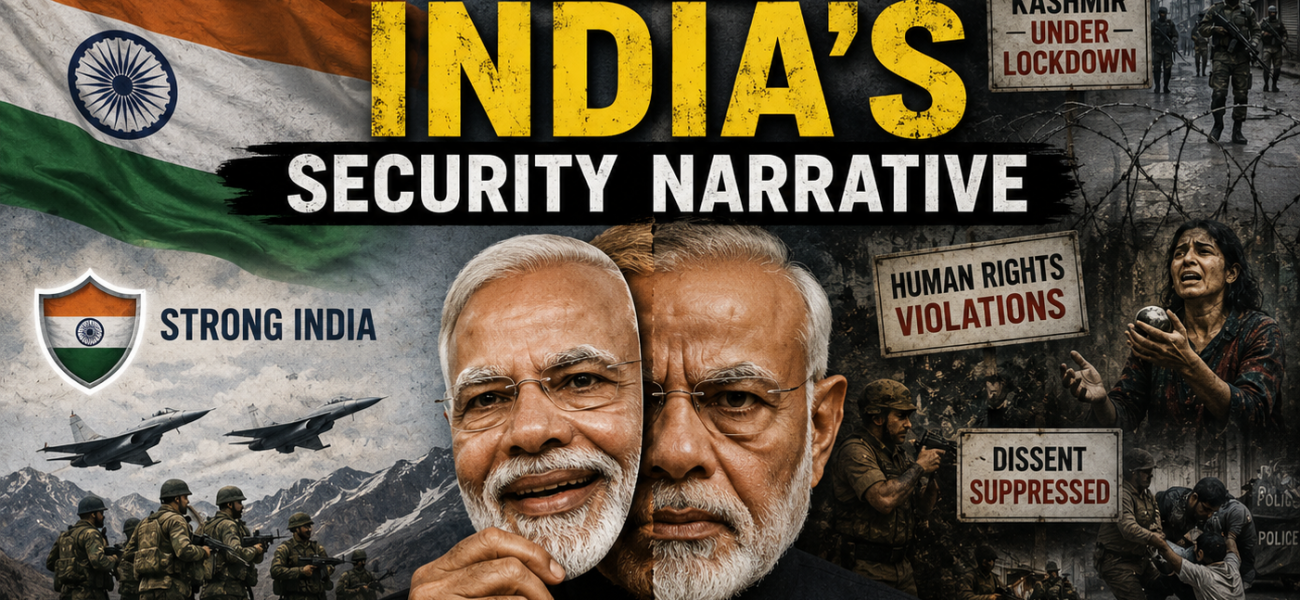
The Hypocrisy Behind India’s Security Narrative
What’s unfolding in Amritsar has, again, revealed a paradox that some people have long noted throughout South Asia. Authorities, which are often accused by Indian authorities of fostering...

What’s unfolding in Amritsar has, again, revealed a paradox that some people have long noted throughout South Asia. Authorities, which are often accused by Indian authorities of fostering instability and separatist activities in neighboring countries, had to employ massive security forces because of the appearance of pro-Khalistan slogans being shouted at one of Sikhism’s holiest towns. It puts New Delhi in uncomfortable situations with the nation as it grapples with its internal issues, and the logic behind the local politics which is often subject to disproportionate standards.
India has been trying to look like a role model nation that is stable and run democratically for decades. It’s regularly chiding others for problems like crime or residential tension or secession. But there are constant signs in India itself that there is great political and social dissatisfaction within its own borders. It is not just about law and order, but that the political discontent mentality cannot be extinguished with official narratives; the emergence of pro-Khalistan slogans and images associated with separatist thinking is a reminder of that.
The size of the response is special. There are reports that thousands of security forces were deployed, checkpoints were set up and movement was well guarded throughout the City. Such measures are typically not linked to a nation that states that separatist sentiment has been vanquished. If a problem is in the past, how is it that it has to be guarded with special security measures every time there is a sensitive anniversary or other meeting?
This is where the concept of hypo criticism is hard to avoid. India has repeatedly called on world powers to keep an eye on potential threats or issues that are outside its borders, but other matters remain under little oversight. Amid the events at Amritsar, however, the official declaration is not the yardstick of the unity of the nation. Real unity lies in the trust in the public, in social cohesion and in the capacity of institutions to unite through dialogue, inclusion and setting to right grievances.
The Indian government is often touted as being democratic in its foreign policies. But democracy is more than just elections or GDP figures. It is also a study of the response of a State to the oppositional voices, the political discontent and the minority concerns. Partial or complete deployments of security staff can overwhelm disturbances initially, but do not necessarily solve the root causes of disturbances in the first place.
The bigger picture is beyond the boundaries of Punjab. The internal problems that are currently being faced by India are social polarization, religious tensions, regional grievances and political divisions. These are truths accepted by not only by critics, but by many Indian commentators/ analysts. However, when such problems arise, official speeches try to explain them as individual occurrences instead of signposts for overall worries. It can be a short-term political move, but it isn’t necessarily a long-term solution.
📄 POLICY WIRE WHITEPAPER PUBLISHED: PAKISTAN'S NATIONAL SECURITY POLICY PRIORITIES
👉 READ BY CLICKING HEREInternational observers have become more aware of this paradox with time. To lead the region, a nation must be ready to impose itself and its sovereignty the same standards which it imposes on others. In foreign policy, credibility is enhanced when there is consistency and not selective outrage at the examples of others. Threatening to use “unusual force” to quell domestic unrest while preaching peace and tranquility to other states is bound to raise issues of double standards.
The events in Amritsar will not mean a single day or single gathering, but of a historical period. They draw attention to the discrepancy between politics and reality. They remind this area that things can’t be forgotten by a public relations campaign. Most importantly, however, they reject the notion that instability is always ‘the other person’s problem’.
Each country has its own problems internally and no country is free of political tension. True progress comes from admitting the challenges found. The scenarios unfolding in Punjab hint at some unanswered questions in India regarding national integration, inclusion and representation. There’s been criticism the other way that continues to be met with skepticism until we are transparent and consistent with our answers to these questions. The lesson from Amritsar is that instead of shoe stringing it, governments need to first address the issues within their own specific boundaries.
Author