


The Grim Calculus: Four More Names in the Shadowy Registry of Eastern Ukraine’s Unending Conflict
POLICY WIRE — Kyiv, Ukraine — They won’t be etched into any grand memorial, not yet anyway. Just four more anonymous casualties, tucked into the ever-growing, meticulously dull daily casualty...

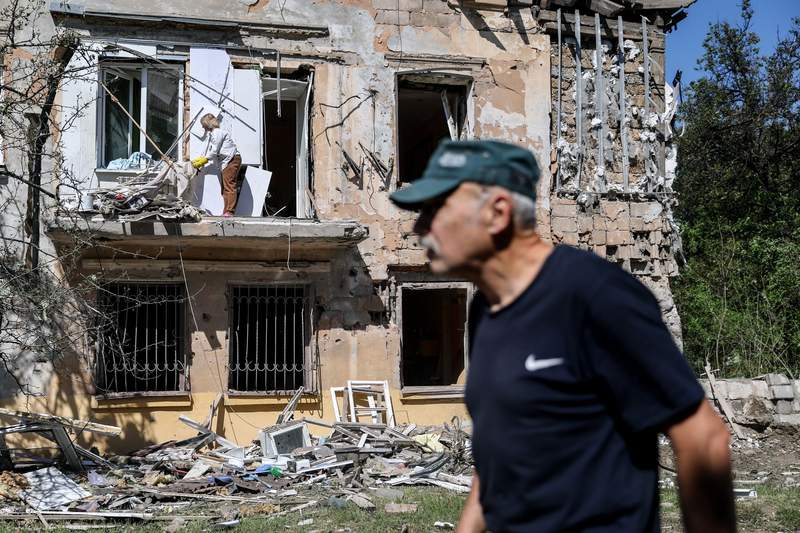
POLICY WIRE — Kyiv, Ukraine — They won’t be etched into any grand memorial, not yet anyway. Just four more anonymous casualties, tucked into the ever-growing, meticulously dull daily casualty reports. Four human beings—men, women, children, we’re not told—ceased to exist in some beleaguered, forgotten eastern Ukrainian town, according to occupation authorities. And just like that, the grind continues. It’s the routine, you see, the numbing cadence of conflict that truly grinds people down, not always the spectacular explosions.
Because who really registers these discrete incidents anymore? We’re so accustomed to the grim arithmetic, aren’t we? A town—unnamed in the initial wire brief, adding to the desolate anonymity—somewhere along the frozen, jagged frontline of Eastern Ukraine. Russian-backed forces, masters of a particular brand of officialese, delivered the tidings of death as if announcing a minor traffic infraction. Four souls, reportedly victims of Ukrainian shelling, vanish into the data stream. Their lives, however violently curtailed, become mere fodder in the endless propaganda mill. It’s efficient, really. Heartbreakingly so.
But scratch beneath that clinical surface, and you’ll find a festering wound, a ceaseless low-grade fever that refuses to break. The very act of reporting casualties by an occupying force—especially in a territory they claim as their own—speaks volumes. It’s a statement, an accusation, carefully crafted to absolve themselves — and indict the other. But it’s also, fundamentally, a concession: people are still dying on their watch, under their jurisdiction, whether they admit the cause or not.
“Moscow’s cynical game persists,” thundered Mykhailo Podolyak, advisor to Ukraine’s Presidential Office, in a recent online missive. “They seize our lands, brutalize our people, and then point fingers when the natural chaos of their illegal occupation claims more innocent lives. We mourn every victim of Russian aggression. Every single one is a wound on our nation’s soul.” He wasn’t shy about it. And why should he be? This isn’t a game for Kyiv.
Across the dividing lines, the narrative spins differently, always. “Ukrainian shelling continues to terrorize civilians,” stated Denis Pushilin, head of the self-proclaimed Donetsk People’s Republic, via his official Telegram channel just last week, addressing another similar incident. “Kyiv’s Western backers turn a blind eye as their proxies indiscriminately target our cities. It’s an act of desperation, and frankly, a war crime against our peaceful citizens.” You’d expect nothing less, wouldn’t you? They’ve got their script, they stick to it. It’s a tragedy, because it all sounds so predictable, despite the sheer human loss involved.
The situation isn’t confined to the abstract; it’s tangible, immediate, and has echoes far beyond these war-torn plains. Imagine the unseen silent casualties in the Gulf region—workers, migrants, people caught in the crossfire of geopolitical maneuvers and economic shifts—or in other contested territories like Kashmir or Palestine, where similar official tallies obscure deeper, wrenching human stories. It’s the constant displacement, the shattering of communities, the slow-motion collapse of entire social structures. These are wounds that bleed silently, far from the cameras, impacting not just individual families, but potentially sending ripple effects across continents, altering migration patterns and economic stability in countries like Pakistan, often through unseen pressure valves.
📄 POLICY WIRE WHITEPAPER PUBLISHED: PAKISTAN'S NATIONAL SECURITY POLICY PRIORITIES
👉 READ BY CLICKING HEREAccording to the UN Human Rights Monitoring Mission in Ukraine, over 10,500 civilians have been killed since the full-scale invasion in February 2022, with a conservative estimate, but the actual figure is almost certainly far higher, obscured by hostilities in occupied zones and mass burial sites still unexamined. The statistic, stark as it’s, struggles to convey the full spectrum of suffering.
What This Means
These reports, clipped — and sanitized as they’re, signify several critical realities. Firstly, the so-called ‘stabilization’ of occupied territories remains a fantasy; the region is a live, festering wound, constantly generating new tragedies. Secondly, they serve as potent—if tragically frequent—propaganda ammunition for both sides. The occupation authorities use them to decry Ukrainian aggression and solidify their claims to the land, while Kyiv seizes on every reported death to rally international condemnation and demand more robust support.
Economically, the impact is utterly devastating. Infrastructure isn’t just damaged; it’s often annihilated. Human capital—skilled workers, educated professionals—fled years ago or now lies beneath rubbled buildings. This renders any notion of meaningful economic recovery, even post-conflict, an incredibly distant prospect. For now, the focus isn’t on rebuilding, but merely on surviving. But the geopolitical implication is perhaps the starkest: these regular, localized reports of civilian deaths ensure that Ukraine, even when overshadowed by other global crises, remains a bleeding point. It prevents a comfortable slide into international complacency, always tugging at the frayed edges of global conscience. They won’t let us forget, even when we try to look away.
📖 GET YOUR FREE COPY NOW OF POLICY WIRE DIGITAL MAGAZINE JULY 2026 EDITION
👉 READ & DOWNLOAD FREE MAGAZINE