


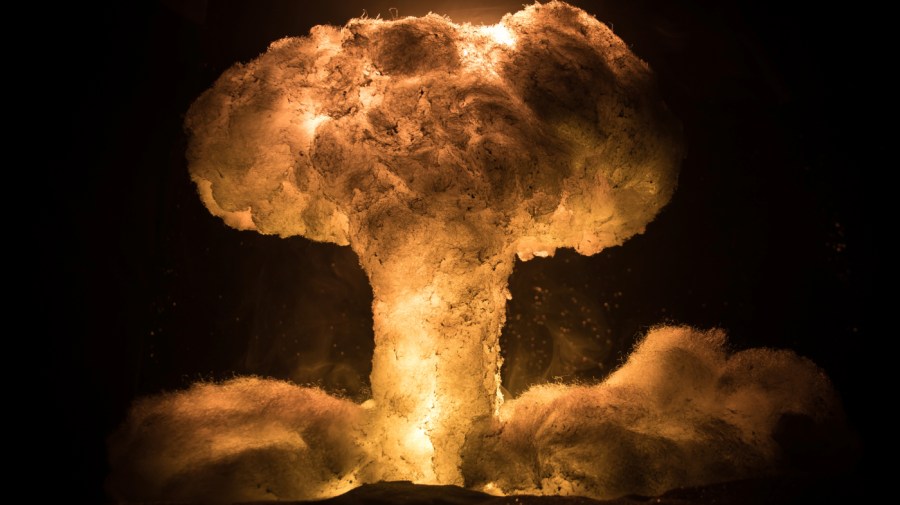
The Grand Delusion: Why Blowing Up Problems Won’t Disarm a Nuclear World
POLICY WIRE — Washington D.C., USA — There’s a particular kind of stubborn political alchemy—a kind of wishful thinking—that perpetually haunts foreign policy corridors. It’s the notion that...

POLICY WIRE — Washington D.C., USA — There’s a particular kind of stubborn political alchemy—a kind of wishful thinking—that perpetually haunts foreign policy corridors. It’s the notion that you can bash an adversary into abandoning their most treasured, fearsome assets. Think of it, a bit like trying to make a school bully put away their fists by punching them first. Absurd, isn’t it?
Yet, in the convoluted world of nuclear proliferation, this delusion — that one can somehow bomb a path to global disarmament — persists with a baffling tenacity. It’s not just naive; it’s a blueprint for escalating precisely what we claim to dread. Every saber-rattle, every preemptive threat, every whisper of a military option aimed at disarming a nuclear hopeful or an existing power, pretty much guarantees the opposite. [QUOTE_PLACEHOLDER]
For nations watching, especially those in dicey neighborhoods, these grand pronouncements aren’t calls to peace. Nope. They’re a ringing affirmation that nuclear weapons are, in fact, the ultimate insurance policy. They’re hearing, loud and clear, that having a bomb in the basement is the only real deterrent against bigger, stronger players wanting to rewrite their geopolitical script. It’s simple, stark logic when you’re standing at the receiving end of threats.
And let’s be real, the argument has become stale, trotted out by officials who know the lines by heart but rarely look beyond the teleprompter. They’ll tell you we need to be tough, that appeasement never works. But you can be tough without being an utter fool. You can negotiate from a position of strength, sure, but you can’t credibly demand disarmament while simultaneously demonstrating that only nuclear might grants genuine sovereignty in a world obsessed with power dynamics. It’s a bit of a pickle, that.
But how do we know this isn’t just a journalist’s jaded cynicism? Because we’ve seen the playbook before. Time and again, states that perceive an existential threat, especially from nuclear-armed neighbors or hegemonic powers, double down on their own weapons programs. It’s a race, not for the finish line, but for survival. Just consider the long shadow cast by Pakistan’s nuclear ambitions. Developed in response to perceived threats—and very real conflicts—with India, it wasn’t about projecting global power; it was about ensuring national survival. Islamabad’s calculations, even today, are framed by its strategic environment. The prospect of an external military intervention designed to disarm it wouldn’t eliminate its weapons; it would more likely accelerate their deployment, or God forbid, use them as a last resort. Because when the chips are down, a nation will always fight for its existence.
The global nuclear arsenal, far from shrinking substantially, has actually stabilized and is even showing signs of potential growth. According to data from the Stockholm International Peace Research Institute (SIPRI), the total number of operational nuclear weapons actually increased slightly in 2023, with states continuing to modernize their stockpiles. This isn’t a trajectory toward disarmament, is it? It’s more of a cautious, nervous shuffling toward a deeper abyss. You can’t just wish away these weapons, nor can you wish away the reasons nations seek them.
📄 POLICY WIRE WHITEPAPER PUBLISHED: PAKISTAN'S NATIONAL SECURITY POLICY PRIORITIES
👉 READ BY CLICKING HERESo, what’s the real talk? If you want to move toward a safer world, you gotta change the conversation, not just the military posture. That means addressing root causes: regional conflicts, security dilemmas, — and deep-seated mistrust. It means engaging in dialogue—real, painstaking, mind-numbing diplomacy—even with adversaries who make your skin crawl. And yeah, it’s boring. It’s not the stuff of blockbuster movies. There are no heroes crashing through windows to save the day. But it’s what works. Because force, in this arena, is an accelerant, not a extinguisher. We can’t keep applying the same blunt instrument — and expect different results. It’s frankly ridiculous, a tragic charade played out on the global stage. It’s a gambit that redefines risks, alright, but not for the better.
What This Means
The continued reliance on coercive threats against states with nascent or existing nuclear capabilities carries significant political and economic ramifications. Politically, it deepens the existing chasms between nuclear haves and have-nots, undermining international non-proliferation treaties like the NPT (a point of contention for non-signatories like India, Pakistan, and Israel). Every explicit or implied military threat legitimizes a nation’s decision to pursue nuclear arms as the ultimate sovereign guarantee, making future disarmament talks exponentially harder.
Economically, this posture funnels vast sums into military modernization and arms races rather than development or stability. For instance, any nation under the explicit threat of military action to disarm would, reasonably, divert more of its national budget to bolster defense, potentially starving other critical sectors. a failure to establish viable diplomatic off-ramps entrenches regional instabilities, which in turn deters foreign investment, stifles trade, and contributes to cycles of poverty and conflict, particularly in volatile regions like the Middle East or South Asia. The international community becomes locked in an expensive, dangerous standoff. It isn’t just about avoiding a mushroom cloud; it’s about building a framework where states don’t feel the need for one in the first place. That requires less bombast — and more uncomfortable conversations. And honestly, isn’t that the very least we can try?