


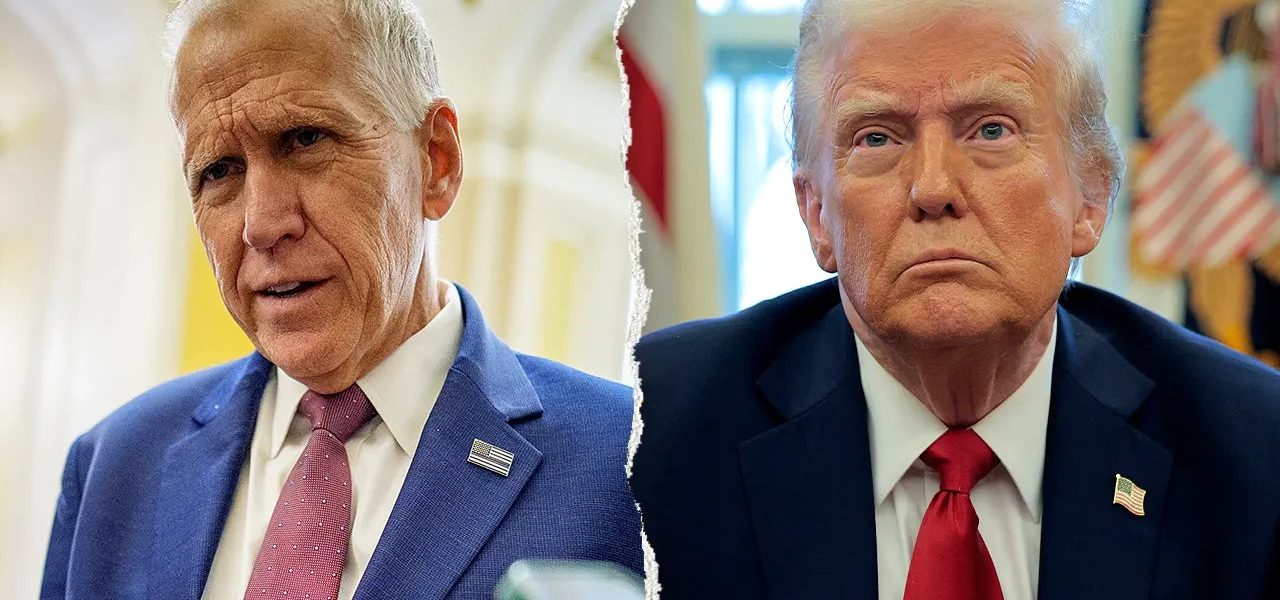
The GOP’s High-Wire Act: One Senator’s Dire Warning as November Looms
POLICY WIRE — Washington D.C., USA — The whispered fears of the Grand Old Party’s old guard — those graying, suit-clad figures who once steered the ship — are finally...

POLICY WIRE — Washington D.C., USA — The whispered fears of the Grand Old Party’s old guard — those graying, suit-clad figures who once steered the ship — are finally echoing through marble halls, louder than ever. Not as defiant roars, mind you, but as weary sighs, laced with an exasperation so profound it tastes like electoral defeat. It isn’t just about winning or losing anymore, they say; it’s about whether the party — their party — can even hold itself together. A senior Republican, who’s seen more Capitol Hill sunsets than most, recently delivered a stark assessment, though not entirely surprising to those paying attention.
It boils down to this: former President Donald Trump’s penchant for — shall we say — the theatrically divisive, is an electoral self-infliction. That’s the gist. No polite political jargon. Just a blunt declaration that the antics, the noise, the seemingly endless churn of controversy, they’re not energizing a wider base. Nope. They’re repelling folks. Think swing voters in the suburbs. Think young people weary of the constant political bruising. And they’re thinking of November — what it means for House seats, Senate majorities, and, oh yeah, the White House itself. But, really, this isn’t about just one election, is it? It’s about a party’s soul, its trajectory.
But how do you rein in an insurgency that swallowed the party whole? “Look, you can’t build a governing coalition solely on anger,” Senator Mitt Romney (R-UT) recently told Policy Wire, a sentiment he’s expressed many times over. “History tells us that doesn’t usually end well for the party holding the matches.” He’s been there, done that, tried to lead. His voice carries a weight of resignation, frankly, a ‘told you so’ woven into every syllable, though he’d never say it outright.
And that sentiment? It isn’t isolated. It’s a chorus in the background of Washington’s — or at least some parts of it — power plays. Republicans once saw themselves as the party of stable foreign policy, strong alliances. How does a mercurial leader — someone seen as perhaps unreliable or impulsive by international partners — play with those ideals? For nations like Pakistan, navigating a delicate regional balance with an ascendant China and a prickly India, the perceived consistency of U.S. foreign policy isn’t a theoretical concern; it’s existential. Erratic signals from Washington, a leadership vacuum, or shifting allegiances could easily destabilize fragile regional peace efforts, or at least change the calculus for allies on who they can really count on. It’s all connected, these global ripple effects.
Because the American political system, fractured as it appears, still projects immense power. That projection falters when the homeland appears perpetually on the brink. “Voters, particularly independents and those disengaged with the most strident rhetoric, they want to see stability,” Senator Susan Collins (R-ME) noted during a quiet moment off the floor. “They want solutions. They don’t want constant drama, and they don’t want us handing the keys back to the other side because we couldn’t get our own house in order.” She’s a survivor of tough elections herself; she knows how this works. Her focus group probably tells her exactly that. According to a late April Ipsos/Reuters poll aggregate, a rather startling 54% of registered voters expressed a high level of unfavorability towards Donald Trump, suggesting a significant hurdle for his appeal beyond his dedicated base.
📄 POLICY WIRE WHITEPAPER PUBLISHED: PAKISTAN'S NATIONAL SECURITY POLICY PRIORITIES
👉 READ BY CLICKING HEREIt’s not just about what Trump does, though, is it? It’s about how the entire party reacts. Do they parrot the rhetoric? Do they shrink from the cameras? Do they just keep their heads down — and hope it all blows over? They’re clearly worried about electoral contagion, about being too close to — as one senior staffer anonymously put it to me — “the wrong kind of crazy.” The sort of ‘crazy’ that loses districts, loses states, loses seats.
And so, we watch. November’s coming, bringing with it not just ballots, but a reckoning. Can the party of Lincoln, Eisenhower, and Reagan — or whatever permutation it calls itself these days — pull off an electoral win while grappling with its own internal civil war? It’s a pretty audacious gamble. A desperate gamble, some would say.
What This Means
This internal friction within the Republican Party, driven by unease over former President Trump’s electoral viability and his impact on down-ballot races, isn’t just internal bickering. It represents a deep existential crisis for the party. Economically, prolonged political instability or a radical shift in trade and regulatory policies — as often signaled by Trump — could create uncertainty in markets, both domestic and global. Internationally, the perception of a U.S. unable to consistently project a unified or stable foreign policy undermines traditional alliances, empowering rivals, and complicates diplomatic efforts from the Middle East to South Asia. Our allies, such as those in Pakistan, rely on a predictable American partner for strategic stability; a tumultuous U.S. election cycle can ripple through their geopolitical calculations, impacting security initiatives and trade relationships. If Trump’s style alienates moderate voters and leads to significant GOP losses, it might force the party to fundamentally reassess its appeal. Or it could entrench the hardliners, leading to even more pronounced partisan divides. It’s a lose-lose in some ways — either a political bloodbath for the party or a victory that alienates large swaths of the electorate, making governing a ceaseless battle.