


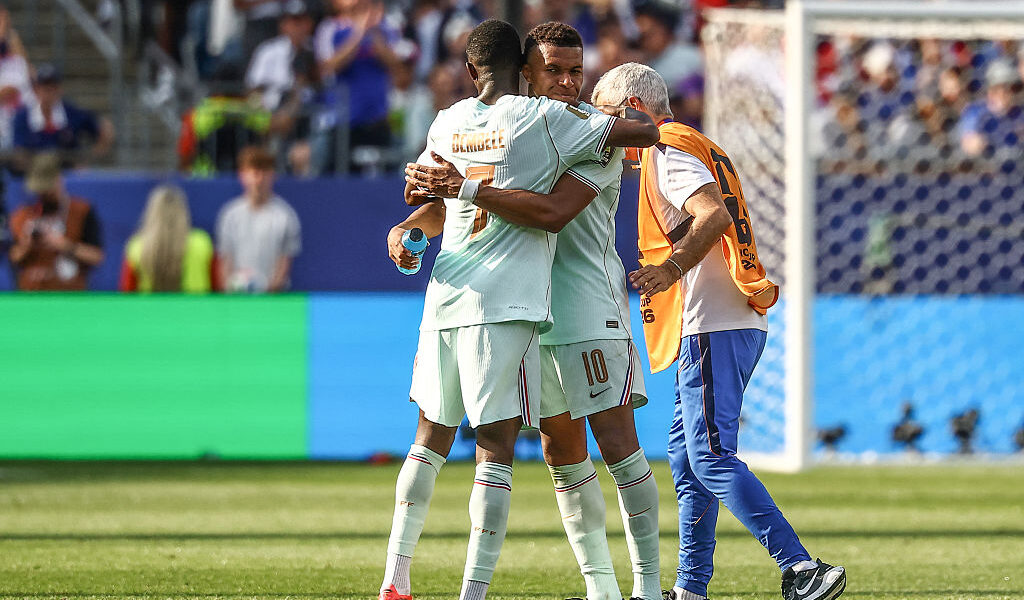
The Golden Thread: France’s Dominant Duo and the Geopolitics of Glory
POLICY WIRE — Doha, Qatar — There’s a particular kind of alchemy at play when individual brilliance so perfectly aligns with collective ambition, especially on football’s grandest stage....

POLICY WIRE — Doha, Qatar — There’s a particular kind of alchemy at play when individual brilliance so perfectly aligns with collective ambition, especially on football’s grandest stage. It isn’t merely about scoring goals; it’s about shouldering a nation’s hopes, defying the gravity of expectation, and, if you’re French phenoms Kylian Mbappé and Ousmane Dembélé, echoing ghosts of glories past while forging new legends.
Much chatter has fixated, rightly, on Mbappé’s individual brilliance—a relentless, almost preternatural ability to bend games to his will. But look closely, — and you’ll see the often-overlooked companion in this double act. Ousmane Dembélé, the mercurial winger, isn’t just making up the numbers. He’s actively dismantling defenses, his electric runs and crucial strikes creating a dual threat that few opponents, if any, can genuinely contain. It’s a striking confluence of talent that begs a deeper question than just ‘will they win?’ It’s about what such dominance means.
It’s rare to witness two offensive titans from the same squad operate with such synchronized, almost symmetrical impact in a tournament that traditionally highlights singular heroes. Think back, if you will, to 2002. ESPN, the sports broadcasting giant, reported then that Brazilians Ronaldo and Rivaldo etched their names into the history books as the last pair to each bag five goals or more in a single World Cup campaign. They also, hoisted the trophy. Fast forward two decades, and France finds itself with Mbappé already leading the scoring charts and Dembélé trailing with a robust five goals. The statistical symmetry with that legendary Brazilian duo is chilling, isn’t it?
But the numbers only tell half the story. The raw, exhilarating energy these two bring to the pitch isn’t just good football; it’s a powerful narrative. It captures imaginations from the boulevards of Paris to the crowded alleys of Karachi. The global spectacle of such sporting dominance resonates far beyond the typical fan base. We’re talking soft power, pure — and uncut. When France plays, eyes turn, flags wave, and for many, a sense of aspirational identification takes hold, particularly in regions with strong diaspora links to Europe or where football is nothing short of religion. In Pakistan, for example, where cricket often dominates, the sheer magic of a World Cup campaign like France’s can — temporarily, at least — capture widespread attention, uniting diverse groups under the spell of the beautiful game.
French Minister for Sports, Amélie Oudéa-Castéra, a seasoned observer of national morale, articulated the sentiment recently. “Our boys aren’t just playing football; they’re painting a masterpiece of national unity and fierce ambition on the world stage,” she remarked, a palpable pride in her voice. “This kind of performance elevates everyone, reminding us what collective effort, anchored in extraordinary talent, can achieve. We don’t just watch; we breathe with them.” And she isn’t wrong; there’s a genuine feel-good factor afoot.
The global sports punditry, ever keen to place phenomena in their broader context, doesn’t miss the underlying currents. Dr. Aziza Iqbal, a political sociologist specializing in sports diplomacy from the University of Malaya, noted, “You can’t isolate sport from geopolitics, not anymore. These French players, many with origins tracing through North and Sub-Saharan Africa, represent a dynamic, diverse France. Their success on the world’s biggest platform sends a powerful message, inspiring millions in places like Morocco, Algeria, and indeed, further east in the broader Muslim world, including South Asia, about opportunity and inclusion. They don’t just win games; they subtly influence perceptions.” That’s a weighty mantle to wear.
📄 POLICY WIRE WHITEPAPER PUBLISHED: PAKISTAN'S NATIONAL SECURITY POLICY PRIORITIES
👉 READ BY CLICKING HERESure, Dembélé doesn’t have Mbappé’s universal name recognition just yet. He’s more the silent assassin, an electrifying presence capable of moments of sheer, unadulterated brilliance. But he’s showing up when it counts, notching goals and assists with a quiet menace that rounds out the French attack into something truly formidable. They’re still got two more matches—if they make it to the final—to improve their numbers. It’s a compelling, almost fated showdown, watching if history truly can repeat itself.
What This Means
Beyond the celebratory chants and the impending shower of gold confetti, France’s deep run, powered by its dual-threat attack, carries considerable implications. Economically, a World Cup win would translate into a tangible surge in national morale, consumer confidence, and a significant boost in merchandise sales—everything from official jerseys to commemorative coins. Politically, President Macron’s government can capitalize on this wave of national pride, potentially distracting from domestic challenges or bolstering a narrative of French excellence and soft power projection. Think of it as a momentary inoculation against malaise. It’s not just about football; it’s a statement on the vibrancy of French society, its talent pool, and its capacity to inspire across diverse populations, both at home and abroad. This goes well beyond the beautiful game itself; it’s a nation seeing itself, and being seen by the world, in a powerful, triumphant light.