


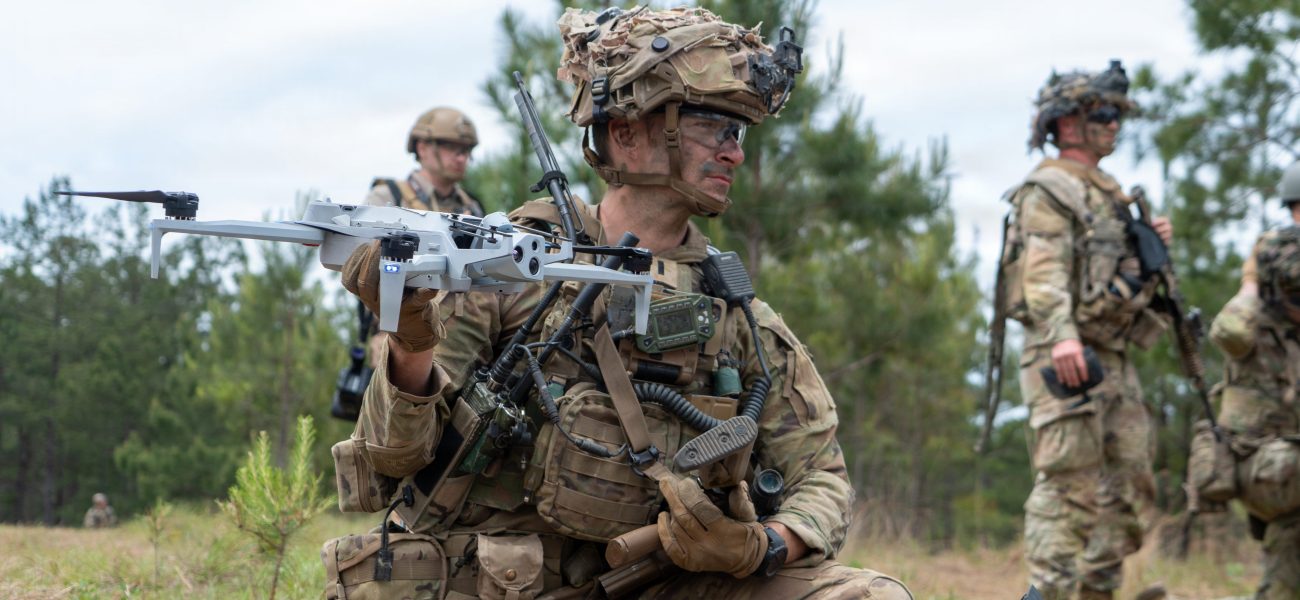
The Ghost in the Machine: US Army’s Robot Advance Reshapes Combat’s Gritty Edge
POLICY WIRE — Washington D.C., USA — The visceral clang of steel on steel, the sharp intake of breath before the charge—it’s all becoming a rather quaint notion, isn’t it? Modern warfare,...

POLICY WIRE — Washington D.C., USA — The visceral clang of steel on steel, the sharp intake of breath before the charge—it’s all becoming a rather quaint notion, isn’t it? Modern warfare, particularly on the sharpest end of engagement, looks less like cinematic valor and more like a game of lethal chess played by unseen hands. One US Army commander, pushing the envelope of autonomous conflict, recently directed an operation where attack drones and C4-packed robots handled a deadly breach entirely on their own, well before any soldier had to risk a pinky finger.
It’s not just about efficiency, you see. It’s a profound shift, almost philosophical in its implications for who, or what, fights our battles. These machines weren’t just scouting; they were neutralizing, delivering explosive payloads, making decisions at a speed and distance humans simply can’t match. An operator, sitting in a climate-controlled trailer hundreds, even thousands, of miles away, guided—or perhaps merely observed—a swarm of mechanical proxies making fatal calls.
And this isn’t science fiction anymore, not even the B-movie kind. This is the messy, terrifying present. The commander, reportedly operating with an uncanny detachment, employed these automated assets to achieve what was described as [QUOTE_PLACEHOLDER], ensuring personnel safety at an unprecedented level. One might argue it’s a moral triumph, reducing casualties. Or, one might simply wonder about the distance we’re creating between cause and effect, the sanitized lethality that risks turning combat into a depersonalized exercise in algorithmic superiority.
These weren’t simple reconnaissance tools. We’re talking about autonomous units—ones that can identify, target, and engage without a human holding a joystick for every single action. That’s a game-changer. It shrinks reaction times, certainly. It multiplies destructive capability. But it also raises a whole host of gnarly questions about accountability, about the nature of engagement when the trigger pull is, metaphorically speaking, diffused through circuits and software. Imagine the psychological toll, or lack thereof, on a machine that has just cleared a fortified position with lethal force. Pretty chilling, I’d say.
Because the strategic implications here ripple far beyond a single battlefield success. We’re on the precipice of a global arms race in autonomous systems. Nations in South Asia, including Pakistan, are keenly watching these developments. Countries there, already navigating complex geopolitical fault lines and internal security challenges, understand that integrating advanced drone and robotics capabilities could fundamentally alter regional power dynamics. It’s a scramble for advantage, often cloaked in the language of defensive necessity, but it’s a scramble all the same. The notion that [QUOTE_PLACEHOLDER] will likely fuel further investments across the globe.
This tech isn’t cheap, of course, nor is it easy to master. Yet, the perceived benefits—fewer human lives lost, enhanced precision, access to dangerous zones—make it an almost irresistible proposition for militaries worldwide. The global military robotics market, for instance, is projected to swell from roughly $22.4 billion in 2022 to an estimated $66.4 billion by 2030, according to data compiled by Research and Markets. That’s a nearly threefold increase in less than a decade; money talks, — and in this case, it screams robotic warfare.
But there’s a real unease, a sort of low hum beneath the surface of all this innovation. What happens when these systems falter? When they encounter scenarios they haven’t been programmed for? Who carries the can then? It’s easy enough to say [QUOTE_PLACEHOLDER], but the reality of a machine-driven miscalculation in a volatile region could spark unintended escalation, particularly where human command and control layers are thin or communications are unreliable. And, frankly, we’ve barely scratched the surface of the ethical quagmire surrounding true AI autonomy in lethal operations.
📄 POLICY WIRE WHITEPAPER PUBLISHED: PAKISTAN'S NATIONAL SECURITY POLICY PRIORITIES
👉 READ BY CLICKING HEREWhat This Means
This US Army operation, even if its specifics remain shrouded in the usual military opaqueness (a common theme, wouldn’t you agree?), serves as a stark inflection point. It isn’t merely about soldiers coming home safe. It’s about a reconceptualization of warfare itself. The economic implications are staggering; nations unwilling or unable to invest heavily in this kind of remote, autonomous capacity risk becoming militarily obsolete—or, at the very least, severely disadvantaged on the global stage. This drives a powerful economic incentive for defense contractors and tech giants, shifting immense wealth into a new military-industrial complex of AI and robotics. The geopolitical reverberations are just as profound.
For regions like the Middle East — and South Asia, this accelerating tech curve presents both temptation and peril. An acquisition of advanced armed drones by one nation invariably pushes its rivals to seek similar or superior capabilities. Think of India’s push for indigenous drone tech or Pakistan’s ongoing efforts to modernize its air force; this development will only intensify those strategic drives. This could easily lead to an escalation of cross-border skirmishes and a new kind of proxy war, where human lives are conserved on one side, perhaps, while devastating accuracy is unleashed via remote, depersonalized systems on the other.
And let’s not forget the political narrative. Governments might increasingly rely on these [QUOTE_PLACEHOLDER] to avoid domestic casualties, making interventions more palatable to their electorates. But this lower political cost of war doesn’t necessarily equate to fewer human casualties overall, particularly on the receiving end. The temptation for intervention becomes much greater when the perceived sacrifice from the intervening power is minimized. This can create unstable power vacuums, fuel resentment, and lead to protracted, asymmetric conflicts where the human element, for all its supposed removal, remains stubbornly—and tragically—present. This trend mirrors some of the concerns around AI rewriting global price tags across various sectors, not just military.
Ultimately, as we shift responsibility for the dirty work of war to machines, we have to seriously reckon with what kind of conflicts we’re creating—and what kind of humans we’re becoming in the process. It’s a conversation that frankly isn’t happening fast enough, as the robots are already doing the heavy lifting, quite literally.