


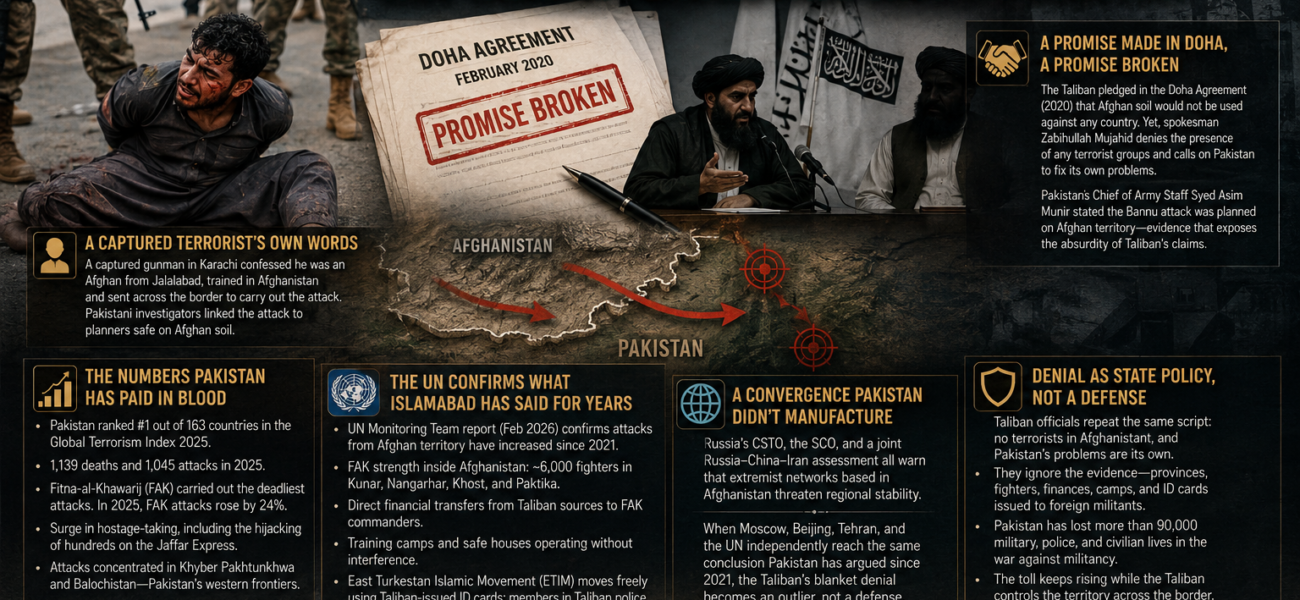
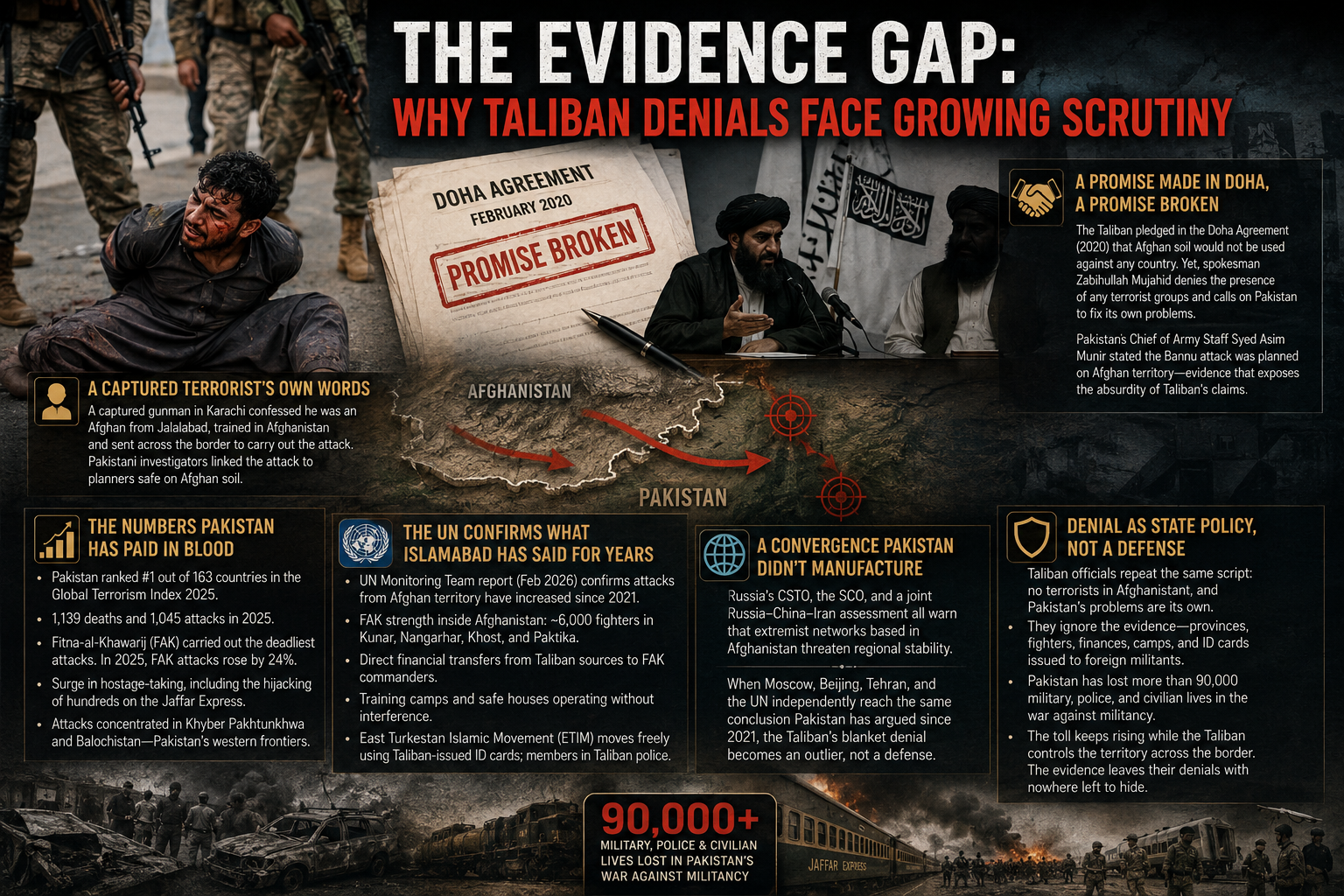
The Evidence Gap: Why Taliban Denials Face Growing Scrutiny
A Captured Terrorist’s Own Words A wounded gunman lies on a street in Karachi where three soldiers were martyred in an attack with heavy weapons on a Pakistan Rangers camp, June 2026. He was...
A Captured Terrorist’s Own Words
A wounded gunman lies on a street in Karachi where three soldiers were martyred in an attack with heavy weapons on a Pakistan Rangers camp, June 2026. He was taken alive by security forces and his confession was published by local media. The prosecution said he gave his name as an Afghan who lived in Jalalabad and named three accomplices with whom he had crossed into Pakistan days earlier. He detailed recruitment at a religious seminary within Afghanistan and training at two terrorist camps before his handlers dispatched him across the border. The same attack was later connected by the Pakistani investigators with a group of planners who were safe on Afghan territory during the operation. This one case speaks to a trend that Pakistani officials have reported for years: militants recruited, trained and guided out of Afghanistan and sent over the border to kill.
A Promise Made in Doha, A Promise Broken
The Taliban agreed to the provisions of the Doha Agreement in February 2020 and thus formally committed itself to ensuring that the Afghan territory does not pose a security threat to any other country. That pledge has now become the starting point of every statement made by respective spokesmen of the Taliban. Zabihullah Mujahid reiterated this promise once again this week claiming that Afghanistan is free of any terrorist organization and rejected Pakistan’s claims, arguing that Islamabad should address its own internal security challenges. Following the Intelligence report containing the material results of the investigation of the attack on the military base in Bannu Cantonment, Pakistans Chief of Army Staff Syed Asim Munir stated that the attack had been planned on the territory of Afghanistan, which serves as an evidence of the absurdity of Taliban’s claims.
The Numbers Pakistan Has Paid In Blood
Independent data validates the contention made by Pakistani officials for years, Pakistan is still one of the country’s most heavily impacted by terrorism and nearly all attacks occur in western border areas. The worst global toll came in 2025, the highest since 2013, when Pakistan was ranked first of 163 countries for terrorism impact by the Sydney, Australia-based Institute for Economics and Peace, registering 1,139 deaths and 1,045 attacks. According to the index, it is Fitna-al-Khawarij (FAK) who has carried out deadliest terrorist operations against Pakistan. Islamabad has regularly insisted the group does not operate from Pakistan, but uses sanctuaries and logistic networks over the Afghanistan borders to plan and carry out attacks inside Pakistan. In 2025, the total number of FAK attacks increased by 24 percent¸ and violence linked to its group has continued to inflict substantial fatalities on civilians and security forces alike. Hostage-taking rose precipitously, with hundreds of passengers on board the Jaffar Express being hijacked. The near-total focus of the attacks primarily in Khyber Pakhtunkhwa and Balochistan underlines insecurity that plagues Pakistan’s western frontiers, where terrorist groups across Pakistani borders use geographic and security weaknesses to their advantage.
The UN Confirms What Islamabad Has Said For Years
The United Nations Security Council’s Analytical Support and Sanctions Monitoring Team raised concerns that align with several of Pakistan’s long-standing security claims. Its February 2026 report explicitly endorsed Pakistan’s long-standing complaint and confirmed that attacks originating from Afghan territory have increased since the Taliban took power in 2021. Monitoring Team assessments put FAK strength inside Afghanistan at roughly 6,000 fighters, concentrated in Kunar, Nangarhar, Khost, and Paktika provinces. Investigators have traced direct financial transfers from Taliban sources to FAK commanders and documented training camps and safe houses operating without interference. The same report found that the East Turkestan Islamic Movement moves freely inside Afghanistan using Taliban-issued identity documents, with members even joining Taliban police units.
A Convergence Pakistan Didn’t Manufacture
Pakistan’s case rests on far more than its own testimony. Russia’s Collective Security Treaty Organisation has separately warned that extremist networks based in Afghanistan threaten to destabilize Central Asia. The Shanghai Cooperation Organisation and a joint Russia-China-Iran security assessment have each reached parallel conclusions. This convergence spans capitals with sharply different interests and little incentive to echo Islamabad’s talking points, which makes the agreement among them the strongest evidence available. When Moscow, Beijing, Tehran, and the UN Secretariat independently arrive at the conclusion Pakistan has argued since 2021, the Taliban’s blanket denial becomes an outlier position rather than a credible defense.
Denial as State Policy, Not a Defense
Taliban officials answer every one of these findings with the same script: no terrorist group exists on Afghan soil, and Pakistan’s troubles are its own creation. This script never engages the specific record investigators have published, the named provinces, the fighter counts, the financial trails, the identity documents issued to foreign terrorists. A government confident in its own record would confront that evidence point by point rather than repeat a general assurance each time a fresh attack strikes Pakistani soil. Pakistan has absorbed more than 90,000 military, police, and civilian deaths since its long war against militancy began, and the toll keeps climbing precisely in the years the Taliban has controlled the territory across the border. That timeline, backed by the UN’s own numbers, leaves the Taliban’s denials with nowhere left to hide.
Author