


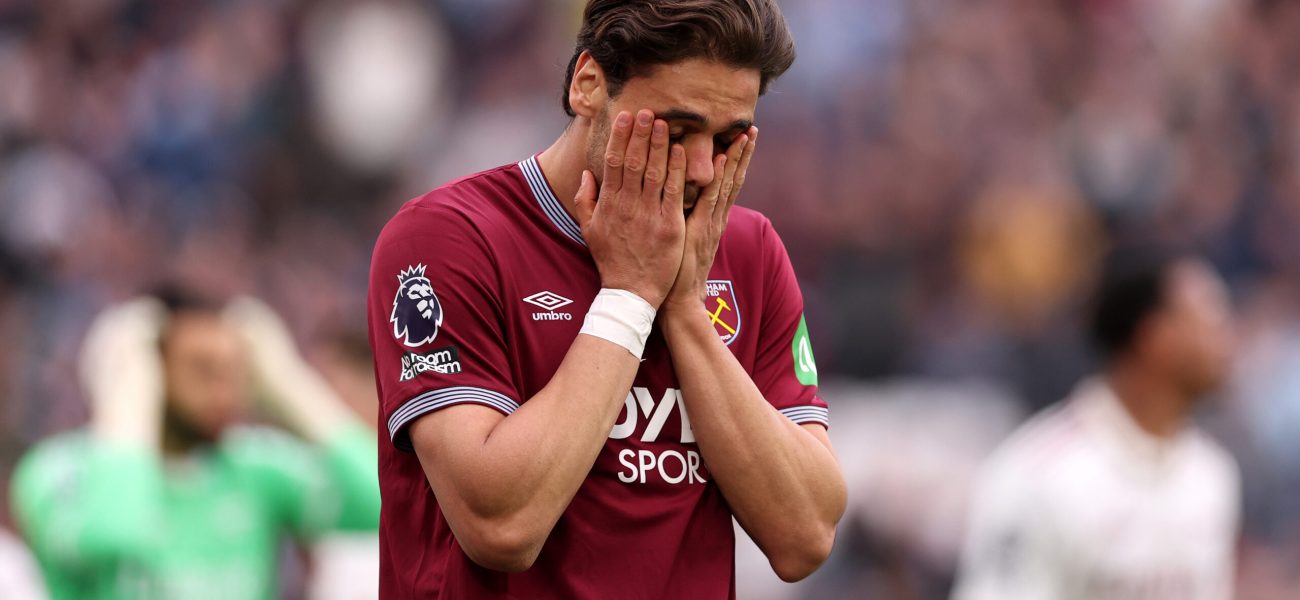
The Brutal Economics of Talent: Europe’s Top Clubs Lock Horns for West Ham’s Portuguese Gem
POLICY WIRE — London, UK — The asphalt battlefield isn’t just for global superpowers anymore. Turns out, the fight for supremacy can be found on a football pitch, or, more accurately, in the...

POLICY WIRE — London, UK — The asphalt battlefield isn’t just for global superpowers anymore. Turns out, the fight for supremacy can be found on a football pitch, or, more accurately, in the backroom deals preceding it. We’re talking about a cold war of a different kind—one waged with astronomical transfer fees and opaque player valuations, where clubs like Tottenham Hotspur and Manchester United vie for a slice of what they hope is future glory. The latest skirmish? Portuguese midfielder Mateus Fernandes.
It’s no small wonder these giants are circling. Fernandes, a 21-year-old dynamo from West Ham, has become the new shiny object, despite his previous club’s rather unfortunate trip to relegation. He might not have saved the Hammers, but his individual brilliance—five goals and five assists in 42 appearances across all competitions—didn’t go unnoticed. The kid’s got vision, a powerful shot, — and he just doesn’t stop running. A box-to-box terror, he can even slot in as a holding midfielder or a number ten. Coaches dream of such versatility.
But this isn’t some quaint neighborhood club scramble. No, this is an economic arms race, and Fernandes, still contracted until 2030, carries a hefty price tag, making him a prize worth breaking the bank for. Tottenham, under manager Roberto De Zerbi, is reportedly hot on his trail, and you can bet Manchester United aren’t far behind. And that, dear reader, is where the real drama unfolds. This isn’t just about winning games; it’s about winning the narrative, about projecting power, about owning a piece of global human capital.
“Every top club is a talent scout now, but also a sovereign wealth fund, almost,” mused De Zerbi last week, a sly smile playing on his lips when pressed about transfer strategy. “We’re not just looking for feet; we’re looking for engines, for minds. Fernandes? He’s an engine with a brain. But everyone knows that, don’t they? That’s the tricky bit.” And he’s right, it’s. Because in an era where elite youth sports mirror geopolitical struggles, securing a player like Fernandes isn’t merely a tactical decision; it’s a strategic coup.
His impressive performances for West Ham caught enough eyes that it’s sparked a full-blown tug-of-war. Manchester United, always eager to reclaim their former glory, see him as a midfield lynchpin. Tottenham wants to deepen their squad, particularly after a season that, while not disastrous, certainly lacked the depth required for consistent challenges across multiple fronts. These big-money transfers, sometimes stretching well into nine figures for a truly exceptional talent, reflect not just a demand for quality, but the immense financial leverage wielded by a select few clubs. It’s a seller’s market for the best, a brutal truth for the rest.
Consider this: the average transfer fee for players aged 21 or under moving between Europe’s ‘Big Five’ leagues climbed nearly 40% in the last three years, according to a recent CIES Football Observatory report. Forty percent! That’s a staggering rate of inflation driven by intense competition, a global media rights boom, and an influx of foreign investment that shows no signs of slowing down. For clubs, it’s about staying relevant. For players, it’s a golden ticket.
📄 POLICY WIRE WHITEPAPER PUBLISHED: PAKISTAN'S NATIONAL SECURITY POLICY PRIORITIES
👉 READ BY CLICKING HEREAnd then there’s the broader narrative. The fervour for these European leagues extends far beyond their home countries, creating a colossal global fanbase. In Pakistan, for instance, a nation often captivated by cricket, viewership for the Premier League alone has seen significant spikes over the last decade, a testament to the league’s global reach and the marketing might of these powerhouse clubs. Every big signing, every transfer rumor, becomes a talking point in Karachi, Lahore, and Islamabad, fostering new generations of loyal supporters who buy jerseys, watch games, and generally deepen the global footprint of brands like Tottenham and Manchester United. These aren’t just footballers; they’re cultural ambassadors, commodity — and myth all wrapped into one.
But, does De Zerbi actually need him? Fernandes is Premier League-proven, won’t need an adjustment period—a priceless asset in today’s cutthroat league. He’s got the work rate, the tackling ability, — and the knack for turning defense into attack. Tottenham’s boss isn’t blind. He knows a good thing when he sees it. And he’ll want it badly.
What This Means
This escalating contest for Mateus Fernandes, a situation mirrored across European football every transfer window, isn’t just sports news. It’s a vivid illustration of late-stage capitalism’s intersection with entertainment, of human capital’s global flow. The astronomical sums involved in transfers represent not merely the athletic value of an individual, but a speculation on future revenue streams from broadcasting rights, merchandise sales, and an ever-expanding, interconnected global audience. Clubs become less like sporting institutions and more like venture capital firms, betting huge on individual talents with the hope of an even bigger return.
The influx of money, particularly from oil-rich Gulf states, has further distorted the market, creating an inflationary spiral where smaller clubs struggle to compete, selling their prize assets just to stay afloat. For the likes of West Ham, seeing a talent like Fernandes poached is a painful, inevitable consequence of an unequal economic playing field. The political implication here? Sports has become a critical soft power tool, a vehicle for national branding, and a highly visible arena for economic dominance, blurring lines between geopolitics, finance, and raw athleticism. It’s a complex, often brutal, business.