


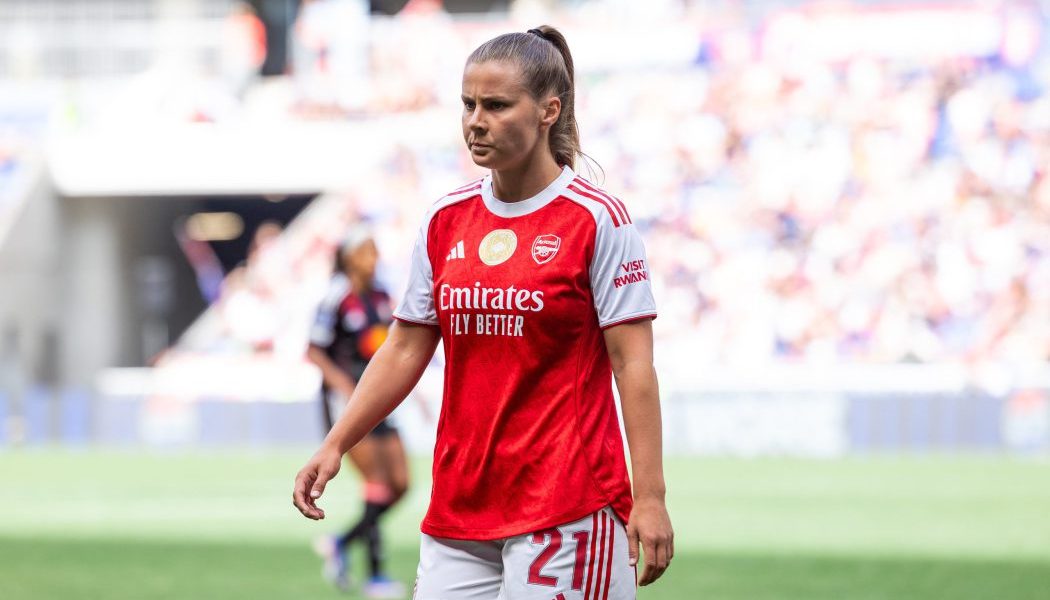
The Brutal Calculus of Professional Football: Arsenal’s Latest Departure Signals Larger Shifts
POLICY WIRE — London, UK — There’s a certain, almost chilling arithmetic at play in professional football these days, a dispassionate calculation that underpins every tactical shift, every audacious...

POLICY WIRE — London, UK — There’s a certain, almost chilling arithmetic at play in professional football these days, a dispassionate calculation that underpins every tactical shift, every audacious transfer, and, yes, every quiet goodbye. It isn’t just about trophies or cheers anymore; it’s the cold business of contracts, market value, and strategic reshuffles. And Victoria Pelova, Arsenal’s seasoned Dutch midfielder, has just become another data point in that evolving equation, her impending departure from the North London club less a surprise and more a stark reminder of the sport’s ruthless, yet burgeoning, economy.
It’s a peculiar thing, seeing established players—even those with respectable statistics like Pelova’s 87 appearances and six goals for the Gunners since her January 2023 arrival from Ajax—simply, well, disappear when a contract hits its expiration date. No big-money transfer fanfare, no protracted bidding wars. Just a press release, neat and tidy, confirming that the 26-year-old will seek “a fresh challenge” come summer 2026/2027. It’s the silent majority of player movements, often more telling about the inner workings of a club—and the wider league—than the splashy, record-breaking deals.
“Look, this is the raw truth of elite sport,” an Arsenal club spokesperson, who wished to remain unnamed but has an ear close to the ground, told Policy Wire. “Players come, they pour their hearts into the jersey, and sometimes the club’s long-term vision, or a player’s individual ambition, simply dictates a different path forward. Victoria’s been absolutely superb for us. We just don’t get sentimental in this game.” His words hang in the air, a pragmatic, if slightly brutal, assessment of modern football’s operational philosophy.
Pelova’s exit isn’t an isolated incident either. She’s following goalkeeper Naomi Williams, who spent eight years at Arsenal since joining at 13, and defender Laia Codina, recruited just three seasons prior. It’s a trio of goodbyes that hints at more than just squad rotation; it smacks of an almost aggressive reshaping, a shedding of assets and talent with surgical precision. But why now? And why such a conspicuous exodus of experienced campaigners?
But the women’s game is professionalizing at an incredible clip. What we’re witnessing isn’t merely routine roster management; it’s the dynamic pulse of a truly global market now beating fiercely, driven by increasingly competitive contracts and an insatiable desire for clubs to dominate. This mobility, as a kind of ruthless optimization, is now standard practice, pushing clubs to continually reassess their strategic imperatives. That’s the view from Sarah Clarke, a former Football Association official now working independently. “Player movement has become a huge part of the overall strategy. Clubs aren’t just buying; they’re building, year after year, — and it means tough calls are made when contracts expire. Every single decision now is weighed against performance metrics, market opportunity, and a broader strategic vision for sustained success.”
It’s all part of the surging financial tide lifting women’s football worldwide. A recent Deloitte report estimated the women’s football market could be worth £1 billion annually by 2027. That’s an insane jump, demonstrating precisely why clubs like Arsenal aren’t leaving anything to chance. Every player, every salary, every transfer decision is now meticulously scrutinized under the unforgiving glare of potential commercial return and competitive advantage. Money talks, and it’s starting to speak volumes in the women’s game, echoing the brutal efficiency long common in the men’s leagues.
📄 POLICY WIRE WHITEPAPER PUBLISHED: PAKISTAN'S NATIONAL SECURITY POLICY PRIORITIES
👉 READ BY CLICKING HEREAnd these European movements, however small in the grand scheme of a single player’s career, reverberate far beyond their immediate impact zones. Consider a country like Pakistan, where women’s football is nascent but dreaming big. Fans there, following the English Women’s Super League avidly, absorb these shifts—not just as news, but as a subtle cultural commentary. The professional infrastructure, the player development pathways, the economic opportunities that lead a Pelova to London or a Codina to Arsenal are studied intently by emerging football nations. For them, every contractual decision in Europe informs how they might someday, perhaps, build their own vibrant women’s leagues and nurture local talent, hoping one day to compete for the kind of talent currently making headlines in Europe.
What This Means
The strategic reshaping at Arsenal—part of a trend visible across top-tier women’s football—isn’t just about individual careers; it’s a window into the sport’s economic and political maturation. Economically, we’re seeing an increasingly hyper-professionalized market. Clubs, backed by growing revenue streams from broadcasting rights, sponsorships, and merchandise, are adopting sophisticated portfolio management strategies for their player rosters. This means a reduced tolerance for players not fitting the precise tactical or commercial mold, even if they’ve delivered in the past. Contract expiries are no longer benign events; they’re tactical opportunities for refresh and recalibration, akin to corporate restructuring.
Politically, this professionalization implies a deepening global talent pool and a competitive arms race among elite clubs. It fuels a system where talent is identified younger, nurtured more intensely, and then ruthlessly evaluated on its ability to contribute to title aspirations and brand value. But it also raises questions about player welfare, the fleeting nature of loyalty, and the sheer mental burden on athletes caught in this whirlwind. Players aren’t just athletes; they’re valuable, short-term assets in a high-stakes, rapidly evolving global enterprise. Their departures, even if quiet, signal louder implications for a sport striving for parity with its male counterpart, navigating its own particular brand of brutal pragmatism.