


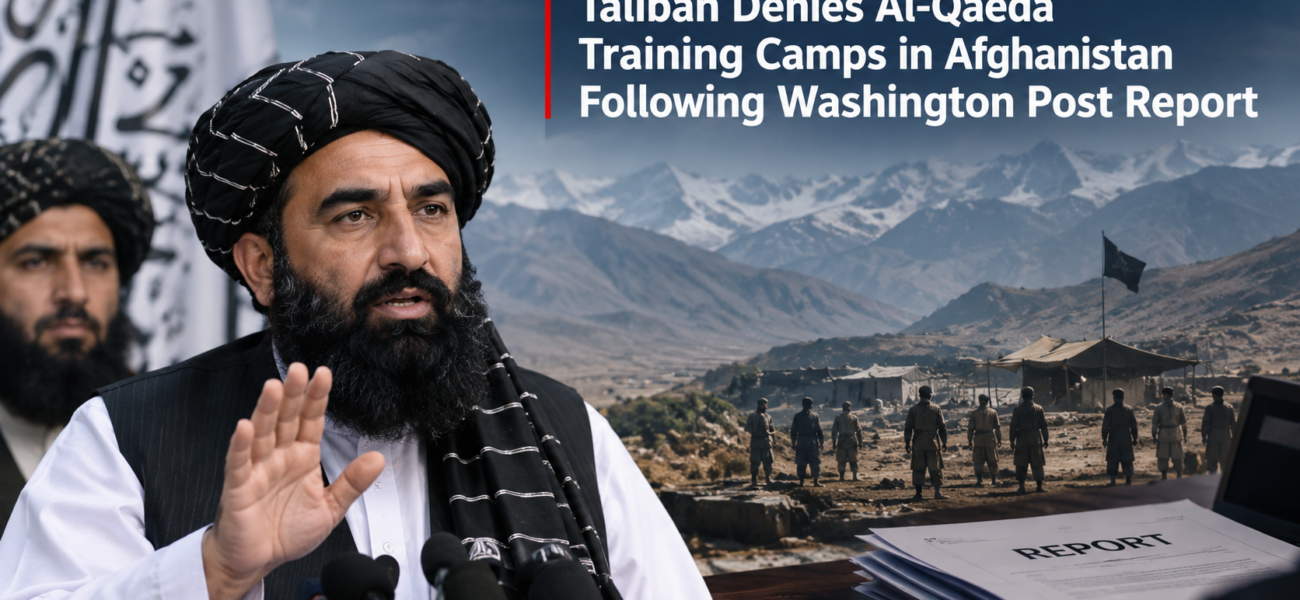
Taliban Denies Al-Qaeda Training Camps in Afghanistan Following Washington Post Report
The Taliban Has Denied This Before
On 13 September, the Taliban's chief spokesman, Zabihullah Mujahid, told the Afghan channel Tolo News that reports of al-Qaeda training camps in Afghanista...

The Taliban Has Denied This Before
On 13 September, the Taliban’s chief spokesman, Zabihullah Mujahid, told the Afghan channel Tolo News that reports of al-Qaeda training camps in Afghanistan were part of a negative campaign against his government. Such claims, he said, came from biased circles and intelligence agencies seeking to raise tension and manufacture insecurity in the region, and he insisted that no foreign group, al-Qaeda included, was present in Afghanistan and that Afghan soil was not used against any other country. The denial arrived a day after the Washington Post reported, citing United States and Western intelligence officials and a United Nations body that monitors terrorist networks, that al-Qaeda and its offshoots had established at least eight training sites in Afghanistan over the past three years. The denial is worth examining less for its content than for its lineage.
The response follows a script the Taliban has used on every allegation of sanctuary. It denied that the Tehreek-e-Taliban Pakistan operates from Afghan soil, and the United Nations sanctions monitors found that it does. It denied the presence of the East Turkestan Islamic Movement, and the same monitors, along with China’s own stated concerns, recorded otherwise. Now it denies al-Qaeda. In each case the elements are identical: reject the presence, attribute the report to hostile intelligence services, and offer nothing that could be independently checked. The consistency of the script is itself a reason for caution before accepting the latest instance of it.
The al-Qaeda denial, however, carries a heavier history than the others, because the Taliban’s record on precisely this claim is the most thoroughly discredited of all. The movement denied sheltering Osama bin Laden before 2001. In the Doha Agreement of February 2020, it committed to preventing al-Qaeda and other groups from using Afghan territory to threaten the United States and its allies, the central counterterrorism guarantee on which the American withdrawal was built. Then, in the summer of 2022, a United States drone killed Ayman al-Zawahiri, al-Qaeda’s leader, on the balcony of a house in an affluent quarter of Kabul, a residence reported to be linked to the Haqqani network that sits at the core of the Taliban government. The Taliban had said al-Qaeda was not in Afghanistan. Its leader was living in the capital.
That history is why the current reporting cannot be waved away as one newspaper’s assertion. The Washington Post drew on Western intelligence and a United Nations monitoring organisation, and its findings align with what the UN’s own sanctions monitoring team has documented for two years. That team has described a permissive environment under the Taliban that has allowed al-Qaeda to consolidate through safe houses and training camps across the country, and in earlier reporting it located new camps in provinces including Ghazni, Laghman, Parwan, and Uruzgan, along with a weapons stockpile in Panjshir and religious schools used to indoctrinate children. When Western intelligence services and United Nations monitors independently arrive at the same conclusion, the result is a documented finding rather than a rumour.
For the region, the most important detail in the reporting is where the danger now points. The groups rebuilding in Afghanistan appear, by these accounts, more focused on regional fights than on elaborate plots against the West, and they seem constrained for now by Taliban hosts wary of again drawing the wrath of global powers. That regional focus is not reassuring to Afghanistan’s neighbours. It is the opposite. According to the reporting, al-Qaeda is providing training and operational guidance to other militant groups, including the Tehreek-e-Taliban Pakistan, and is said to be involved in preparing TTP fighters and suicide bombers. Some seven thousand TTP members are assessed to be present in Afghanistan, operating from camps of their own across several provinces. The al-Qaeda infrastructure the Taliban denies is, in part, a training base for the violence that crosses into Pakistan.
This is the thread that ties the camps to the checkpoints. The suicide bombers who strike Pakistani police posts, the fighters who infiltrate across the Durand Line, and the networks that plan those attacks are not operating in a vacuum. They draw on the same permissive space, and increasingly on the same expertise, that a resurgent al-Qaeda provides. A country that hosts training infrastructure for one transnational network hosts the conditions that regenerate several, and the first to pay for that are the states next door.
Against all of this, the Taliban offers a single word, propaganda, and nothing behind it. It grants no access, permits no independent inspection, and provides no evidence for its denial beyond the assertion that those reporting the camps are biased. That is a refusal to engage rather than a rebuttal, and it is the same non-answer the movement has given every time the question has been raised. A government genuinely confident that no camps existed on its territory could allow the monitoring that would settle the matter in its favour. The Taliban does not, because the denial is a posture maintained regardless of what is found.
The world has heard the Taliban deny al-Qaeda’s presence in Afghanistan before, and those denials did not survive contact with the evidence. A movement that concealed bin Laden, pledged at Doha to bar al-Qaeda, and then sheltered al-Qaeda’s leader in its own capital is not a credible witness to al-Qaeda’s absence. When the Washington Post, Western intelligence, and United Nations monitors describe training camps and the Taliban answers with the word propaganda, the weight of the record rests with the reports. And for Afghanistan’s neighbours the matter is not one of distant history. The camps that once trained a generation to strike New York are, by these accounts, training the next to strike closer to home.
Author