

Subsidies, Profits, and Public Trust: The Real Test for the Awami Action Committee in Azad Kashmir
In every democracy, movements rise in the name of public welfare. In Azad Jammu and Kashmir, the Joint Awami Action Committee (JAAC) has taken that role, mobilizing citizens against inflation and...

In every democracy, movements rise in the name of public welfare. In Azad Jammu and Kashmir, the Joint Awami Action Committee (JAAC) has taken that role, mobilizing citizens against inflation and promising justice for the common man. Yet, the real test of any movement lies not in its slogans but in its sincerity. It is now time for the AAC to prove through action that it genuinely represents the people, not private interests.
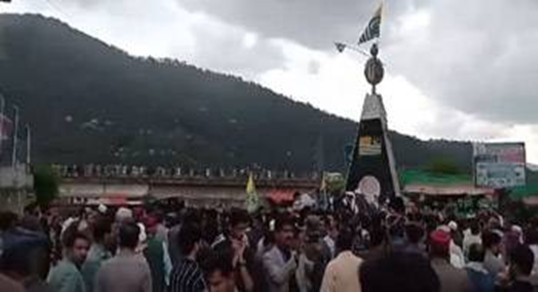
A Movement at a Crossroads
The JAAC’s challenge begins within. Many of its leaders come from the trader community, the same class accused of manipulating prices. This overlap creates a conflict of interest: those demanding relief from high costs are often the very actors driving those costs.
Take the example of wheat. A 40-kg bag of flour in AJK costs roughly Rs. 3,000, despite the region receiving heavy subsidies on wheat and electricity. In 2024, the federal government allocated Rs. 23 billion in relief funds specifically for these two sectors. With such financial support, prices in AJK should logically be lower than in mainland Pakistan. Instead, traders continue to sell at near-market or inflated rates, pocketing the difference. This means public money intended to ease inflation is effectively enriching those who are already profiting from it.
When a movement’s leadership benefits from subsidies while charging consumers high prices, it risks losing moral ground. The JAAC cannot claim to fight economic injustice while remaining silent about profiteering within its own circles.
Economic Fault Lines and Weak Oversight
Pakistan’s nationwide inflation has strained families, but AJK’s markets have become volatile. Food inflation exceeded 27 percent in 2025, with local consumer indices above the national average. Weak regulatory enforcement allows arbitrary pricing, while under-resourced consumer departments fail to hold violators accountable.
Low tax compliance deepens the problem. Studies show AJK’s tax-to-GDP ratio is among the lowest in South Asia. Many traders are unregistered; others under-declare income. Nationwide, fewer than 3 percent of traders file income tax returns. Thus, the same group that profits from subsidies often contributes little to public revenue. This imbalance perpetuates a cycle where consumers pay indirect taxes and inflated prices, while traders expand profits with minimal civic contribution.
Protest Without Reform
The Joint Awami Action Committee gained prominence in 2024 after mass protests over rising wheat and electricity prices. The government’s Rs. 23 billion relief package was hailed as a victory. Yet, prices soon rebounded, and the same grievances resurfaced in 2025. The pattern of agitation, negotiation, and temporary relief repeated, without structural reform.
A movement that aspires to genuine representation must go beyond street politics. The JAAC can either remain a protest platform or evolve into a credible reform force that promotes transparency, tax discipline, and fair trade.
Restoring Ethical Ground
This is more than an economic crisis; it is a moral one. Profit is not the enemy — exploitation is. Islamic teaching is unequivocal: “Give full measure and weight with justice” (Quran 6:152). Fairness in trade is a duty, not an option. When traders inflate prices on subsidized goods, they betray both the state and the citizen.
A Way Forward
For the JAAC to restore credibility, reform must begin at home:
- Publicly disclose members’ tax and subsidy records.
- Support a digital price-tracking system for essentials.
- Back an independent market-monitoring authority.
- Encourage an “Ethical Trade” certification for honest businesses.
Beyond Slogans
The JAAC’s own rallying cry, “Prove by actions that you stand with the people”, must now apply inwardly. If its members demonstrate integrity through transparent business practices, fair pricing, and tax compliance, they will gain more moral authority than any protest could deliver. But if they continue to profit from subsidies while blaming the system, the movement will lose its legitimacy.
The people of Azad Kashmir deserve not just affordable flour, but a marketplace rooted in honesty. The time for slogans has passed; now the measure of leadership will be integrity, in both word and deed.
Author