


Spain’s Collective Iron Will Silences French Gala, Forging a New Sporting Orthodoxy
POLICY WIRE — Dallas-Fort Worth, USA — It wasn’t the fanfare or the shimmering presence of a royal decree that truly defined Spain’s World Cup semi-final triumph; no, that came later....

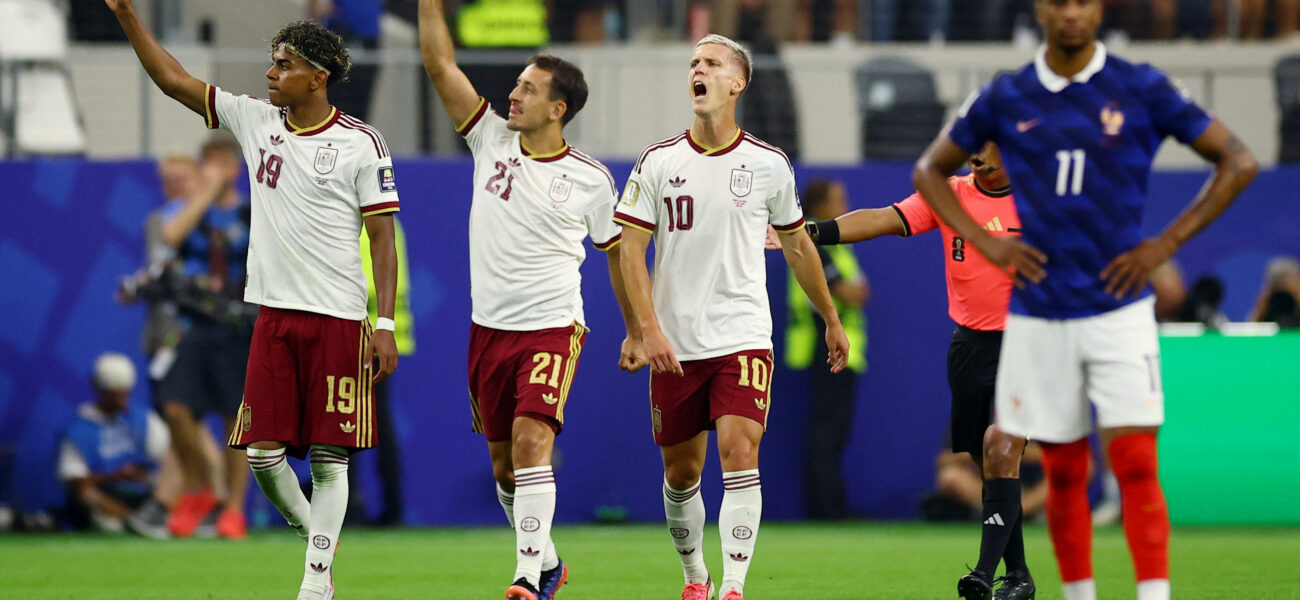
POLICY WIRE — Dallas-Fort Worth, USA — It wasn’t the fanfare or the shimmering presence of a royal decree that truly defined Spain’s World Cup semi-final triumph; no, that came later. What hit harder, right in the gut for anyone watching, was the sheer, suffocating silence of Kylian Mbappé—a global icon reduced to an afterthought against an unyielding red tide. Spain, that ever-unpredictable force, didn’t just win; they made the sport’s current darlings, France, look profoundly, tragically human.
Luis de la Fuente, the Spanish coach, later recounted the call from King Felipe VI. It’s certainly a source of pride when royalty dials you up. But the real story wasn’t who called after the whistle, it was how a team built on meticulous system-play managed to choke out the flashiest talent football has seen in years. France’s ’16 goals in six matches’ record leading up to this point meant precisely squat against a side that moved like a single, predatory organism. They showed up expecting a carnival, but found a brick wall.
This wasn’t just another game. This was a masterclass in collective effort—a symphony of precise passes, relentless pressing, and a defense that seemed to anticipate every French thought before it fully formed. De la Fuente himself pointed to the very essence of their victory: it came through “discipline, being organized, with sacrifice, with commitment, with effort.” No grand declarations of individual genius, just the quiet, grinding work of the unit. They made sure that a squad boasting generational talents found not an inch of space—almost like trying to break concrete with a butter knife.
The goals themselves were less about individual brilliance than clinical execution. Mikel Oyarzabal’s early penalty—drawn by the young phenom Lamine Yamal, a player who truly dazzled—set the tone. Then, Pedro Porro’s second-half strike solidified what everyone already knew: Spain wasn’t just holding on; they were dismantling. French coach Didier Deschamps, perhaps reflecting a touch of Gallic resignation, had to concede that [QUOTE_PLACEHOLDER] It’s an understated observation, a polite concession that must have chafed, particularly for a coach accustomed to perennial success.
You see, for all the talk of superstars, Spain’s academy system, what de la Fuente calls the [QUOTE_PLACEHOLDER] quietly churns out technically proficient players, not necessarily household names from day one. These are players taught to “interpret and read the games” with a collective consciousness. It’s a stark contrast to the often ‘hero-ball’ approach one sees elsewhere—a single talent expected to carry an entire nation on their shoulders. But in this semifinal, that familiar narrative fell apart. And for that, there’s a valuable lesson for every aspiring footballing nation, especially those outside Europe’s gilded circles.
This is a particularly potent observation for regions like South Asia and the wider Muslim world, where football—the beautiful game—is religiously followed, often despite national teams struggling on the global stage. Nations from Pakistan to Egypt, often reliant on flashes of individual flair from diaspora players or singular local heroes, could learn something from Spain’s methodical, integrated approach. Their challenge isn’t just funding; it’s embedding a deep-rooted, long-term system that fosters collective intelligence and self-sacrifice over isolated, often unsustainable, moments of individual brilliance. This Spanish victory speaks to a structural depth that transcends momentary form or star power.
📄 POLICY WIRE WHITEPAPER PUBLISHED: PAKISTAN'S NATIONAL SECURITY POLICY PRIORITIES
👉 READ BY CLICKING HERE“We’re so proud of this,” de la Fuente enthused, “We are responsible for this joy people are feeling in the streets.” It’s a genuine feeling, for sure. The team, as Oyarzabal noted, is [QUOTE_PLACEHOLDER] They carry an incredible 37-game unbeaten streak into the final, against either Argentina or England. This consistent dominance isn’t an accident. It’s a cultivated, systematic process—one that perhaps reflects a more profound, patient national character than often attributed to Spain during its past economic turbulence. They haven’t just built a team; they’ve built a belief system, from the ground up.
But the French? [QUOTE_PLACEHOLDER] admitted midfielder Rayan Cherki. “We should have done better.” Easier said than done when confronted with a wall that refuses to crack. France’s defeat marked an unceremonious end to Deschamps’ long reign. He’d [QUOTE_PLACEHOLDER] but acknowledged, “Today’s feeling is that I am not happy.” That’s understandable, especially after such a dominant run by France over recent years. They came in expected to sail through, but found the Spanish defense impenetrable. It’s a humbling, almost brutal, reminder that sometimes, the machine beats the showmen. And Spain, quite simply, had the better, more perfectly oiled machine this time around. As Pedro Porro aptly summarized their sentiment, after such an amazing game, “this is our team.” A team, perhaps, built not for celebrity, but for destiny. Find more nuanced football analysis at Fandom’s Fervor: How Sporting Triumphs Mask Regional Anxieties on a Global Stage.
What This Means
Spain’s World Cup semi-final triumph is more than a sporting event; it’s a potent geopolitical parable, a fascinating counterpoint to conventional wisdom about success. Politically, the victory provides a much-needed morale boost for a nation that’s navigated its share of internal and economic challenges in recent years. It presents a unified, effective national image on a global stage, subtly enhancing its soft power. This isn’t about military might or economic leverage; it’s about showcasing an institutional efficacy and a collective will that can be just as impactful in shaping international perceptions. This kind of success can inspire a quiet patriotism, galvanize public spirit, and even, indirectly, foster a sense of shared purpose that can transcend domestic political divides.
Economically, the implications are more subtle than immediate. A World Cup final appearance generates significant international media exposure, enhancing Spain’s brand value—potentially boosting tourism and attracting foreign investment. It underscores the success of long-term investments in sports infrastructure and youth academies, suggesting a replicable model of human capital development. For instance, the original content indicates France recorded a robust 16 goals in its six World Cup matches leading to the semi-final, an impressive statistic underscoring their attacking prowess which was, nonetheless, nullified. Such numbers, when linked to effective systems like Spain’s, suggest economic benefits from investing in comprehensive, grassroots development over a purely market-driven pursuit of individual ‘star’ acquisitions. But the biggest takeaway might be less about direct financial gain and more about the psychological capital it accrues—a sense of national achievement that, in an increasingly fragmented world, is an invaluable, if unquantifiable, asset. It signals capability, organization, and a quiet, formidable strength that nations often envy and seek to replicate, from burgeoning economies to established powers, and its reverberations can even be felt in places like the geopolitical tensions around the Strait of Hormuz where national pride, in any form, holds significant weight.