

Smoke and Mirrors: Wildfires Erase Decades of US Clean Air Progress, Report Finds
POLICY WIRE — WASHINGTON D.C. — For more than a decade, the United States meticulously scrubbed its skies. Regulatory victories meant national smog levels plummeted, a testament—or so we thought—to...

POLICY WIRE — WASHINGTON D.C. — For more than a decade, the United States meticulously scrubbed its skies. Regulatory victories meant national smog levels plummeted, a testament—or so we thought—to the efficacy of policy and hard science. But a new study suggests that hard-won progress? It’s going up in smoke, literally.
It’s not just the familiar hazy air settling over cities now; it’s a silent killer, slipping into lungs and rewriting the nation’s environmental ledger. Since 2015, smoke from increasingly larger wildfires has become the unbidden architect of America’s renewed air pollution crisis. This isn’t just about localized problems anymore, it’s about a continent-spanning menace, obliterating years of work, proving that even the most stringent domestic rules can’t wall off atmospheric contaminants—a lesson keenly understood in places like Pakistan, where cross-border haze from regional agricultural burning regularly chokes major urban centers. Air, it turns out, really knows no boundaries.
The numbers don’t mince words. From 2003 to 2015, national smog—specifically, ground-level ozone—dropped by 11% thanks to tough federal regulations on industries and vehicles. But then the fires began to rage, — and with them, that clean air trajectory snapped. Since 2015, the nation’s average ground level ozone increased by 4%. We’re not talking about a hiccup. The trajectory, according to study lead author Weizhi Deng, an atmospheric scientist at the University of Iowa, suggests that if smoke keeps increasing at this rate, smog will be back up to 2003 levels in a mere 20 years. All that effort, just… wiped out. Talk about disheartening.
The Thursday study in the journal Science calculated an increase of 318 American deaths per year since 2013 attributable to this ozone resurgence, linking it to established epidemiological studies comparing mortality rates in clean versus dirty air. And remember, that’s just ozone. A 2023 study by a similar team already flagged increased particle pollution deaths, to the tune of 670 annually, as well. Death, it seems, has found a new avenue.
Here’s the thing: fires don’t make smog directly. Nope. But they spew out precursor chemicals—chemical soup ingredients—that, when baked by sunlight, brew up ozone. “Higher daily ozone concentrations can increase asthma attacks, hospital admissions, and mortality,” said Kristie Ebi, a University of Washington public health — and climate scientist. She notes it’s “still a very important pollutant, which is why it’s regulated.” But regulating something doesn’t necessarily stop its emergence from, say, Canadian forest fires.
But the biggest punchline of all this? We weren’t even truly seeing the problem until now. The US Environmental Protection Agency has limited smog monitor coverage—about 2% of the nation, mostly urban. So Deng and his crew, like modern-day detectives, cobbled together satellite, pollution, and weather data, then tossed in artificial intelligence to create a comprehensive nationwide picture. EPA figures, relying on those sparse monitors, only showed ozone levels vacillating since 2015. Deng says, “by considering everywhere in the U.S., we actually found an increase in ozone starting from 2015.” Because, you know, monitors don’t exist everywhere fires do.
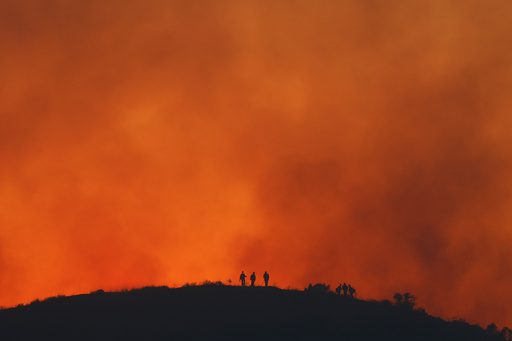
The reach of these wildfires is astounding. Much of the really nasty stuff in 2022, 2023, — and even 2024? It blew down from Canada. The image of orange skies over New York — and people wearing masks on the East Coast in 2023 isn’t some abstract memory. That year, Canada’s land burned not only broke records, but doubled the old one. Brendan Rogers of the Woodwell Climate Research Center wasn’t just pulling figures out of thin air. In fact, a 2025 study linked that particular blaze to 82,100 global deaths from particle pollution alone, with 33,000 of those right here in the United States.
And then there’s the usual suspect, whispering behind the curtain: climate change. Burning coal, oil, and gas intensified Canada’s 2023 fire season by at least 50% and doubled the chances of the hotter, drier weather needed for such infernos. “Human-caused climate change is an important contributor,” Lixu Jin, an atmospheric scientist at Rutgers, stated. And that’s the brutal calculus we’re left with: we clean up our cars, but the planet gets hotter, and the fires just… nullify the effort. For 43 million people exposed to unsafe smog levels—even by the EPA’s current, arguably lax, standards—this isn’t some academic exercise.
Former EPA Administrator Gina McCarthy, from the Obama years, can’t mask her disillusionment. Wildfires cause devastation, yes, but she argues [QUOTE_PLACEHOLDER] Then she puts it bluntly: “So the big question is, when are we going to stop the nonsense from this administration to burn more and more ‘beautiful’ fossil fuels?” A pointed query, indeed, that many would like an answer to. You can find more perspectives on the complex interplay of economic pressures and environmental policy at The Stress Fracture Economy.
What This Means
This report isn’t just another scientific paper; it’s a policy landmine. First, it blows a rather gaping hole in any narrative suggesting a straightforward, domestic approach to environmental clean-up is enough. The air we breathe is a global commons, and Canadian fires impacting American health, or South Asian air quality being dictated by distant stubble burning, drives that home with uncomfortable clarity. Expect heightened diplomatic conversations—or at least finger-pointing—over cross-border pollution controls and climate change mitigation, especially as climate impacts become more acute. Politically, this complicates everything. An administration might brag about domestic emissions cuts, but if transboundary smoke means your constituents are literally dying, those boasts ring hollow. It’s a direct challenge to the notion of national environmental sovereignty. Economically, the human toll isn’t free. The healthcare costs, lost productivity, and—let’s be grim—the increased mortality figures carry a staggering price tag, adding yet another stress fracture to the nation’s fiscal health. And frankly, it’s a powerful, almost tragic, indictment of the snail’s pace of global climate action, showing how our biggest wins can still be undone by larger, unaddressed forces.