

Shanghai’s Iron Glove: The Subtle Art of State Control, Two Decades On
POLICY WIRE — Shanghai, China — On a crisp New Year’s Day some eighteen years ago, on Nanjing Road, one of Shanghai’s bustling thoroughfares, a rather curious public display unfolded. A member of the...

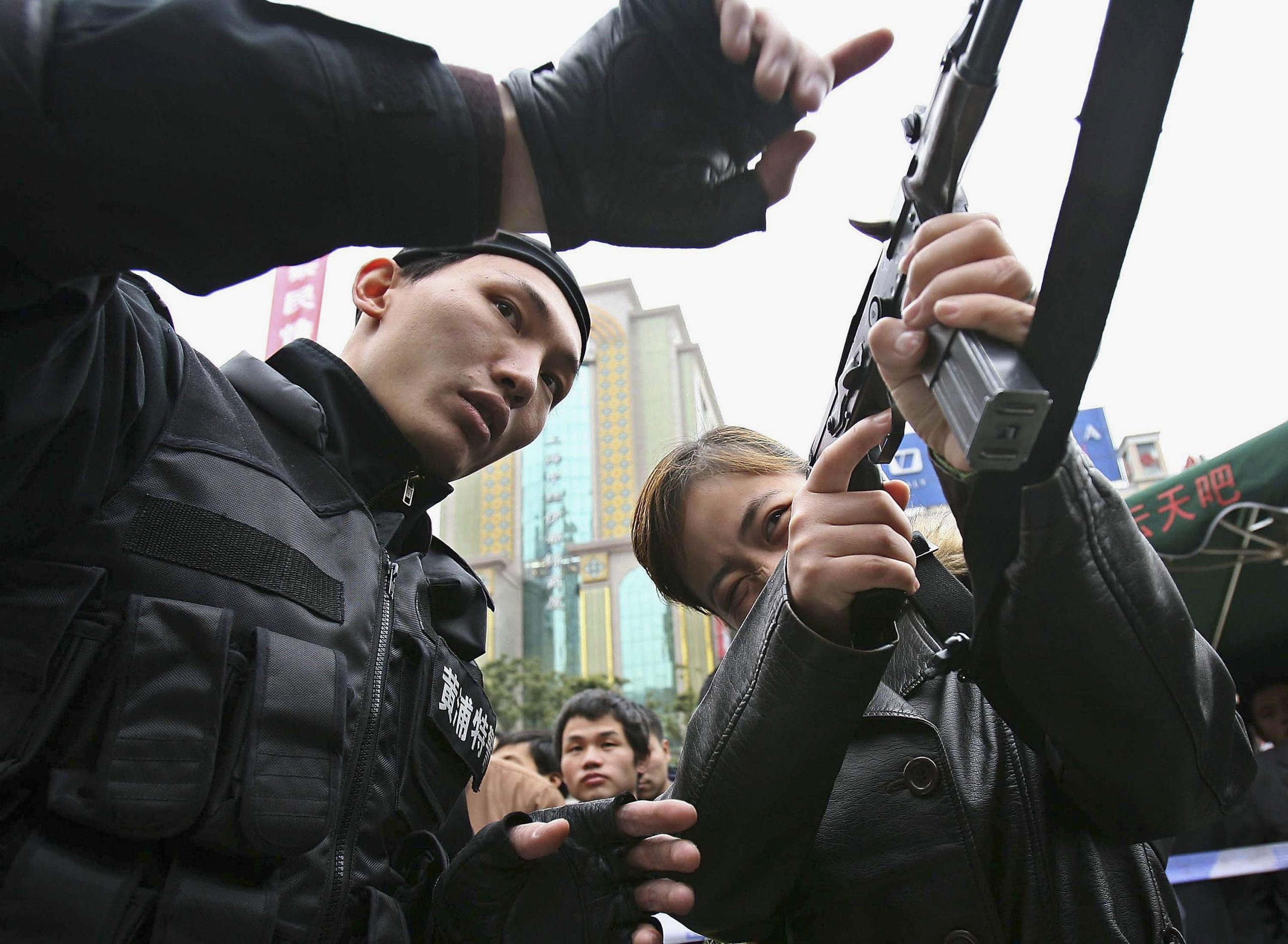
POLICY WIRE — Shanghai, China — On a crisp New Year’s Day some eighteen years ago, on Nanjing Road, one of Shanghai’s bustling thoroughfares, a rather curious public display unfolded. A member of the Huangpu District SWAT Team, a figure draped in state authority, demonstrated the finer points of firearm handling—not to a fellow officer, but to a civilian woman, her hands tentatively wrapped around a weapon. Local media, ever keen to toe the official line, quickly framed the spectacle as a public relations coup, an earnest effort to “improve police image” and foster “community relations.” A benevolent gesture, perhaps, from a government keen on optics.
But hindsight, as they say, sharpens the picture. That seemingly benign photo opportunity from January 1, 2006, wasn’t just about fuzzy feelings between cops and citizens. Not really. It was, instead, a fleeting glimpse into the subtle, meticulously orchestrated ballet of state control that China has refined over decades—a playbook for projecting power, normalizing its presence, and embedding authority deep within the everyday fabric of its sprawling society. This wasn’t merely public relations; it was the quiet, almost invisible militarization of the public consciousness.
Because, you see, it’s not just about a woman holding a gun. It’s about who gives her the gun, the message that sends, — and the implied contract of participation. Major General Fu Qiang, then a senior analyst with the Chinese People’s Liberation Army National Defense University (PLA-NDU), had a characteristically laconic take on such events at the time. “These initiatives,” he’d observed during an unofficial briefing years ago, “show the transparency and accessible nature of our public security forces. It’s about understanding, not just enforcement. Building bridges with the people.” A reassuring narrative, to be sure.
Fast forward, — and those ‘bridges’ have morphed into sophisticated networks, both digital and physical. The public’s seemingly voluntary engagement with security matters—from ubiquitous surveillance cameras lauded for their efficiency, to civilian patrol groups—is now part and parcel of what some term a ‘smart authoritarianism.’ It’s a system where citizens aren’t just policed; they’re subtly enlisted into the maintenance of order, albeit on the state’s terms. And that little handgun lesson on Nanjing Road? It was an early brushstroke in this grand design. Not a pivotal moment in itself, no, but a data point. A telling one.
“They’re exceptionally adept at reframing coercion as collaboration,” remarked Dr. Eleanor Vance, an Asia security expert at the London School of Economics, in a recent interview. “Whether it’s a woman learning to shoot or an AI predicting dissent, the underlying strategy is about proactive state omnipresence. It’s a soft power play with a hard-nosed foundation.”
This subtle art of integration isn’t confined to China’s borders, either. As Beijing’s economic footprint expands across the globe through initiatives like the Belt and Road (BRI), so too does its influence on security frameworks in partner nations. Pakistan, for instance, a steadfast ally and a key node in the BRI, has seen increasing cooperation with China on security matters. This extends beyond conventional arms deals—and according to the Stockholm International Peace Research Institute (SIPRI), China’s exports of major arms grew by 53 percent between 2018 and 2022 compared to 2013–17, with Pakistan being a primary recipient—to training, surveillance technology, and even joint policing exercises. It’s a full-spectrum influence, echoing China’s domestic methods of social control.
It’s not hard to see why these models appeal to states keen on stability and, perhaps, less keen on messy liberal democratic ideals. From Karachi to Khartoum, the efficiency of centralized control, perfected through seemingly innocuous public engagement back in 2006 Shanghai, resonates with regimes prioritizing order above all. They’ve managed to create an environment where security isn’t an external imposition but feels like a shared civic responsibility. What’s often overlooked, of course, is who defines ‘responsibility,’ — and at what cost to individual liberties.
What This Means
The 2006 Shanghai event, seen through the lens of nearly two decades, wasn’t merely a quaint exercise in public relations; it represented a microcosm of China’s long-game strategy in governance. Politically, it signals a deeper integration of public security functions into the everyday lives of citizens, blunting potential dissent by co-opting participation. Economically, this model supports an internal market for advanced surveillance and security tech—think AI-driven policing and ubiquitous monitoring—which Beijing now actively exports. For nations in the Global South, particularly in South Asia and the broader Muslim world, China offers an alternative security paradigm: efficient, technologically advanced, and shorn of the human rights entanglements often associated with Western assistance. But it’s a package deal, offering order at the expense of certain freedoms. The ‘community relations’ photo op on Nanjing Road was never about democratic engagement. It was always about showing the people who held the power, and gently, very gently, inviting them to hold it too—on behalf of the state. That’s a powerful message, one that continues to reshape geopolitical landscapes from China’s megacities to the strategic ports of Pakistan.