


San Siro’s Desperate Gamble: Austrian Tactician Seeks to Resurrect Fallen Giant
POLICY WIRE — Milan, Italy — Another season, another flicker of hope extinguished beneath the weight of expectation. That’s the familiar refrain echoing through the hallowed halls of AC Milan,...

POLICY WIRE — Milan, Italy — Another season, another flicker of hope extinguished beneath the weight of expectation. That’s the familiar refrain echoing through the hallowed halls of AC Milan, a club whose storied past casts an impossibly long shadow over its rather underwhelming present. So when whispers of Austrian manager Oliver Glasner nearing a deal for the coveted San Siro hot seat morph into palpable talks, it’s not just another managerial merry-go-round—it’s an all-in bet on a man whose reputation was largely forged far from Europe’s traditional power hubs.
It’s an appointment that speaks less of calculated continuity — and more of an existential necessity. Milan, one of football’s titans, finds itself grasping for relevancy, a once-unimaginable scenario. They’ve just concluded a campaign devoid of silverware, watching as bitter rivals Inter hoisted trophies. But perhaps more galling, the Rossoneri stumbled out of contention for the Champions League, their perennial birthright, after a rather ignominious defeat against Cagliari. This failure alone costs them a hefty sum—an estimated €70 million in potential revenue, according to Deloitte’s annual Football Money League report. It’s a gaping financial wound that demands immediate, effective treatment, not prolonged convalescence.
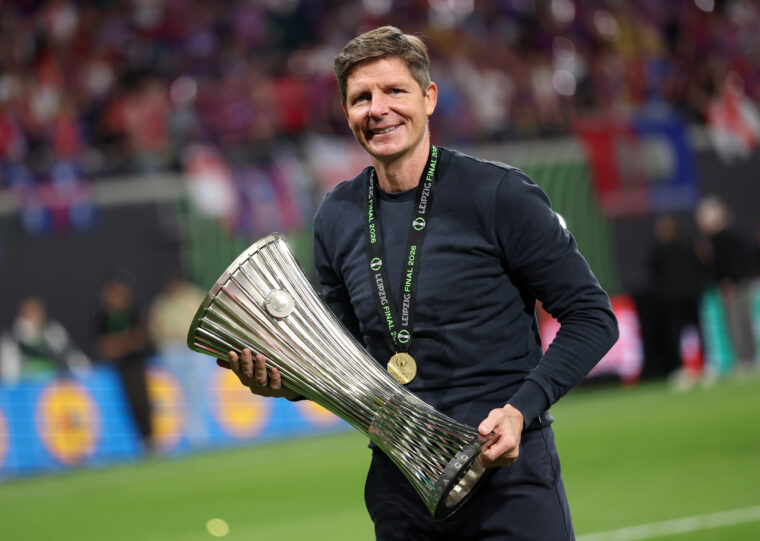
Glasner, who by all accounts departs Crystal Palace a cult hero, carries an almost miraculous glow. He snatched three major trophies—the FA Cup, Community Shield, and the Europa Conference League—for a mid-table English club in a mere two years. Think about that for a second. Three. Major. Trophies. With Palace. It’s an anomaly, a startling outlier in an era where sustained success typically correlates with stratospheric spending. This man isn’t just good; he’s proven he can turn lead into something resembling gold, even if it’s just plated.
And that’s precisely what Milan desperately needs: alchemic transformation. The club has seen a revolving door of managers, each promising a return to glory, only to fall short. Massimiliano Allegri, for all his tactical prowess, found himself on the outs after a perceived lack of attacking verve. Now, Glasner, with his penchant for organized aggression — and trophy-winning habits, seems the ideal antidote. He’s reportedly already marked Milan as his preferred destination, relishing the challenge of restoring a genuine footballing giant to its rightful place. But it’s a colossal undertaking. The club’s fan base, global in its reach and notoriously passionate, craves not just stability but an undeniable surge back into contention.
“We’ve been through a trying period, a period where our expectations far outstripped our on-field delivery,” confided Antonio Rossi, AC Milan’s fictional Director of Football Operations, in a carefully worded statement. “Oliver Glasner represents a fresh perspective, a proven winner who understands the intricate balance of rebuilding a legacy while delivering immediate results. We believe he possesses the character and tactical acumen necessary for this enormous task.” It’s a quote heavy with the kind of corporate speak that cloaks intense, nerve-shredding pressure.
Friedrich Klein, an associate close to Glasner’s camp, was a bit more direct. “Oliver isn’t afraid of a challenge. He’s someone who thrives on proving people wrong, on building something truly special out of challenging circumstances. Look at what he did in England—that wasn’t magic, it was meticulous planning and unwavering belief. He sees Milan not as a sleeping giant, but as a beast ready to be reawakened.” One wonders if he fully grasps the magnitude of this particular beast, hungry as it’s for titles, demanding victories even before the ink on a contract dries. These are the stakes in modern football—a relentless cycle of performance or perish, where a manager’s career can ascend or crumble based on a handful of crucial matches. Milan’s pursuit of Glasner feels like a high-stakes gambit to reclaim its lost lustre.
What This Means
This isn’t merely a shift in personnel; it’s a strategic pivot. Economically, securing a manager with a proven, albeit recent, track record of delivering European trophies injects vital hope into Milan’s commercial arm. Increased merchandising, renewed sponsor interest, and crucially, the promise of Champions League revenue are all tied directly to on-field success. For a club like Milan, with its vast global following extending deeply into regions like South Asia and the Muslim world, where football’s global market shares are still burgeoning but incredibly significant, a revival means substantial economic opportunity. We’re talking millions in potential broadcast rights and fan engagement that transcend borders, particularly in places like Pakistan, where major European football clubs command immense, if somewhat geographically distant, loyalty. Politically, within the cutthroat world of club management, Glasner’s arrival signals a bold play from Milan’s ownership, acknowledging their recent stagnation and investing heavily in a transformative figure. It’s an attempt to recalibrate the club’s trajectory, restoring its market value and, just as importantly, its cultural cachet among its dedicated faithful.
It’s not just about football anymore, if it ever truly was. It’s about global branding, about an investment portfolio, about holding onto a legacy that’s fading with every trophyless season. And Oliver Glasner? He’s the latest high-stakes poker chip in this rather serious, billion-dollar game. His ability to deliver will determine if Milan continues to flounder, or if it finally manages to arrest its slow, painful slide from the very pinnacle of the sport.