


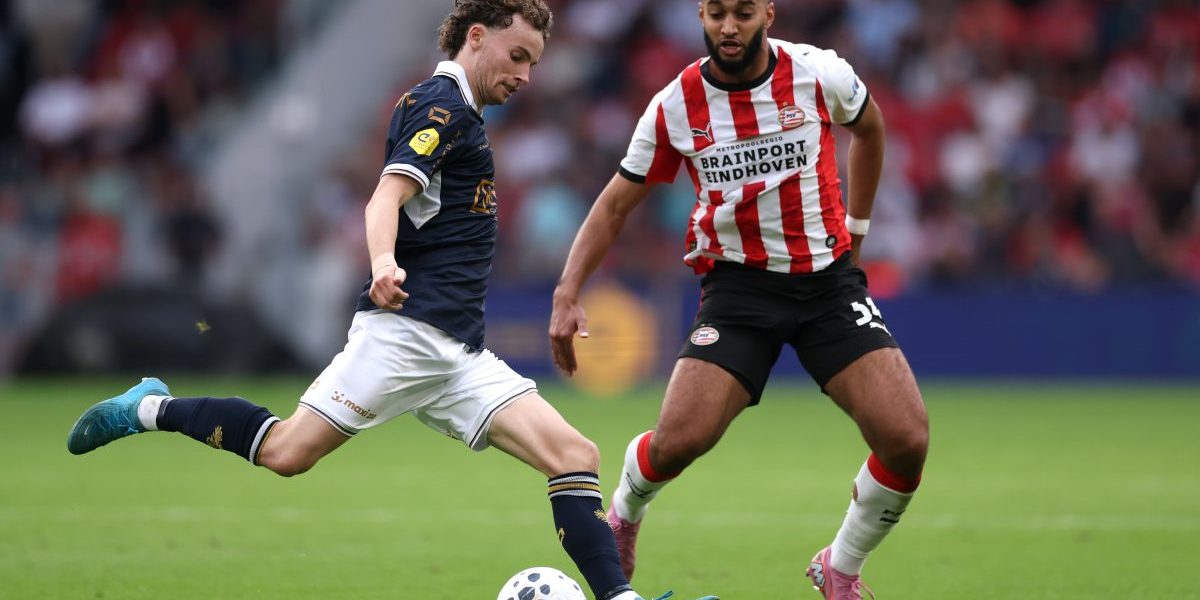
Saint-Étienne’s Big Bet: Danish Talent Breum Arrives
AS Saint-Étienne signs Jakob Breum, a 22-year-old Danish talent. This strategic move is a make-or-break bet for the struggling French giant's return to Ligue 1.

POLICY WIRE — Paris, France — Another Danish import, another hopeful gaze fixed on a European giant, though Saint-Étienne isn’t quite the titan it once was. Call it a wager. A calculated gamble in a transfer market where a good pair of boots now costs more than some national GDPs. AS Saint-Étienne, the storied French club, is reportedly poised to ink Jakob Breum, a 22-year-old attacking midfielder from the Netherlands’ Go Ahead Eagles. It’s not a splashy headline—not Ronaldo to Saudi Arabia, nor Mbappe’s protracted sagas. But for those watching the silent churn of European football’s economic undercurrents, it’s a transfer that whispers volumes about ambition, austerity, and the relentless hunt for undervalued talent.
Voetbal International, a Dutch outlet, spilled the beans. Agreement? Done. Medical? Imminent. A four-year deal, extending to 2030, with an option for an extra year. That’s faith in a kid, or a calculated strategy to lock down an asset that could balloon in value. It’s what smaller clubs do: nurture, then sell. But Saint-Étienne? They’re on the buyer’s end, trying to reclaim some faded glory. They’re chasing promotion back to Ligue 1, which isn’t just about sporting pride; it’s about the very solvency of the enterprise, the broadcast revenues that keep the lights on and the academies funded.
“We don’t buy stars; we buy potential. That’s the cold reality of our economic landscape right now,” stated Roland Romeyer, President of AS Saint-Étienne, in a recent, somewhat exasperated, interview. “The era of throwing vast sums at aging legends? It’s done, particularly for clubs like ours. We’re rebuilding, brick by bloody brick, — and talent identification is our primary weapon. Breum represents that focus. He’s young, he’s hungry, — and he’s got the numbers to back it up.”
Breum, a Danish Under-21 international with six caps, isn’t an unknown quantity. He came up through the Odense BK academy. You know, where they still value old-school technique. During the 2025-26 season with GAE, he started in 32 of 37 matches. He delivered the goods on 13 occasions, scoring six goals and chipping in with seven assists, according to stats from *Voetbal International*. That’s respectable. He even got a taste of the Europa League, squaring off against the likes of OGC Nice and, rather inconveniently for his future club, Olympique Lyonnais—ASSE’s eternal rivals. You can bet that last tidbit won’t be lost on the faithful at the Stade Geoffroy-Guichard.
And so, Breum becomes the latest cog in the elaborate, sometimes absurd, global machinery of football transfers. From Pakistan to Panama, kids kick a ball, dreaming of exactly this—a move to a European club, however modest its current standing. Because it’s the gateway. It’s the chance to prove you belong, that you’re worth something in a multi-billion dollar industry that still manages to feel intensely local, yet simultaneously universal. Consider the economic gravity pull, the ‘silent slide’ of talent, if you will, toward these established, money-rich leagues. But what happens when the gravitational source itself, a club like Saint-Étienne, is struggling for altitude?
📄 POLICY WIRE WHITEPAPER PUBLISHED: PAKISTAN'S NATIONAL SECURITY POLICY PRIORITIES
👉 READ BY CLICKING HEREJean-Michel Aulas, the former president of bitter rivals Olympique Lyonnais, offered a characteristically sharp-tongued take from his perch of semi-retirement. “Saint-Étienne? They’re grasping at threads, always have been,” he quipped. “This Breum is decent, certainly. But a single signing won’t erase years of strategic missteps. You need a deeper well of talent, a consistent vision. It’s not a romantic play; it’s business. And their business model has been shaky, to put it politely.” He’s not wrong, you know. Football’s a zero-sum game sometimes, especially at the margins where ambition battles with austerity.
The global audience for French football—including a growing contingent from the Middle East and North Africa—will be watching. Because for many, it’s not just about the specific club, it’s about the narrative: the underdog striving for glory, the individual rising against the odds. It’s about more than just football; it’s a proxy for aspirations.
What This Means
This transfer isn’t just about a player changing shirts; it’s a microcosm of the pressures on legacy European football clubs outside the elite tier. Saint-Étienne, once a dominant force, now finds itself in Ligue 2, fighting tooth — and nail to reclaim its spot. Breum’s signing reflects a strategy rooted in shrewd scouting rather than deep pockets—a necessity when you’re not swimming in Champions League cash. The success of such a player is critical, not just for points on the board, but for future transfer value, which can directly impact the club’s financial health. It’s a make-or-break bet. For clubs of their ilk, each promising young talent isn’t just an addition to the squad; they’re an economic lifeline, a lottery ticket. The ripple effect extends even beyond France; these kinds of transfers keep the development pipelines running in countries like Denmark and the Netherlands, ultimately fueling the larger ecosystem that drives player movements and, frankly, the hopes of countless youngsters around the world. But it also highlights the increasing commercialization where player success isn’t purely athletic; it’s financial, a stark reminder of the economic currents reshaping European football.