


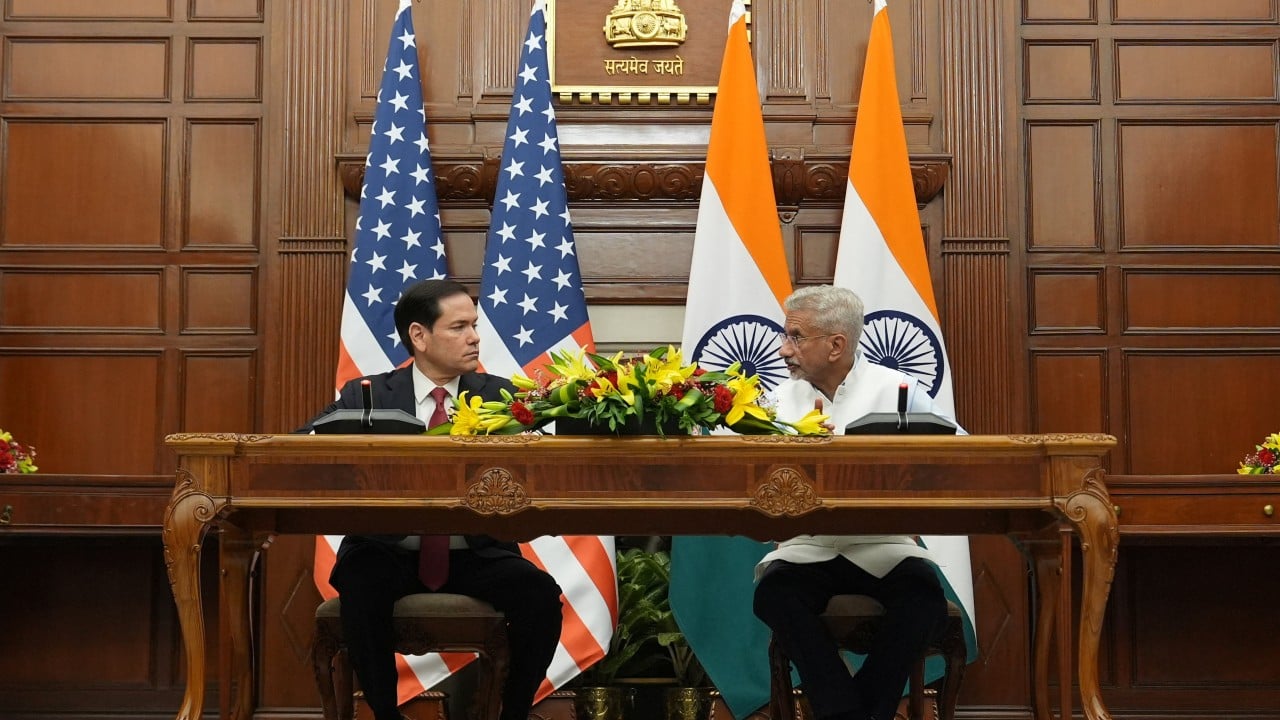
Rubio’s Delhi Jaunt: An Optical Fix Amidst Geopolitical Jitters
POLICY WIRE — New Delhi, India — There’s an old saw in diplomacy about fixing the window dressing before the foundation crumbles. American diplomatic missions abroad often embody this...

POLICY WIRE — New Delhi, India — There’s an old saw in diplomacy about fixing the window dressing before the foundation crumbles. American diplomatic missions abroad often embody this principle, and nowhere is it more evident than in Secretary of State Marco Rubio’s latest sashay through New Delhi. The talking points? Cooperation, of course. Always cooperation.
It’s a peculiar thing, this ritual of high-level visits. The handshakes are firm, the smiles practiced, — and the joint statements predictable. But beneath the polished veneer, Washington—or at least the folks shaping the narrative—seem to acknowledge that something isn’t quite right with its biggest Asian gamble, India. Call it a charm offensive, if you like, but it feels more like an acknowledgment that the American lens on US-India ties has become, well, smudged. Rubio’s jaunt was clearly designed to “get the optics right” regarding ties between the two sides. They’ve certainly got their work cut out for them, what with persistent friction over unresolved trade issues and broader international cooperation continually nipping at their heels.
And let’s be honest, getting the optics right isn’t just about New Delhi; it’s about a complex, multi-faceted engagement across a contentious region. The diplomatic song and dance, frankly, usually hits the same familiar notes: trade, energy, defense, maritime security. Rubio stressed cooperation on trade, energy, defence and maritime security in meetings with Indian Prime Minister Narendra Modi and External Affairs Minister Subrahmanyam Jaishankar. This was, as one might expect, right after his Sunday arrival in the sprawling chaos of New Delhi. Jaishankar said that the two [QUOTE_PLACEHOLDER], which for all its vagueness, indicates a meeting of minds, or at least a public appearance of one.
But the subcontinent is a tough crowd. Any diplomatic tightrope walk between Washington — and Delhi automatically raises eyebrows in Islamabad. Pakistan, for its part, watches these engagements like a hawk, sensing shifts in regional allegiances, always alert to anything that tips the scales too far. This isn’t just about ancient rivalries; it’s about strategic positioning in a theater that stretches from the Afghan borderlands to the Indian Ocean. Every U.S. overture to India, no matter how framed, is inevitably parsed through a security-centric, historically tense Pakistani filter. You can’t make a big move here without considering the ripples.
Consider the Quad talks – the Quadrilateral Security Dialogue, that club of democracies comprising the US, India, Australia, and Japan. It’s meant to project a unified front against certain regional powers, a subtle nod and a wink towards China’s growing influence. But here’s the rub: if the foundational bilateral relationship (US-India, in this case) isn’t operating on all cylinders, how effective can a multilateral grouping truly be? It’s like trying to run a marathon on one good leg; you can try, sure, but it’s probably gonna be slow going, and frankly, painful.
The energy deals mentioned in dispatches are another interesting layer. America, after all, isn’t shy about wanting to be the world’s preferred energy partner. India, a nation hungry for power to fuel its astronomical growth (which, by the way, has seen a compound annual growth rate of roughly 6.5% over the past two decades, according to the World Bank), offers a lucrative market. It’s a transaction as old as global politics: resources for influence, capital for stability. But economic partnership isn’t just a matter of signing checks; it requires consistent political will, something that’s proven erratic over the years between these two, a classic push-and-pull situation.
And let’s not forget the defense angle. Washington’s eagerness to sell more hardware to India—shifting it away from Russian reliance, among other things—is no secret. The intent is clear: draw India deeper into the Western orbit, creating a stronger counterweight in Asia. Yet, India plays its own game. It always has. This isn’t some junior partner taking marching orders; it’s a behemoth with its own distinct interests, its own strategic calculus. This dance of influence and independence—it’s what makes the US-India relationship such a fascinating, exasperating case study. Delhi’s shrewd gambit has always been to maintain strategic autonomy, and that’s not changing anytime soon, no matter how many smiles Rubio gets.
What This Means
Rubio’s visit underscores Washington’s unease about the perceptible drift in its relationship with India. It’s less a groundbreaking shift — and more an admission that the shine has worn off, compelling the U.S. to overtly address the optics. Economically, expect renewed pushes for specific trade concessions and expanded energy infrastructure collaboration, aimed at solidifying market access for American firms while nominally bolstering Indian development. Politically, the overtures aim to stabilize India as a critical node in Washington’s broader Indo-Pacific strategy, particularly as regional competition heats up. But this strategy isn’t a solo act. The lingering ghost of Kashmir and its fallout across the Muslim world (as well as America’s own Muslim diaspora), alongside Islamabad’s ever-present concerns, means any perceived tightening of US-India ties invariably complicates America’s nuanced engagements across the wider Islamic world. The delicate balancing act the US has attempted for decades – engaging India while not entirely alienating Pakistan – gets harder with every high-profile handshake. They’re trying to project strength — and unity, but the internal squabbles and the regional sensitivities? Yeah, they’re still there, bubbling right beneath the surface.