


Rewriting Antiquity: 8,000-Year-Old Plaster Shakes Up Conventional History
POLICY WIRE — Jerusalem — Forget your high school history books—those neat timelines of Roman ingenuity? Well, they’ve just taken an 8,000-year beating. That’s a serious wallop, not just...

POLICY WIRE — Jerusalem — Forget your high school history books—those neat timelines of Roman ingenuity? Well, they’ve just taken an 8,000-year beating. That’s a serious wallop, not just a gentle nudge. Turns out, a technological feat long pegged to the engineering might of ancient Rome was, in fact, old news to folks living way, way before Caesar ever wore sandals. It’s a reminder, I suppose, that our tidy narratives about human progress often unravel quicker than a cheap suit in a sandstorm.
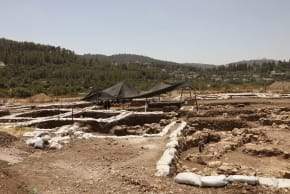
Recent archaeological findings near Motza, just outside Jerusalem, have dramatically upended the accepted timeline for advanced construction materials. What experts previously attributed to the sophisticated building practices of the Roman Empire—namely, the precise plaster-making technique
—was, it appears, in full swing some 8,000 years earlier
in this very region. Think about that for a second. We’re talking about an entire span of human history—the rise and fall of countless empires, the dawn of writing, the invention of the wheel—all fitting neatly into that yawning gap. [QUOTE_PLACEHOLDER]
And when I say plaster-making technique
, we’re not talking about some rudimentary mud-and-straw concoction. We’re talking sophisticated chemistry here, materials that demanded a serious understanding of geology and calcination, a mastery of high temperatures, and a careful mixing process. This wasn’t accidental. It represents a systematic knowledge that points to complex societal structures and a deeply rooted architectural tradition. We’re consistently underestimating our forebears, aren’t we?
But the Motza revelation—it’s not just a footnote in an obscure archaeological journal. It re-calibrates our understanding of innovation itself. It suggests that these fundamental construction methods didn’t suddenly appear with the Roman legions, but evolved slowly, regionally, across swathes of the ancient Near East. These early settlers, who built and perhaps embellished their homes, were chemists of their day, even if they didn’t know a beaker from a brick.
It’s always the same story, isn’t it? Something thought to be groundbreaking in one era gets exposed as ancient in another. Consider how rapidly our own digital advancements are viewed through a lens of inevitable obsolescence. These long-ago innovations demonstrate human ingenuity is persistent, geographically diverse, and frankly, a bit cocky in assuming our modern superiority. We tend to centralize genius in places we find comfortable, then get slapped with inconvenient truths like this.
This historical revision has ramifications for how we view the very origins of settled life, particularly across the Fertile Crescent—a cradle of civilization that includes not only modern-day Israel but also crucial parts of Iraq, Syria, Lebanon, and, yes, Pakistan’s ancient Indus Valley regions. The sophistication discovered at Motza challenges a euro-centric view of technological development. The implications stretch to sites like Mehrgarh in Balochistan, Pakistan, where evidence of early agriculture and even dentistry—albeit rudimentary—predates many European advancements. This regional continuity of innovation, often overlooked, deserves serious academic re-evaluation. Because these communities weren’t just surviving; they were building, experimenting, and mastering their environments in ways we’re only now appreciating.
And what’s particularly telling about this finding is its precision. Scientists examined samples and determined that the specific method of preparing limestone to create a durable, binding plaster was used at Motza
and was remarkably similar to what’s been seen millennia later. The analysis revealed not only the material but the deliberate processes involved. One study from the Hebrew University of Jerusalem’s Institute of Archaeology, published in the journal PLOS One, details evidence of lime plaster dating back roughly 12,000 years, showing an incredible, early grasp of pyrotechnology for material transformation. That’s some serious old-school chemistry.
But doesn’t this put a bit of a wrinkle in the idea that big empires somehow invent everything worth inventing? Motza was, presumably, a comparatively small settlement at the time. Yet, its residents mastered a technology that fundamentally changed how people built shelter and, by extension, how societies functioned. It’s enough to make you wonder what other secrets the ground holds, waiting to challenge our neatly cataloged history.
What This Means
This archaeological bombshell carries significant weight, reaching far beyond dusty excavation sites. Politically, it complicates any narrative of singular cultural or regional superiority regarding technological origins. When advanced methods like this pop up independently, or far earlier than expected, in diverse locations like the Levant, it dismantles simplistic historical progression models. For countries like Pakistan, grappling with narratives about their own ancient heritage, it provides compelling ammunition for highlighting their integral role in global human innovation—a historical weight often minimized in broader Western academic circles. Economically, understanding these early material sciences offers fresh perspectives on resource management and early trade networks. These folks weren’t just cooking up dinner; they were refining materials for buildings that still impress us. It suggests an early form of industrial capability, albeit on a micro-scale, where specialized knowledge would have been highly valued and likely passed down through generations. Such discoveries continuously force us to reassess foundational assumptions about how technology spread, how societies organized themselves, and where the true genesis of modern life actually lay. It’s a humbling, — and frankly, thrilling shake-up to the intellectual establishment. These finds are priceless in pushing against a homogenizing global history. They remind us of the independent sparks of genius that ignited across the globe, not just in predictable pockets.