

Rethinking Governance: How Smaller Administrative Units Can Build Stronger States
Pakistan’s debate over creating additional provinces should be approached not as a question of dividing the country, but as a question of how to make the state more effective, representative and...

Pakistan’s debate over creating additional provinces should be approached not as a question of dividing the country, but as a question of how to make the state more effective, representative and responsive to its citizens. As Pakistan’s population has expanded and regional economic and geographic realities have become increasingly diverse, there is a strong case for examining whether the existing provincial structure remains the most effective model for delivering governance and development.
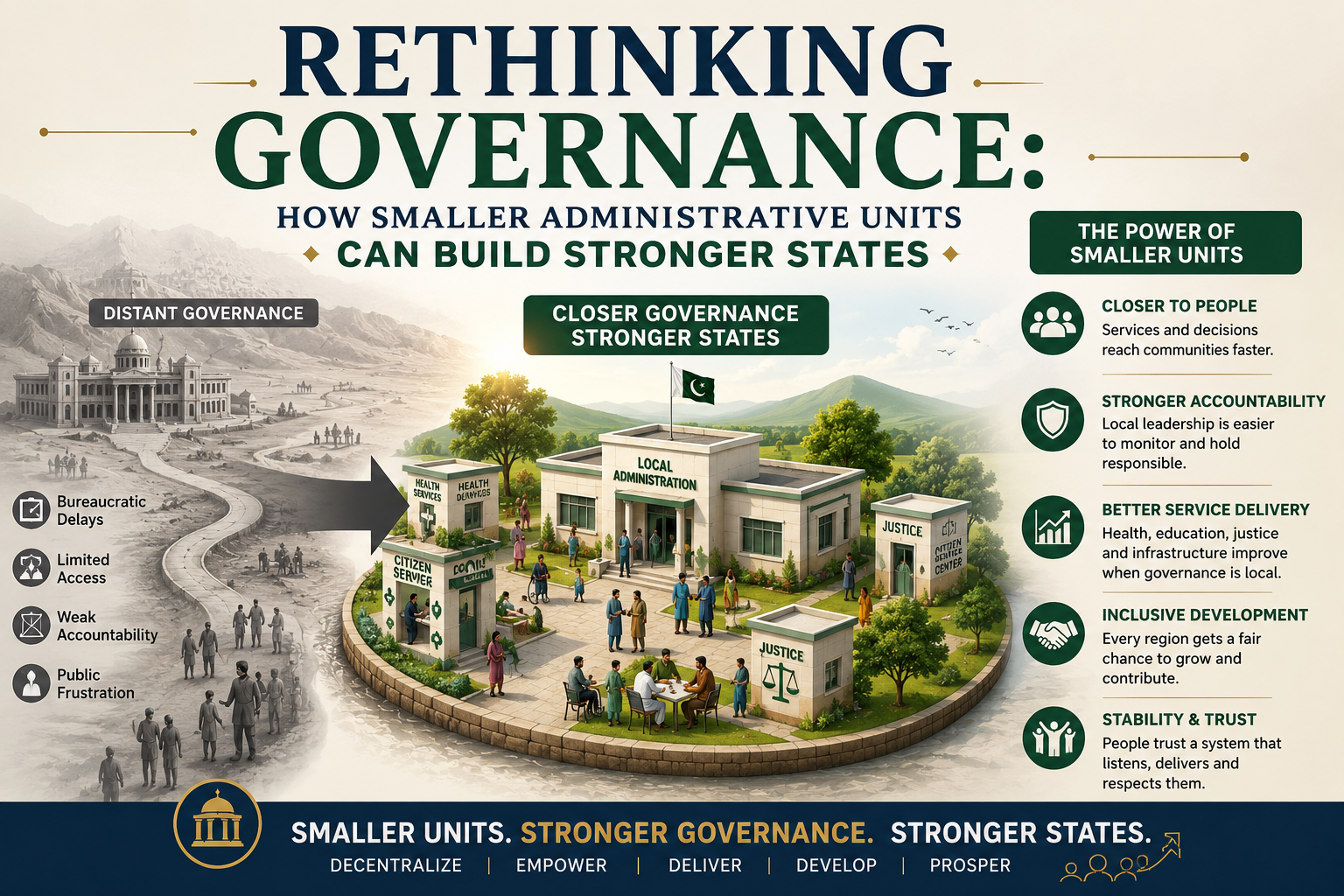
Pakistan’s population has increased more than sixfold since independence, while its four-province structure has remained fundamentally unchanged. Today, the provinces contain vastly different demographic, geographic and economic realities. Punjab has a population exceeding 120 million, while Balochistan covers almost 44 percent of Pakistan’s territory but has a much smaller population. Khyber Pakhtunkhwa combines densely populated urban centres with mountainous and geographically remote districts, while Sindh contains both a major megacity and extensive rural areas. These differences create governance challenges that cannot always be addressed effectively through highly centralised provincial administration.
The consequences of weak or distant governance are visible in Pakistan’s human-development challenges. More than 25 million children remain out of school, while malnutrition and child stunting continue to affect millions of children. Healthcare access, employment, infrastructure and food security also vary considerably between regions. These challenges are not evidence of a failure of Pakistan as a state; rather, they demonstrate the scale of the governance challenge facing a rapidly growing country.
This is where administrative decentralisation deserves serious consideration.
Smaller provinces could bring decision-making closer to the populations affected by government policies. A provincial government responsible for a more manageable population and a more coherent geographic area could potentially identify local priorities more effectively, improve monitoring of public services and make development planning more responsive to regional requirements.
However, creating new provinces is not a magic solution. Redrawing administrative boundaries without institutional reform could simply reproduce existing weaknesses. Any new provinces would need transparent fiscal arrangements, professional public administration, empowered local governments, effective auditing and measurable service-delivery targets. The objective should be better governance, not merely more political offices.
The case of Southern Punjab illustrates why the question deserves serious policy consideration. The region has long seen demands for greater administrative representation and development attention. A dedicated provincial administration could potentially focus more closely on its agricultural economy, urbanisation, education, healthcare and infrastructure requirements.
Khyber Pakhtunkhwa provides another important example. The Hazara region and other geographically distinct areas have periodically witnessed demands for greater administrative representation. Regardless of the preferred constitutional arrangement, the underlying governance principle remains relevant: citizens should have meaningful access to institutions capable of understanding and responding to their local economic, geographic and social realities.
Karachi presents a different but equally important challenge. As one of Pakistan’s largest urban centres, it requires sophisticated governance of transport, water, sanitation, housing, waste management and urban planning. Its experience demonstrates that administrative effectiveness depends not simply on the amount of money available, but also on whether institutions possess sufficient authority, coordination and accountability to use resources effectively.
Balochistan highlights the geographic dimension of the issue. Its enormous territory and dispersed population make the delivery of education, healthcare, infrastructure and government services exceptionally demanding. More rational administrative structures, combined with stronger local institutions, could help bring government services closer to communities located far from provincial centres.
Importantly, decentralisation does not have to weaken Pakistan’s federation. On the contrary, a federation can become stronger when its constituent units are capable of responding effectively to their populations. National sovereignty, the Constitution, defence, foreign policy, currency and the broader Pakistani identity would remain shared. Administrative reform would simply seek to make governance more accessible.
There is also a peacebuilding dimension to this debate. When communities believe that political representation, resources and state institutions are inaccessible, regional grievances can deepen. Responsive institutions can provide peaceful channels through which communities articulate demands and participate in decision-making. Decentralisation, therefore, can contribute not only to development but also to social cohesion and conflict prevention.
Pakistan should consequently treat the question of new provinces as a serious constitutional and policy discussion rather than an inherently divisive proposition. Any restructuring should be based on demographic evidence, geographic realities, economic viability, public consultation and constitutional procedures.
The objective should not be to create more administrative boundaries for their own sake. It should be to create more capable governments, stronger local representation and more equitable access to development.
Pakistan does not need weaker national cohesion; it needs stronger institutions at every level. Additional provinces, if designed carefully and accompanied by genuine decentralisation and institutional accountability, could help bring the state closer to its citizens while strengthening the federation as a whole.
The debate over new provinces should therefore not be framed as a choice between unity and division. It should be framed as a choice between maintaining administrative structures unchanged and building institutions capable of meeting the realities of twenty-first-century Pakistan. A Pakistan governed closer to its people can ultimately be a more responsive, more stable and stronger Pakistan.
Author