


Redrawing Democracy: Trump’s Map Play Falters in SC, Legal Battles Mount
POLICY WIRE — Washington, D.C. — South Carolina’s Senate recently gave a rather emphatic ‘thanks, but no thanks’ to the highest echelons of power. It wasn’t about some arcane...

POLICY WIRE — Washington, D.C. — South Carolina’s Senate recently gave a rather emphatic ‘thanks, but no thanks’ to the highest echelons of power. It wasn’t about some arcane fiscal policy or even a contentious state budget item, but the far more foundational — and perpetually messy — business of drawing lines on a map, literally the political topography of who gets to vote where. This seemingly local kerfuffle, played out amidst ongoing early voting, highlights an aggressive, nation-spanning effort by one political faction to redraw the very landscape of American democracy, occasionally stumbling as it goes.
It’s a peculiar sight, really, to watch lawmakers try to halt an election already underway. Picture it: folks lining up, casting ballots, and then an argument erupts to simply invalidate the whole shebang because a new, more politically advantageous map might come along. But that’s exactly what the South Carolina Republican Senate conference weighed – a plan to scrap those congressional votes and, you guessed it, schedule a brand new primary under revised districts tailored to bolster the GOP’s hold.
Thankfully, sanity prevailed, or at least pragmatism. Because, let’s be real, you can’t just stop an election like it’s a minor inconvenience. Some senators understood that. And it’s not just about tradition, but about trust. Republican state Sen. Richard Cash laid it bare: [QUOTE_PLACEHOLDER] Sometimes, even in hyper-partisan times, a line holds.
This episode, however, isn’t isolated. It’s a cog in a much larger machine, a Republican strategy—propelled by a former president whose name, if we’re honest, we’ve heard before—to gerrymander the nation. The goal? To sculpt districts for an advantage in midterm elections — and keep a tight grip on Congress. They’ve been emboldened, perhaps, by a recent U.S. Supreme Court decision that chipped away at minority protections woven into the federal Voting Rights Act. And who can blame them for trying? If the rules flex, they’ll push.
But the mapmakers haven’t had it all their own way. Consider Alabama, where a three-judge federal panel stepped in, slamming a preliminary injunction against a Republican-drawn congressional map. This one, the court noted, “intentionally discriminated based on race” by limiting Black-majority districts. It mandated continued use of a court-imposed map that sports two districts with a healthier proportion of Black residents. But Alabama’s Attorney General, Steve Marshall, isn’t backing down, predicting an eventual victory through appeal.
These battles for electoral turf are hardly unique to American shores. Just look at the enduring controversies around constituency delimitation in South Asian democracies like Pakistan. Every election cycle, fresh accusations of partisan manipulation emerge as boundary commissions redraw maps, frequently sparking outcry from minority parties or communities alleging their representation is diluted. It’s a continuous, often fractious dance, with allegations ranging from the redrawing of electoral borders to intentionally fragment existing support bases or create artificial majorities. The parallels with the American redistricting drama are stark, laying bare how fundamental the lines on a map are to the very fabric of democratic representation, whether in Columbia, South Carolina, or Karachi, Pakistan.
While the Alabama courts delivered a stinging rebuke, other jurisdictions provided more favorable outcomes for Republican strategists. A state judge in Florida, for instance, declined to block new congressional districts passed by the Republican-led Legislature. Those new maps? They could net the GOP as many as four additional seats. The judge wasn’t convinced that voting rights groups had demonstrated a likely win for their claim that the map was designed with partisan intent, which Florida’s Constitution apparently frowns upon. But those groups aren’t quitting, they’re appealing.
And Tennessee? Another win for the mapmakers there, for now. A federal court refused to issue a temporary restraining order in a lawsuit against new House districts alleged to be racially discriminatory. This new map carves up a majority-Black district in Memphis, essentially handing Republicans a better shot at flipping the state’s sole Democratic-held seat. This is a cold, hard strategic calculus. They’re playing the long game, seat by seat.
It’s been a protracted fight, these boundary wars, stretching over ten months. Redistricting usually kicks off after a census. But this current, turbo-charged scramble? It’s directly tied to a former president’s insistence that Republican-led states redraw things *now* to counter political headwinds often felt by the sitting president’s party in midterms. He pushed Texas last summer, and since then, new maps have popped up in Missouri, North Carolina, Ohio, Florida, and Tennessee. Republicans, they reckon, could gain up to 14 seats from these efforts, potentially 15 if that Alabama map somehow finds its way back into play. Meanwhile, Democrats eye five additional seats from voter-approved maps in California and one in Utah, though they hit a snag in Virginia, where the state Supreme Court invalidated a voter-approved plan.
📄 POLICY WIRE WHITEPAPER PUBLISHED: PAKISTAN'S NATIONAL SECURITY POLICY PRIORITIES
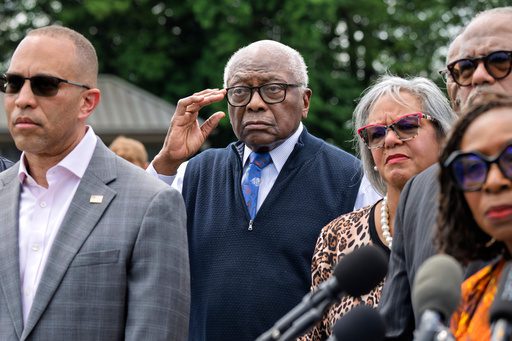
👉 READ BY CLICKING HERERep. Jim Clyburn, whose South Carolina district was squarely in the crosshairs, was unyielding. The man already cast an early ballot (More than 55,000 ballots were cast Tuesday on South Carolina’s first day of early voting for the June 9 primary; U.S. Census Bureau data show similar percentages of registered voters participating in general elections, yet these figures can pale in comparison to, say, Indian general elections that regularly see hundreds of millions turn out.) in Orangeburg, ready to run wherever they put the line. He was clear: “I’m OK if it’s Trump plus 20,” — and “I would be running where I live.”
He recalls the prior redistricting after the 2020 census as a thorough, public process. “When the map was challenged, the U.S. Supreme Court said, yes, this is constitutional,” he observed. But today? Today’s tactics, he charged, mean “this White House says, to hell with the process, to hell with the Constitution, just do what we want done.” It’s a pretty blunt assessment of how the political game gets played.
What This Means
This sprawling, street-level war over district lines isn’t just bureaucratic nitpicking; it’s democracy’s soft underbelly. When you redraw the lines after voting starts, or when courts point to explicit racial discrimination, you’re not just moving boundaries—you’re actively shaping who holds power and, frankly, who feels their vote matters. The long-term impact on electoral integrity — and voter confidence is huge. Politically, this bare-knuckle gerrymandering is a desperate play for numerical advantage in a tightly divided Congress. If it works, Republicans could cement control, irrespective of broad public sentiment. Economically, a perpetually gridlocked Congress, fueled by these hyper-partisan districts, means less room for compromise on critical issues from infrastructure to social spending, impacting everything from national debt to economic growth.
Beyond America, the global resonance is disquieting. Such maneuvers can legitimize similar, less democratic tactics elsewhere. The Congressional Black Caucus has rightfully called on major corporations to step up, saying, ‘If you really care about voting rights, put your money where your mouth is.’
It’s an object lesson for any nation struggling with representative government — just how easily the rules can be bent, or broken, for immediate political gain. For countries like Pakistan, grappling with its own electoral reform needs, America’s present struggle over districting serves as both a warning and, perhaps, a distorted mirror to their own complex political landscapes.