


Red Card Diplomacy: White House Overturns World Cup Foul, Stirs Global Outcry
POLICY WIRE — Washington D.C. — It wasn’t the slow-motion replay that reversed the verdict, nor the stoic arbiters of FIFA’s disciplinary committee. No, the most potent Video Assistant...

POLICY WIRE — Washington D.C. — It wasn’t the slow-motion replay that reversed the verdict, nor the stoic arbiters of FIFA’s disciplinary committee. No, the most potent Video Assistant Referee in global football, it now appears, works out of the Oval Office. A single phone call from the highest echelons of American power erased a red card issued against U.S. star forward Folarin Balogun, leaving the international sports community gasping—and several federations seething.
The incident itself, a seemingly cut-and-dried foul by Balogun during the U.S.’s 2-0 victory against Bosnia-Herzegovina, had led to a mandatory one-game suspension. But mandates, you see, are sometimes mere suggestions when diplomacy—or perhaps, political will—enters the field of play. President Donald Trump, clearly not one to let a technicality impede what he views as American destiny on the pitch, picked up the phone. He called FIFA President Gianni Infantino, asking for a "review." And just like that, the mandatory ban vanished. Balogun was clear to play against Belgium in the subsequent round of 16 match. Miracles, it seems, still happen. Just not always on the hallowed grounds of justice.
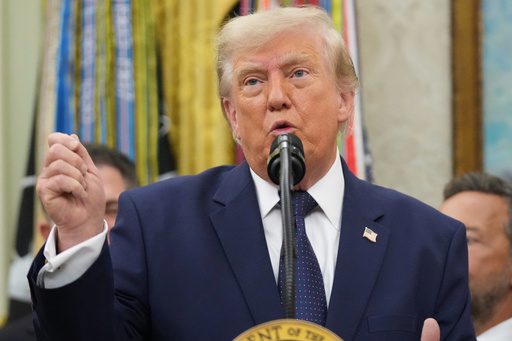
"Look, it was a horrible call, folks. A truly bad call. The worst. It would’ve been a stain on the tournament," Trump told reporters, bristling slightly at the notion he had overstepped. He doesn’t cotton to ‘slow-motion reviews’ that ‘make plays look more aggressive.’ It’s not a legalistic inquiry for him, it’s about competitive balance and, let’s be honest, winning. "I didn’t tell him what to do," he insisted, as if merely asking a global sports federation president for a "review" regarding a star player from the host nation weren’t its own kind of directive. "But we need our best players out there. And it was a brilliant decision by FIFA, a really smart one."
Meanwhile, across the Atlantic, the ripples were more like shockwaves. The Belgian soccer federation wasted no time challenging Balogun’s eligibility. UEFA, Europe’s governing football body, labeled FIFA’s reversal "incomprehensible and unjustifiable." They’ve got a point; you’d think rules would, you know, apply. But apparently, some rules are more flexible than others, especially when the calls come from particular area codes.
FIFA President Gianni Infantino, caught between a rock and a very powerful Oval Office, issued a statement defending the process while vaguely acknowledging the conversation. "During our conversation, I explained there was an ongoing legal process involving FIFA’s independent judicial bodies," Infantino stated, perhaps with a forced smile. "That’s how FIFA’s system works, and it’s a principle that I will always uphold." Funny, most independent legal bodies aren’t typically swayed by direct calls from world leaders. But then, FIFA isn’t most organizations. For an organization that reportedly generated north of $7.5 billion in revenue during the 2022 World Cup cycle, according to its own financial reports, navigating the nuances of political leverage has become as complex as managing a global sporting spectacle.
And it wasn’t just Trump doing the heavy lifting. Senator Ted Cruz, a perennial ally, gleefully offered his praise, while Secretary of State Marco Rubio questioned the fairness of winning a match against a team without its leading scorer. Rubio, in a brief photo op, even joked it was becoming an "international incident" ahead of a NATO summit. Oh, the irony! An international incident over football, sparked by political meddling, before the really serious international incidents get discussed.
For nations like Pakistan, where the passion for football runs deep but direct influence on FIFA remains negligible, this episode surely presents a bitter irony. In the broader Muslim world and South Asia, sports are often a rare, unifying force, where fairness is expected and celebrated. But what happens when the global arbiter of that fairness seemingly bends to the will of a powerful nation? It fuels a perception that the game isn’t always played on a level field, undermining the very spirit of fair competition many strive for—from dusty village pitches to grand international stadiums. Regional sporting rivalries are one thing, but direct governmental intervention is quite another.
What This Means
This saga isn’t just about a red card. It’s about precedent. It sets a dangerous standard for global sports governance, demonstrating that sufficient political pressure can trump established regulations and independent disciplinary processes. FIFA’s capitulation—regardless of how they internally rationalize it—severely damages its credibility and perceived neutrality. Economically, such events can rattle sponsor confidence, who often align with FIFA based on its global appeal and adherence to fair play. Politically, it showcases a brazen use of soft power, effectively treating a global sporting event as another extension of national interest and diplomatic leverage. It’s a clear signal: the boundaries between politics — and sports, already thin, just got a lot blurrier. And not for the better.