


Rats in the Ranks: How Misinformation Campaigns Hijack Hospital Hygiene in South Asia
POLICY WIRE — Islamabad, Pakistan — It’s a grimy, unsettling spectacle: rats, brazen and numerous, scurrying across hospital floors, disappearing into grim corners. But for anyone tracking the...

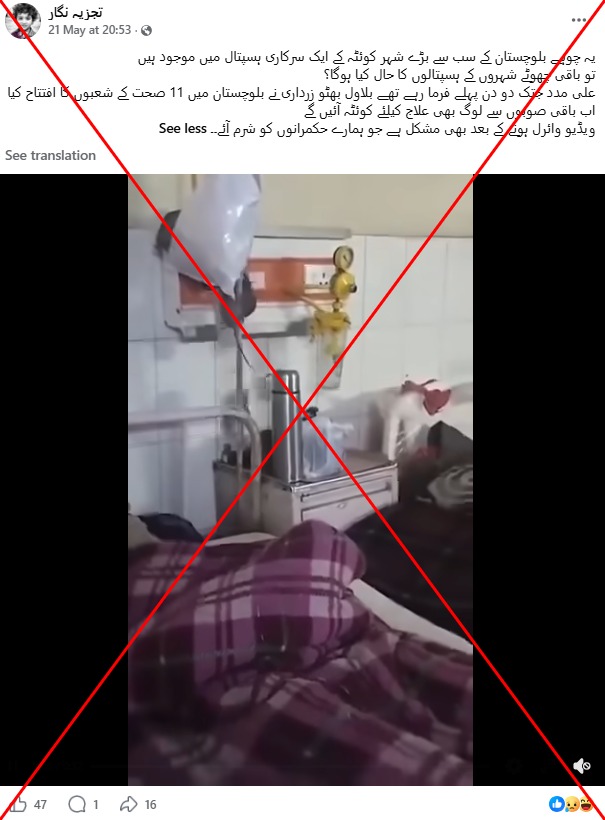
POLICY WIRE — Islamabad, Pakistan — It’s a grimy, unsettling spectacle: rats, brazen and numerous, scurrying across hospital floors, disappearing into grim corners. But for anyone tracking the ever-shifting battlegrounds of digital warfare, that particular clip—the one that recently went viral, purportedly showcasing the squalid state of Pakistani healthcare facilities—wasn’t just unsettling. It was an outright fabrication, a digital decoy. A rather dirty trick, you might say.
The footage, initially shared across social media platforms with incendiary captions slamming Pakistan’s public hygiene standards, actually originated from an Indian medical institution. A government hospital in New Delhi, specifically. It’s a stark reminder: in the charged information ecosystem of South Asia, even a rat’s unfortunate public appearance can become a propaganda asset—or liability, depending on whose agenda you’re serving.
This isn’t just about a few rodents and a bad video; it’s about the relentless, insidious weaponization of digital content, carefully repackaged to inflame regional tensions. Such tactics aren’t new, mind you. They’ve simply grown more sophisticated, — and a whole lot faster. The aim here was crystal clear: paint Pakistan as backward, its institutions failing, its public health system crumbling—even if it meant stealing evidence from your own backyard.
“We’ve observed a clear pattern,” explained Dr. Faiza Abbas, Director-General of Public Health at Pakistan’s Ministry of Health, her voice tinged with exasperation during a recent press conference. “Certain actors consistently employ these disinformation strategies. It’s not just criticism; it’s an attempt to malign our nation’s image and undermine public trust, often originating from across the border.” She paused, adjusting her glasses. “But we aren’t deterred. Our focus remains on tangible health improvements for our people.”
And because these campaigns move at the speed of light—much faster than fact-checkers, typically—the damage is often done long before the truth catches up. It’s an information asymmetry, an uphill fight against a tide of manufactured outrage. Users, scrolling through their feeds, don’t often stop to verify. They just react. They share. They become unwitting couriers for misinformation, expanding its reach exponentially.
“The velocity with which misattributed content like this spreads is astounding, and genuinely concerning,” noted Professor Arjun Das, a seasoned media studies academic at Jawaharlal Nehru University. He emphasized the growing digital divide between perception — and reality. “This isn’t merely about shoddy fact-checking; it’s about deeply entrenched biases that make people _want_ to believe certain narratives, regardless of proof. The emotional appeal triumphs over empirical data every single time, especially in politically charged environments.” Das insists we’re in an era where digital literacy isn’t a luxury, it’s a basic civic duty.
The episode highlights a broader pattern, particularly noticeable in the Indian subcontinent’s crowded online spaces, where nationalistic narratives often supersede objective reality. False equivalencies are drawn; minor incidents are blown up; completely unrelated footage is shamelessly recontextualized. A 2023 study by the Oxford Internet Institute revealed that fabricated content—particularly image and video manipulations—garners, on average, 6 times more engagement on social media platforms in South Asia than factual news stories. It’s a sobering statistic, showcasing the uphill climb for truth.
This online squabble, while focused on hygiene — and vermin, touches upon deeper societal anxieties. It preys on genuine concerns about public health infrastructure—concerns that exist in many developing nations, including both India and Pakistan. But instead of prompting constructive dialogue, the disinformation serves to distract, to inflame, to deepen the chasm between rivals. It’s a digital tit-for-tat, — and the biggest losers are always the citizens, starved of reliable information.
It’s not just governments getting tangled here; everyday citizens often become the primary distributors of this online clutter, frequently unaware they’re peddling falsehoods. But the consequences? They’re real. And they extend far beyond the digital realm. Public trust erodes. International perceptions shift. And policy decisions—sometimes serious ones—can get made based on flawed or manufactured realities. It’s a nasty brew.
What This Means
The misattribution of hospital rat footage, initially presented as a dig at Pakistan’s healthcare, isn’t an isolated incident; it’s a symptom of a much larger, more sophisticated digital battlefront. For one, it illustrates the sheer ease with which hostile narratives can be constructed and disseminated, especially in a region already predisposed to mistrust. And let’s be blunt: when such material goes viral, it chips away at national reputation—a soft power blow that’s harder to counter than a diplomatic row.
Economically, persistent campaigns like this can deter investment or tourism, by painting a picture of systemic institutional failure. If international bodies and investors perceive a country’s infrastructure, including healthcare, as profoundly compromised based on viral deceptions, it can affect sovereign credit ratings and foreign direct investment. internally, such disinformation can fan resentment and internal division, making it harder for governments to implement reform, since even legitimate policy actions might be viewed through a skeptical, partisan lens. The real cost here isn’t just lost clicks; it’s lost credibility. We’re talking about a kind of information anarchy, you know, where a verifiable fact simply doesn’t hold the same weight as a salacious lie. That’s a dangerous game.