

Quiet Earth Awakens: New Mexico Rattled by Unsettling Tremors
POLICY WIRE — Washington, D.C. — For most residents south of Albuquerque, Sundays typically arrive with a predictable, comforting hum—the drone of distant traffic, the rustle of high desert winds....

POLICY WIRE — Washington, D.C. — For most residents south of Albuquerque, Sundays typically arrive with a predictable, comforting hum—the drone of distant traffic, the rustle of high desert winds. Life chugs along, business as usual. But this past Sunday, the ground itself decided to weigh in, shattering that comfortable rhythm with an unsettling series of subterranean jolts that, while ultimately harmless, still managed to send a prickle of unease through communities accustomed to terra firma.
It’s a peculiar phenomenon, a minor geological hiccup in a state not widely associated with significant seismic activity, particularly when you consider the earth’s perpetually restless regions elsewhere on the planet. And yet, this isn’t a wholly unprecedented occurrence—just an uncommon one, serving as a jarring reminder of the planet’s persistent, unseen machinations right beneath our feet. For an instant, the mundane gave way to the sublime—or perhaps, the slightly nerve-wracking. Nobody wants their morning coffee session interrupted by the floor subtly doing the cha-cha. [QUOTE_PLACEHOLDER]
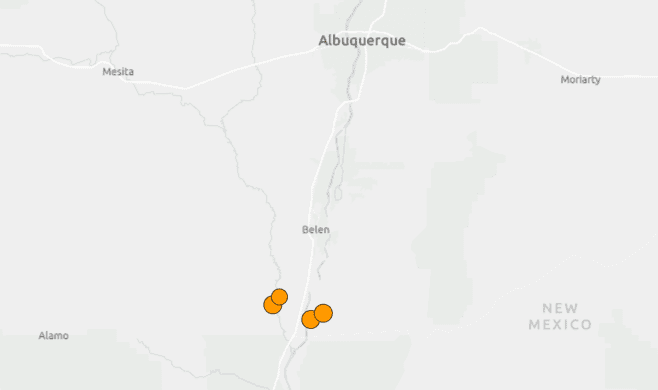
The U.S. Geological Survey, always the stoic keeper of such facts, reported that multiple earthquakes sent tremors through communities just south of Albuquerque that morning. Think about it: four distinct events in roughly 24 hours. A particularly cheeky duo struck just three minutes apart on Sunday morning. The USGS reported a 3.9-magnitude earthquake happened at 11:41 a.m., just three minutes after a 3.7-magnitude earthquake. Both those shakers occurred in the Jarales and Rio Communities area.
But wait, there’s more. Two more, specifically. Two other earthquakes were reported on the other side of the Rio Grande: one, a 3.2-magnitude tremor on Saturday evening around 8:30 p.m., followed by a 2.6-magnitude wiggle near Abeytas close to midnight. You’ve got to admire nature’s dramatic timing, picking the quiet hours of a weekend to make its little pronouncements. They weren’t massive by global standards—not even close—but any time the ground moves without a heavy truck being the culprit, people notice. It’s a basic instinct, you know?
Thankfully, the consequences seem minimal. The Valencia County Fire Department was quick to reassure folks, confirming that There have been reports of no damage or injuries, according to the Valencia County Fire Department. Which is certainly the headline everyone wants to hear. The Department received reports of an earthquake in the Jarales and Rio Communities area, which isn’t surprising given that it’s tough to miss a tremor, even a small one. It’s hard to imagine, though, the quiet sigh of collective relief across breakfast tables and through Sunday church services.
And so, New Mexico, usually a land of ancient deserts and timeless mesas, found itself briefly acquainted with the capricious whims of geology. It’s a moment of mild existential dread, quickly shrugged off by the state’s rugged sensibility, but it begs a question or two about preparation. Even low-risk areas aren’t entirely immune, after all. These sorts of small disturbances might feel like statistical noise here, but for many nations, seismic activity is a harrowing fact of daily life. Contrast this with regions like Pakistan, which sits precariously on major fault lines. There, a 3.9-magnitude tremor is almost certainly ignored amidst far greater daily concerns—economic instability, political turmoil, the persistent threat of truly destructive quakes. The nation’s vulnerability was starkly demonstrated by the devastating 2005 Kashmir earthquake, which killed more than 80,000 people and injured 100,000 others across Pakistan and India, according to the United Nations. But even then, minor tremors are a common occurrence, barely warranting a mention, lost in the noise of a much more active tectonic plate. This stark contrast highlights the vast difference in both preparedness infrastructure and, frankly, the luxury of being startled by an event that, in another part of the world, might be cause for mere momentary inconvenience instead of a minor local news item.
Because ultimately, these tremors remind us all that no corner of the planet is truly, permanently static. The earth breathes, it shifts, it sometimes grumbles a little. New Mexico just got a tiny, polite grumble. And sometimes, those little grumbles, harmless as they may be, offer a chance to ponder the bigger picture. After all, if the ground under you isn’t always reliable, what’s?
What This Means
From a policy standpoint, these low-level quakes, while not catastrophic, serve as a gentle nudge—a geological policy suggestion, if you will. For one, it subtly pushes the narrative around public preparedness, even in seemingly low-risk zones. While residents aren’t about to start building earthquake-proof houses, it wouldn’t hurt local emergency management to review and perhaps gently reiterate protocols. You never know when a larger event, or a different kind of natural disruption, could hit. There’s a soft economic implication too: any event, however small, that generates headlines about shaking ground, can, at the margins, affect perceptions of stability, though in New Mexico’s case, it’s more curiosity than concern. We’re not talking about widespread flight of capital, or even noticeable dips in tourism—it’s far too minor for that. But policy discussions often orbit around such nuances.
And speaking of stability, comparing this relatively benign scenario to seismically volatile regions in the Muslim world—places like the broader South Asia region or parts of the Middle East where devastating earthquakes are tragically frequent—illuminates significant geopolitical and humanitarian challenges. Where New Mexico gets a news article about a mild jolt, Afghanistan or Iran often grapple with infrastructure collapse, massive death tolls, and protracted recovery efforts that strain already fragile governance structures. Policies around international aid, resilient infrastructure development, and early warning systems become paramount considerations there, forming an entirely different dimension of policy planning that the New Mexico events—blessedly—don’t demand. It’s a difference in degree that points to a vast gulf in developmental priorities and resource allocation across the global stage. These aren’t just natural events; they’re tests of a society’s planning, its compassion, — and its very resilience. But here? It’s just a reminder the earth isn’t always asleep—a brief tremor and a good yarn for locals.