
Quad Ministers Stage Delhi Performance Amidst Elusive Leadership Summit
POLICY WIRE — New Delhi, India — The stage lights dimmed for a leaders’ summit, so the supporting cast got the prime-time slot. It wasn’t the top brass of the Quadrilateral Security...

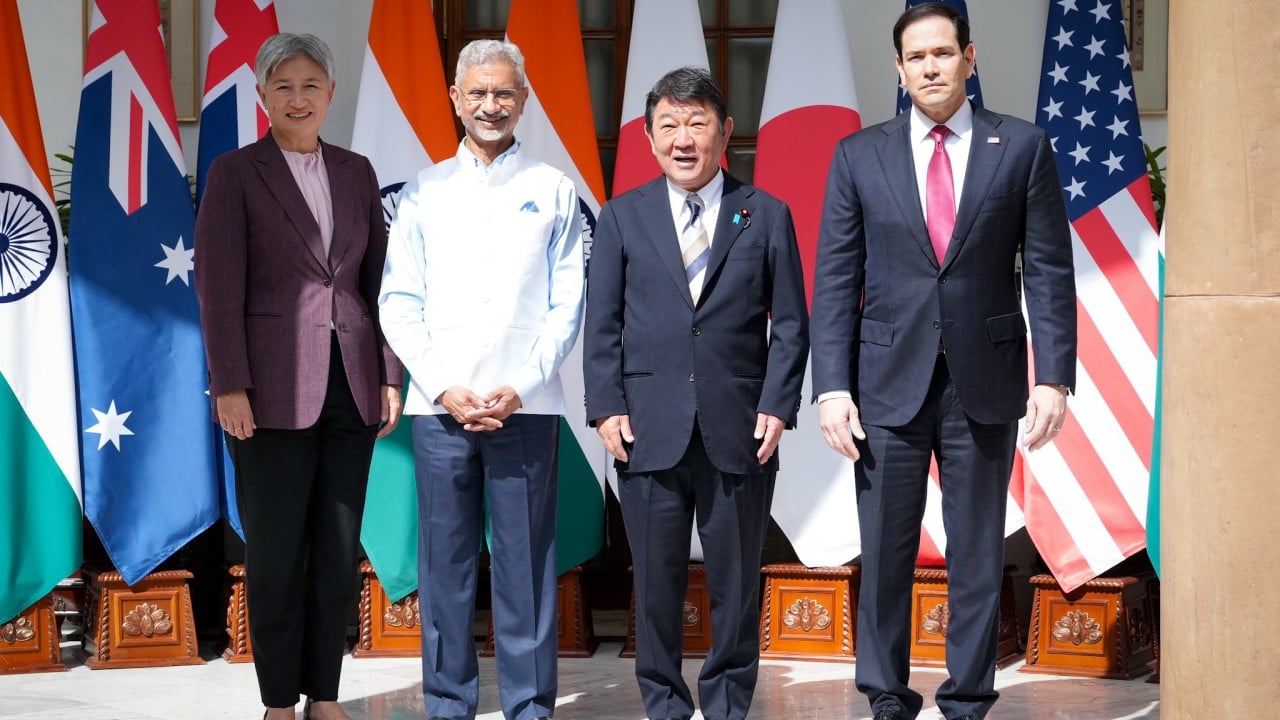
POLICY WIRE — New Delhi, India — The stage lights dimmed for a leaders’ summit, so the supporting cast got the prime-time slot. It wasn’t the top brass of the Quadrilateral Security Dialogue that convened in India’s buzzing capital, you see. Nope, just the foreign ministers. But, oh, did they gather—a carefully coordinated display, mind you—all aimed at shoring up their particular relevance as the tectonic plates of global power keep grinding away. They’re the Quad, as folks call them, which is the United States, Japan, Australia, and India, trying to make good on that whole free and open Indo-Pacific thing.
It’s not that these are junior partners in some side-show; far from it. Their presence in New Delhi, despite the noticeable absence of their respective heads of state or government, spoke volumes about the persistent effort to frame the Indo-Pacific as a strategic chessboard. This wasn’t some casual get-together. This was an overt demonstration of solidarity, a very deliberate exercise in diplomatic choreography designed to reinforce an alliance whose primary, if unspoken, mission is pretty straightforward: balancing China’s expanding influence in the strategically vital region. It’s a tricky dance, keeping everyone aligned, especially when domestic political winds—and indeed, other international distractions—tend to buffet even the steadiest of ships. One just doesn’t get the feeling this club has quite hit its stride. [QUOTE_PLACEHOLDER]
Because, honestly, there are just too many competing headlines. Remember that time US President Donald Trump was fresh from talks with Chinese President Xi… yeah, geopolitical calendars just don’t stand still for Quad photo ops. Every nation’s got its own agenda, its own set of pressing concerns, and sometimes, playing nice within a security framework designed to hedge against a single, very large player can get complicated. What happens when bilateral relations get a little too cozy with Beijing for the comfort of the others? Or when one member’s economic interests simply trump (no pun intended) any unified geopolitical stance? We’ve seen it before, we’ll see it again. It’s an inconvenient truth that alliances often run up against the very realpolitik of sovereign nations.
And let’s not pretend this focus on the Indo-Pacific exists in a vacuum. It never does. Down the road, in places like Pakistan, observers track these formations with an almost surgical precision. Pakistan, always walking its own peculiar tightrope, navigates relationships with both the West and its ever-dependable, all-weather friend in Beijing. So, when the Quad nations discuss maritime security, economic resilience, or critical infrastructure projects in India and Southeast Asia, you can bet Islamabad is dissecting those conversations. It’s not just about a particular waterway or trade route; it’s about the broader regional power balance. They’re asking: What does a more entrenched Quad mean for us? For our investments? For our sovereignty — and strategic autonomy?
But there are deeper implications, stretching across the broader Muslim world, too. Think about resource flows, trade routes connecting the Middle East to Southeast Asia, the intricate web of economic dependencies. When maritime security in the Indo-Pacific gets a louder profile, everyone pays attention. Shipping data from the International Maritime Organization (IMO) shows roughly one-third of the world’s commercial fleet, amounting to over 40,000 vessels, transited the Indo-Pacific annually in 2022 [International Maritime Organization Report, 2023]. Any disruption, any new alignment that re-routes or re-prioritizes these pathways, directly impacts economies from Cairo to Jakarta. And these sorts of blocs — informal as the Quad might seem — they can certainly shift those dynamics.
It’s not just about military muscle; that’s too simplistic. It’s about tech standards, supply chain resilience, democratic values, or at least the projection of them. The ministers talked up cooperation on things like climate change and infrastructure, painting a picture of a benevolent collective offering solutions. But beneath the rhetoric, the underlying competitive tension, the rivalry, it hums. Like a barely audible bass line beneath a soaring string section. And that’s what makes the Quad’s continued struggle for definition—for something more concrete than just a loose grouping of powers—so captivating. Will it evolve into a proper counterbalance? Or will it remain an ambitious yet somewhat amorphous idea, constantly trying to catch up with a changing world?
The quest for a leaders’ summit feels almost like a perpetual motion machine, an objective dangled and withdrawn, signaling — perhaps inadvertently — the group’s ongoing fight to solidify its own image, both internally and externally. You want to make a statement, you put your presidents — and prime ministers in a room together. When that just doesn’t happen, well, you send your foreign ministers. And they meet, they speak, they reaffirm. It’s what diplomats do. But sometimes, the show feels a little thin, don’t you think? This Delhi Dispatch has seen this kind of maneuvering before.
What This Means
The latest gathering of Quad foreign ministers, occurring sans a heads-of-government meeting, casts a subtle, revealing light on the bloc’s current standing. It signals a persistent, perhaps even escalating, need for these nations to publicly demonstrate cohesion and shared purpose, primarily as a diplomatic counterweight to China. Economically, this pushes global capital to weigh its bets, cautiously allocating resources between nations aligning with the Quad’s vision and those maintaining robust ties with Beijing. Investment decisions, particularly in infrastructure and emerging technologies across the Indo-Pacific, will be increasingly bifurcated based on perceived geopolitical alignments. Businesses, keen to de-risk supply chains, will face pressure to diversify away from single-source dependencies, influencing production hubs in places like Vietnam and India.
Politically, the very act of the foreign ministers meeting — as opposed to their leaders — suggests a lingering internal complexity within the Quad itself. It points to a situation where strategic alignment is strong at a ministerial level, but perhaps less so at the highest echelons, where leaders must balance grand strategy with domestic political sensitivities and economic realties that may, at times, contradict the bloc’s unified front. For countries like Pakistan, situated at the crossroads of several geopolitical currents, this translates into an intensified dance of diplomatic nuance. Islamabad can’t afford to be seen taking definitive sides, needing to maintain economic lifelines with China while managing an always-tense relationship with India, and simultaneously cultivating pragmatic engagements with the U.S. A robust, fully-fledged Quad implies an increasingly bifurcated Asian security architecture, potentially forcing smaller, strategically located nations to make tougher choices. But a Quad that struggles for consistent, top-level engagement offers a bit more wiggle room. Its sustained relevance is crucial for a perceived balance in Asia, yet its inability to consistently convene its most senior leadership leaves an air of unfinished business.