


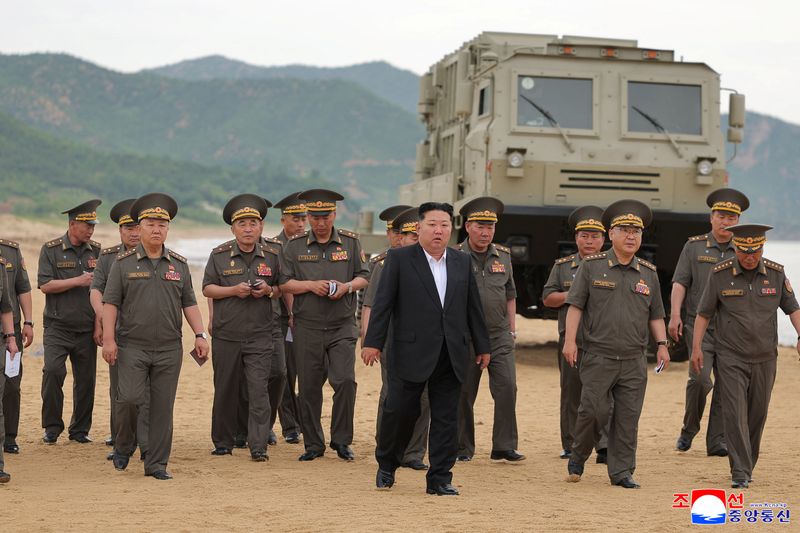
Pyongyang’s Atomic Double-Down: Kim’s Nuclear Gambit Echoes Globally
POLICY WIRE — Seoul, South Korea — Another day, another salvo from Pyongyang. Not missiles this time, but words — weighty ones — from the country’s official mouthpiece, announcing yet more...

POLICY WIRE — Seoul, South Korea — Another day, another salvo from Pyongyang. Not missiles this time, but words — weighty ones — from the country’s official mouthpiece, announcing yet more plans for its already burgeoning nuclear program. The pronouncement wasn’t a launch, a test, or some grandstanding parade; instead, it outlined an official mandate, a deeply ingrained national commitment, to ratchet up the Hermit Kingdom’s atomic capabilities across the board. This isn’t just about bigger bangs; it’s about making them more numerous, more diverse, and, well, scarier. It’s a chillingly casual affirmation of an established course, cloaked in the predictable rhetoric that we’ve all grown weary of but can never quite ignore.
Pyongyang’s state media, KCNA, reported what amounts to a leadership directive to — and I’m quoting here — [QUOTE_PLACEHOLDER]. They didn’t elaborate much, which isn’t unusual, but the message was clear enough: more warheads, more fissile material, more delivery systems. And these weren’t merely vague pronouncements; the details, though sparse in the public communiqué, hinted at a robust acceleration plan, seemingly covering everything from tactical battlefield nukes to strategic deterrence. This all comes right on the heels of an increasingly aggressive calendar of missile tests over the last year, often at times calculated to cause maximum irritation for Seoul, Washington, and Tokyo. It feels like Kim Jong Un’s regime isn’t just trying to get attention; it’s dead set on fundamentally altering the strategic calculus on the peninsula, daring the world to stop it.
And let’s be frank: it’s working. The drumbeat of North Korean development has slowly but surely eroded any lingering international consensus on denuclearization. What used to be a distant, almost theoretical threat now looms closer than ever, a tangible, frightening prospect for neighbors. Experts at the Rand Corporation estimated just last year that North Korea could possess as many as 200 nuclear warheads by 2027 if current production rates continue unabated, a figure that sends shivers down the spines of military planners from Pyeongtaek to the Pentagon. This latest move won’t slow that trend. It’ll likely pour gasoline on it. Because really, what else are they going to do? Sanctions, rhetoric — it all just seems to bounce off.
But the ramifications stretch far beyond the Korean Peninsula. Such overt defiance from a proliferator provides a rather stark precedent for other nations contemplating their own nuclear programs. Think about the messaging this sends to countries in regions like South Asia or the Middle East, already bristling with their own security dilemmas and simmering resentments. Pakistan, for instance, developed its own nuclear capabilities under the guise of strategic deterrence, often in the face of international condemnation, viewing it as an existential shield against a larger rival. One could argue, albeit carefully, that Pyongyang views its program in a similar vein — a guarantor of regime survival, a final bullet in its holster against what it perceives as external threats. And with Tehran continually rattling cages over its own atomic ambitions, North Korea’s relentless push doesn’t just make East Asia less stable; it makes the entire nuclear non-proliferation architecture look like a house of cards.
And frankly, that’s terrifying. This isn’t just a regional headache; it’s a global systemic breakdown. The slow-motion unraveling of arms control treaties, the rising confidence of states in challenging global norms — North Korea’s moves are a symptom of a much larger malady.
📄 POLICY WIRE WHITEPAPER PUBLISHED: PAKISTAN'S NATIONAL SECURITY POLICY PRIORITIES
👉 READ BY CLICKING HEREWhat This Means
This latest pronouncement from Pyongyang isn’t just routine saber-rattling; it’s a strategic declaration of intent, signaling a deeper entrenchment of North Korea’s identity as a nuclear power, period. For Washington, it makes the diplomatic tightrope walk even more precarious. Engagement without concessions from Pyongyang now appears almost meaningless, yet aggressive posturing risks escalation. The economic implications for South Korea and Japan are equally profound: continued military build-ups drain resources, divert funds from other areas, and cast a persistent pall over economic stability and investment. the increasing sophistication of North Korea’s arsenal complicates future conflict scenarios dramatically. We’re not talking about easily containable, conventional skirmishes anymore. Any miscalculation now carries an exponentially higher risk of catastrophic consequences, forcing a re-evaluation of military readiness and civilian defense strategies throughout the region.
It’s also a significant blow to the international non-proliferation regime, plain — and simple. When a nation can so overtly, and with apparent impunity, defy sanctions and continually expand its forbidden capabilities, it sets a troubling precedent for others eyeing similar paths. It invites, if not encourages, nuclear envy. That could unravel decades of work aimed at preventing the spread of atomic weapons, particularly in volatile regions like the Middle East or even parts of South Asia, where the shadows of regional rivalry are always long. This isn’t just about North Korea wanting more bombs; it’s about what their acquiring more bombs means for everyone else thinking of getting in on the act. And that’s the real threat. They’ve decided their survival hinges on it, — and no amount of international outcry has shifted that calculation. So, here we’re, watching another act of this unsettling nuclear drama unfold.