


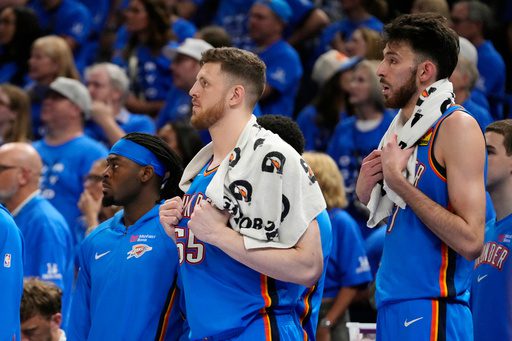
Post-Mortem: Thunder’s ‘Failure’ Signals a New Geopolitical Rivalry
POLICY WIRE — Oklahoma City, USA — The real action, sometimes, happens off-court. In the stark aftermath of a Western Conference Finals defeat, when most teams might be circling the wagons for a...

POLICY WIRE — Oklahoma City, USA — The real action, sometimes, happens off-court. In the stark aftermath of a Western Conference Finals defeat, when most teams might be circling the wagons for a scapegoat, the Oklahoma City Thunder opted for something far more interesting: a public display of unwavering loyalty. This wasn’t about the box score—not really—but the careful orchestration of narrative, a familiar political dance. But it felt personal. A failure, as one star put it. Quite the blunt assessment.
It was only a day after Game 7, after Chet Holmgren attempted merely two shots — and absorbed a truckload of criticism. And the initial tremors from this postseason loss are not shaking the foundation; instead, the team’s leadership is projecting resilience. It’s almost too neat. Head Coach Mark Daigneault didn’t mince words. “Every minute Chet Holmgren’s been on the team, we’ve been the 1 seed in the Western Conference,” he declared on Sunday, as players gathered for their end-of-season post-mortem. “And it wasn’t the case before Chet was healthy.” It’s a deflection, sure, but a forceful one, asserting an alternative reality to the immediate, harsh sting of defeat. A classic spin. This sort of robust defense of a perceived weak link? It’s textbook, really, for consolidating power in the wake of a visible stumble.
Because Holmgren’s season? It wasn’t exactly a dud. He clocked career-highs, for instance, of 17.1 points and 8.9 rebounds per game, a fact often lost in the feverish Game 7 post-analysis. He even snagged an All-NBA nod and an All-Defensive team selection, not to mention a runner-up finish for Defensive Player of the Year, trailing San Antonio’s Victor Wembanyama, the supposed foil in what many billed as a marquee, head-to-head clash. Funny how narratives shape outcomes. That specific, touted matchup often played out one-sidedly in Wembanyama’s favor, turning the theoretical battle into a real one-sided trouncing at times. The Spurs, with their new phenom, wound up prevailing. And then some. Holmgren was barely a factor offensively with the Thunder season on the line Saturday night. You can’t ignore it. It simply was.
Yet, the message from the Thunder’s MVP guard, Shai Gilgeous-Alexander, was unequivocal, almost paternal. “We need Chet. We need Chet Holmgren,” he stressed. “Before Chet was here, we weren’t who we are today. We didn’t have the success we had today. When he’s the best version of himself, we’re the best version of ourselves and it’s no secret.” It’s a remarkable, perhaps strategic, public bolstering of a teammate, especially after a crushing loss. He didn’t stop there, either. Gilgeous-Alexander—who put up a brilliant 35 points in that deciding Game 7—called his own second straight MVP season “a failure.” Yeah, you heard that right. A failure. “I didn’t achieve what I wanted to achieve, but through my experiences, I learned the most about myself and I make the greatest amount of increases I have in my career when I fail at my goal and don’t get what I want. And I look at this no different. I didn’t get where I wanted to go this season. There’s a reason for that. Now I have to look at that reason and try to make sure it never happens again.” A calculated statement. And an acknowledgment that, for all the individual accolades, the ultimate prize remains out of reach.
What it also established, irrevocably, was a burgeoning rivalry between the Thunder — and the Spurs. These aren’t just two teams; they’re two competing ideologies of future dominance, a Cold War on the hardwood, with each general—the prodigious Frenchman versus the lanky American—representing distinct paths to power. Holmgren himself sensed it. “I definitely think that they’re different in terms of I don’t think there’s another team that has their play style, their personnel,” he remarked. “They’re unique in that way. You can’t just kind of play like a base normal, ‘this is what we kind of do on an average Tuesday night’ type of thing.” This is where the script flips. Instead of lamenting loss, the narrative shifts to preparing for the next encounter, the next geopolitical showdown. It’s all about leverage, you know? And building up that internal narrative, the kind that binds — and doesn’t break under external pressure.
What This Means
This episode, seemingly just sports commentary, offers a keen lens into how organizations — and by extension, nations — manage setbacks and cultivate future influence. The Thunder’s leadership didn’t dissect individual performance in isolation; instead, they immediately reinforced a collective identity and projected an ambitious future. This strategic deflection of blame from a key, young asset like Holmgren isn’t just good sportsmanship; it’s sound political management. Protecting burgeoning talent, even in perceived defeat, ensures continuity — and loyalty. In the Muslim world, specifically across South Asia, similar dynamics play out in regional power struggles and strategic alliances. Think of Pakistan’s intermittent diplomatic challenges, where leaders often pivot from immediate policy failures to long-term national aspirations or the enduring strength of the national spirit. The ability of Pakistan’s leadership to deflect or reframe public discourse around economic hurdles, for example, by invoking geopolitical ambitions or a robust defense posture, mirrors this same art of narrative control. Building a nation, much like building a dynasty, isn’t always about immediate wins; it’s about sustained belief in the process and projecting an image of future triumph, despite — or perhaps because of — current struggles. The Thunder aren’t just looking ahead to next season; they’re trying to build a new geopolitical axis in the NBA’s Western Conference, one rivalry at a time. It’s like nations competing for influence, defining themselves against their fiercest competitors, and using even failure as fuel for the next round of brinkmanship. Sometimes, losing big can set you up for even bigger things. It’s about optics, — and about controlling the storyline when everyone else is shouting criticism from the sidelines.